



Solving traffic internally with core 5G CUPS technology
 Published2019.12.25 10:28
Customized B2B services are possible simply by building a traffic processing unit.
As KT builds a dedicated enterprise 5G network at Samsung Electronics' Suwon plant using CUPS technology, one of the core technologies of 5G, the commercialization of 5G-based B2B services is expected to become possible.
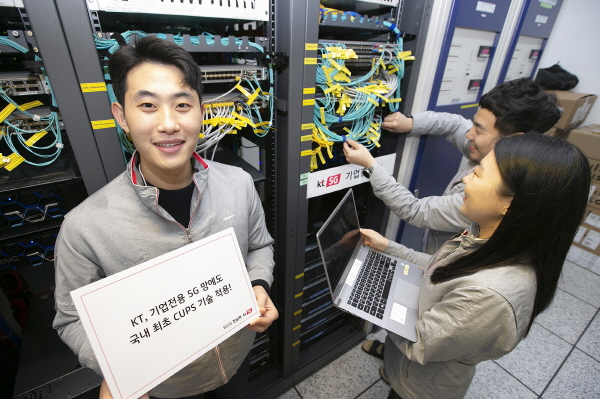
▲ KT Network Division employees are inspecting a 5G enterprise-dedicated system equipped with CUPS technology. <Photo=KT>
KT announced that it completed the construction of a dedicated enterprise 5G system using CUPS (Control & User Plane Separation) technology at Samsung Electronics' Suwon plant last November, the first of its kind in Korea, and that Samsung Electronics plans to utilize it in its equipment manufacturing process.
KT, which built eight 5G edge communication centers nationwide using CUPS technology last March and realized commercial 5G services with significantly reduced service latency, has also applied CUPS technology to the B2B sector to provide dedicated 5G networks to enterprises.
Unlike general-purpose 5G networks, dedicated enterprise 5G networks require the rapid deployment and provision of 5G systems tailored to the scale and services of client companies in the form of a dedicated network. In 5G networks utilizing CUPS technology, signal processing and traffic processing can be separated, allowing companies to use the service by installing only traffic processing devices at their business sites.
In addition, applying CUPS technology not only makes 5G network deployment much simpler but also internal enterprise 5G servicesIt can rapidly respond to traffic generated in the system on its own, making it possible to build a 5G system tailored to the type of client.
Seo Chang-seok, Executive Vice President and Head of KT’s Network Strategy Division, said, “KT aims to provide highly satisfactory services through continuous 5G technology development,” adding, “We will lead the era of the Fourth Industrial Revolution by supporting the realization of smart factories, robot services, and smart manufacturing in various corporate sites through CUPS-based enterprise-dedicated 5G networks.”
KT plans to contribute to the discovery of 5G-based B2B services, such as smart factories and robot control, by expanding the application of CUPS technology when building dedicated 5G networks for enterprises.
Comments
Related news
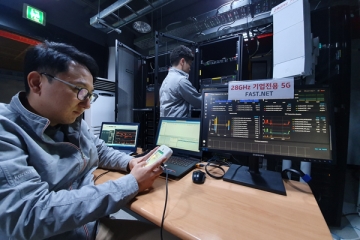
KT Demonstrates 28GHz Band Enterprise 5G Network Technology
KT demonstrated FAST.NET, an enterprise-dedicated 5G network technology, using the 28GHz frequency band. The FAST.NET technology is KT's ultra-low latency infrastructure technology designed to transmit all data from terminals through networks to services within a round-trip latency of 10ms or less. It is a core technology for future enterprise-exclusive 5G networks aimed at realizing autonomous vehicles and smart factory automation control. In the demonstration, using 5G base station equipment and terminals supporting the domestic 28GHz band, ultra-low latency data transmission of a minimum of 5ms and an average of 8ms was achieved in actual wireless environments.
2019.10.31by 이수민 기자
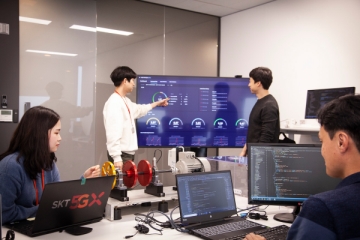
SKT Launches Metatron Grandview for Cloud Facility Management
SK Telecom has launched Metratron GrandView, a cloud-based facility management solution, in partnership with Bistel. Metratron GrandView is a solution built on SK Telecom's Metratron platform. Through sensors attached to major equipment within factories, it collects diverse data such as rotation speed, vibration, and electric current, and displays real-time predictions of the equipment's current status and the timing of required maintenance on the screen.
2019.12.10by 이수민 기자
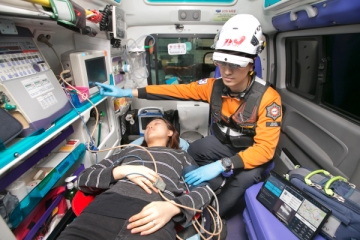
5G-based 119 video call reporting service commercialized nationwide.
Over 10 million emergency calls to 119 are received annually, with the vast majority coming through voice calls. Although 119 call centers wanted to conduct video calls with callers to better understand the situation, the system infrastructure was insufficient to enable this. Accordingly, the National Fire Agency and KT commercialized the 5G-based 119 video call reporting service nationwide today, which allows 119 call centers and emergency patients to conduct mutual video calls based on wireless communication including 5G.
2019.12.15by 이수민 기자
European Patent Applications Surpass 200,000 for the First Time… South Korea Maintains 5th Place, Led by Batteries and Telecommunications
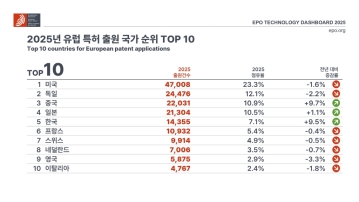
According to the European Patent Office (EPO)'s 'Technology Dashboard 2025', European patent applications last year reached 201,974, surpassing 200,000 for the first time. Korean companies and inventors filed 14,355 applications, representing a 9.5% increase from the previous year and maintaining 5th place by country. Battery, digital communication, and semiconductor technologies led the growth, with Samsung ranking as the top EPO applicant for the second consecutive year and LG reaching 3rd place. The presence of major domestic cities such as Seoul, Suwon, and Yongin was also confirmed. It was also revealed that Korea's European patent strategy is expanding beyond individual technologies to span the entire industry.
2026.03.24by 명세환 기자

SK Telecom First Applies AI-Based Network Operations at Gwanghwamun K-Pop Concert
SK Telecom announced that it applied an AI-based network operation system for the first time at a large-scale K-pop concert held in the Gwanghwamun area of Seoul on March 21st, managing communication quality throughout the event. Mobile data usage during the three hours before and after the concert reached 12.15TB, approximately doubling compared to the same time slot the previous weekend. SK Telecom monitored traffic using the AI system 'A-One' in five-minute and 50-meter units to respond to potential overload situations, while also operating temporary communication facilities and on-site personnel in parallel. This case is interpreted as confirmation of the practical applicability of AI-based autonomous network operation in an environment where demand from dense events and foreign users increases simultaneously.
2026.03.23by 명세환 기자











