



Five Key AI Technology Outlooks to Watch in 2020
 Published2020.01.02 11:38
In 2020, automation, natural language processing (NLP), and trust are expected to lead industry advancement in the AI sector.
Through automation, AI systems will operate swiftly and accurately, while natural language processing will play a central role in conversations, discussions, and problem-solving using everyday language. Meanwhile, supported by technologies enabling explainability and bias detection, the trend toward transparently and responsibly managing AI data is expected to expand.
IBM Research announced five major AI-related outlooks on January 2.

▲ IBM Research identified automation, natural language processing, and trust as AI trends to lead 2020
Enhanced Comprehension and Task Execution Capability
AI systems have the characteristic of advancing more rapidly as they acquire more data. In 2020, more AI systems are expected to begin relying on "neuro symbolic" technology, which combines learning and logic.
Neuro symbolic is an important indicator in the advancement of natural language processing technology, enabling computers to leverage common sense reasoning and domain-specific knowledge to help humans understand language and conversation more easily and quickly.
Enterprises can utilize this technology to automate customer management in conversational formats and use technical support tools, while also being able to train AI with less data.
Changes in Work Methods
AI will not replace human jobs but will transform the way people work through automation. Experts anticipate that AI will assist with tasks such as schedule coordination but will not directly impact specialized work such as design and strategy development.
Companies adopting AI are expected to reflect the trend of AI transforming work methods by adjusting employee tasks and investing in strengthening employee competencies in relevant areas.
Implementation of Trustworthy AI Systems
To trust AI, systems must be reliable and fair, technology must be secure, and one must be confident that conclusions or recommendations provided by AI are neither biased nor manipulated.
In 2020, components regulating trustworthiness are expected to be incorporated into the AI lifecycle, with trustworthiness being considered alongside performance in AI application development, testing, operation, monitoring, and certification processes.
Additionally, as AI controlling AI emerges, similar to Auto AI which uses AI to create AI, trustworthy AI workflows are expected to form across industries, including heavily regulated sectors.
Growing Demand for Eco-Friendly Technology
Data centers based on AI currently account for approximately 2% of global total energy consumption. In 2020, efforts to make AI technology more sustainable over longer periods are anticipated to increase.
This includes development of new materials such as transition-metal oxides that enable more flexible devices, new chip designs processing both analog and mixed signals, and novel software technologies based on approximate computing that operate with limited computing power while achieving results above certain performance levels.
All such technologies will be utilized as means to reduce carbon emissions while supporting growing AI-related workloads.
AI-Related New Materials Development
Over the past 200 years, organic molecular synthesis has been an important axis of research in chemistry and has been applied to pharmaceutical and synthetic fiber development.
Today, scientists worldwide are researching tens of thousands of chemical reactions to create new molecules, but the vast volume of information makes it impossible for any single expert to master all fields.
However, AI is expected to help overcome these limitations. As IBM developed RXN for Chemistry, an AI tool capable of synthesizing molecules on the cloud and predicting millions of chemical reactions before and after, 2020 is anticipated to see breakthrough progress in discovering and developing new materials utilizing AI and automation technologies.
Comments
Related news
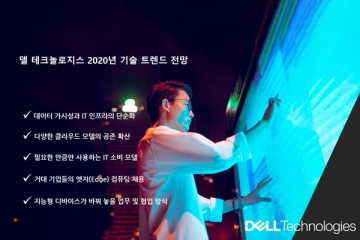
Top 5 Technology Trends for 2020, the Inaugural Year of the Data Era
Dell Technologies has announced its forecast for innovations and technology trends that will occur over the next decade. Viewing 2020 as the opening year of the Next Data Decade, Dell Technologies has made predictions regarding the technologies and innovations that will form the foundation of this new data era, including rapidly growing data and the computing, edge, and cloud solutions that process it.
2019.12.19by 이수민 기자
.jpg)
What are the top eight enterprise technology trends for 2020?
Enterprise software specialist VMware announced eight key enterprise technology trends to watch in 2020. By keyword, these include hybrid applications, unified edge solutions, specialized hardware remote support, intrinsic security, compact devices, machine learning, cloud segregation, and shared service platforms.
2019.12.26by 최인영 기자

5 Tech Trends That Will Drive CES 2020 in 2020
The US Consumer Technology Association (CTA) announced five major technology trends to watch in 2020 in November, ahead of the opening of CES 2020, the world's largest consumer electronics trade show. The five technology trends selected by the CTA are Digital Therapeutics, Flying Cars, The Future of Food, Facial Recognition, and Robots.
2019.12.31by 이수민 기자

Camera for Both Humans and Machines: ST BrightSense 5MP Dual Shutter Image Sensor
Video consumed by humans and imagery analyzed by machines impose different requirements on the sensor in terms of shutter method and wavelength band. Until now, sensors had to be separated or supplemented with companion chips and high-performance processors, and this cost and complexity became a bottleneck in vision system design. The ST BrightSense next-generation 5MP image sensor (VD5943, VD1943, VB5943, VB1943) with 2.25 µm pixels supports both global and rolling shutters, and through on-chip staggered HDR (up to 100 dB), on-chip RGB-IR separation and 5MP NIR smart upscaling, and frame-by-frame context switching, absorbs both requirements internally at the sensor level. This white paper describes the rationale, choices, trade-offs, and results of each design decision based on presentation slides and technical Q&A, and specifies application boundaries. The product is scheduled for mass production in February 2026, and evaluation and sampling are currently available.
2026.10.13by 편집부

AI-based Universal Robots Automation Solution
In manufacturing environments where declining labor populations overlap with frequent production item changes, existing programming-based robot automation requires reconfiguration from weeks to several months each time product models change. This white paper takes this flexibility gap as its starting point and synthesizes, based on webinar presentation materials and technical Q&A, what collaborative robots gain and forfeit compared to industrial robots, why process automation is transitioning from rule-based to learning-based (4th generation) approaches, and how Universal Robots' hardware, software, and partner ecosystem implement this. Additionally, it clarifies the application boundaries and limitations, including that AI Accelerator is still at the development kit stage.
2026.10.13by 편집부











