



Maintaining Global 5G Dominance with Three Key 5G Investment Promotion Packages
 Published2020.01.02 17:11
Expanding 5G network investment tax credits and introducing frequency license fees
The easing of registration license taxes for 5G base stations is also being pursued.
The hottest topic in the domestic IT industry in 2019 was undoubtedly 5G.
As of December 14, 2019, the number of domestic 5G subscribers exceeded 4.49 million, and the number of base stations exceeded 94,407 as of December 20, 2019, based on the completion report. This represents a 163% increase compared to the 35,851 stations on April 3, 2019.
Terminal sales also performed well. According to SA, Samsung Electronics ranked first in global 5G smartphone market share with 74.2% as of the third quarter of 2019, followed by LG Electronics with 5.6%. According to IHS, Samsung Electronics ranked second in global 5G equipment market share with 23.3% as of the third quarter of 2019.
Representatives from the OECD, the World Bank, Argentina, the US AT&T Mobile, the UK Vodafone, Japan KDDI, Germany Deutsche Telekom, Finland Elisa, China Telecom, Southeast Asia, and the Middle East visited Korea to discuss sharing 5G know-how and cooperation.
The Ministry of Science and ICT (Minister Choi Ki-young) announced on the 2nd that it will actively pursue policies to foster 5G-related industries in order to maintain its dominance in the 5G market.
In 2020, we plan to continue the achievements of 2019 and strengthen government-wide support for the 5G industry to enable the public to experience 5G firsthand.
First, to improve network quality, which has resulted in low subscriber satisfaction since commercialization, we will pursue the "3 Major Packages for 5G Investment Promotion" in collaboration with relevant ministries.
First, tax deductions for 5G network investments will be expanded.
In the metropolitan area, the tax deduction rate, which was 1%, will increase to 2% this year. In non-metropolitan areas, the deduction rate will remain the same as last year (2% + 1%), but construction costs will be newly included in the tax deduction.

Next, the frequency usage fee system is integrated into the frequency license fee system.
In order to increase the fairness and efficiency of frequency use in response to the increasing demand for frequency, a frequency license fee will be imposed on all frequency licenses. However, the frequency license fee will be reduced for national/local government frequency licenses, terrestrial broadcasting, and frequency use for purposes such as promoting public welfare. Frequency license fees are calculated by comprehensively considering the target frequency, purpose, and bandwidth, and the detailed calculation method is stipulated in the Enforcement Decree of the Radio Waves Act.
Lastly, we are pursuing a relaxation of registration license taxes for newly established 5G base stations.
When telecommunications companies and others report the establishment of base stations, they pay an annual registration license tax (KRW 40,500 for cities with a population of 500,000 or more, KRW 22,500 for other cities, and KRW 12,000 for counties) to the local government where the base station is located, in accordance with the Local Tax Act. However, due to the characteristics of 5G frequencies, which are highly linear and have shorter ranges, the construction of more base stations is necessary compared to LTE. This has led to a significant burden on the private sector for network investment. Starting this year, the government plans to encourage increased investment in 5G by easing the registration license tax burden for newly constructed 5G base stations through measures such as preliminary feasibility studies and amendments to the Local Tax Special Measures Act.

Additionally, seven additional testbeds will be built to support testing and verification of 5G-based terminals and services, bringing the total to 12. To help 5G companies secure overseas markets, we will collaborate with the Korea Trade Insurance Corporation to support export financing and export-oriented business development starting next year.
In addition, to foster the 5G-based immersive content industry, a new XR+α project (newly launched with KRW 15 billion in 2020) will be launched to integrate immersive content into public services, industry, and science and technology. The development of drone services closely related to people's lives, such as public safety, security, and the environment, will also be promoted (newly launched with KRW 6.7 billion in 2020). In addition to this, we will pursue technological development, including hologram technology development (new KRW 15 billion in 2020), domestic production of 5G equipment and terminal components (new KRW 10.3 billion in 2020), and development of source technologies for unmanned vehicles (new KRW 13 billion in 2020), as well as institutional improvement through a regulatory sandbox.
Jang Seok-young, Second Vice Minister of Science and ICT, said, “Following Korea’s commercialization of 5G in 2019, competing countries such as China and Japan are bringing forward their commercialization schedules, and the global 5G competition will intensify starting this year,” adding, “The government will not spare any support to help our companies stay ahead in the global competition.”
Comments
Related news
5G will cover 65% of the world's population by 2025.
By 2025, 5G services are projected to cover 65% of the global population and handle 45% of mobile data traffic. Average monthly data traffic per smartphone is expected to increase from 7.2GB to 24GB, and IoT connections are anticipated to grow from 1.3 billion at the end of 2019 to 5 billion by the end of 2025.
2019.12.19by 최인영 기자

LTE services remain strong despite the introduction of 5G
In 2019, the average download speed of domestic LTE service was 158.53Mbps and the upload speed was 42.83Mbps, showing a similar level to the previous year. The average download speed of commercial WiFi was measured at 333.51Mbps, and public WiFi at 394.76Mbps, representing improvements of 9% and 11.5% respectively compared to the previous year. Despite the introduction of 5G service, LTE continued to maintain service quality.
2019.12.23by 최인영 기자
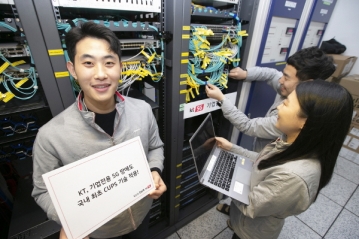
Solving traffic internally with core 5G CUPS technology
KT has applied CUPS technology, a core 5G technology, to enterprise-dedicated 5G networks for the first time in Korea, enabling simplified 5G network construction and customized B2B services for enterprises. In a 5G network with CUPS technology applied, signal processing and traffic processing can be separated, allowing enterprises to use the service by deploying only traffic processing equipment at their business sites and handling traffic generated within their internal 5G services independently.
2019.12.25by 최인영 기자
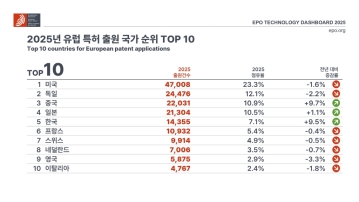
European Patent Applications Surpass 200,000 for the First Time… South Korea Maintains 5th Place, Led by Batteries and Telecommunications
According to the European Patent Office (EPO)'s 'Technology Dashboard 2025', European patent applications last year reached 201,974, surpassing 200,000 for the first time. Korean companies and inventors filed 14,355 applications, representing a 9.5% increase from the previous year and maintaining 5th place by country. Battery, digital communication, and semiconductor technologies led the growth, with Samsung ranking as the top EPO applicant for the second consecutive year and LG reaching 3rd place. The presence of major domestic cities such as Seoul, Suwon, and Yongin was also confirmed. It was also revealed that Korea's European patent strategy is expanding beyond individual technologies to span the entire industry.
2026.03.24by 명세환 기자

SK Telecom First Applies AI-Based Network Operations at Gwanghwamun K-Pop Concert
SK Telecom announced that it applied an AI-based network operation system for the first time at a large-scale K-pop concert held in the Gwanghwamun area of Seoul on March 21st, managing communication quality throughout the event. Mobile data usage during the three hours before and after the concert reached 12.15TB, approximately doubling compared to the same time slot the previous weekend. SK Telecom monitored traffic using the AI system 'A-One' in five-minute and 50-meter units to respond to potential overload situations, while also operating temporary communication facilities and on-site personnel in parallel. This case is interpreted as confirmation of the practical applicability of AI-based autonomous network operation in an environment where demand from dense events and foreign users increases simultaneously.
2026.03.23by 명세환 기자











