


'STPMIC1 PMIC' Optimized for ST32MP1 MPU Launched
 Published2020.01.06 10:00
Compared to products with power rails
Reduction in board space and component costs
On the 6th, STMicroelectronics released the STPMIC1, a power management IC (PMIC) that integrates four DC/DC buck converters, one boost DC/DC converter, and six Low-Dropout Regulators (LDOs) to meet the complex power requirements of systems based on highly integrated application processors.
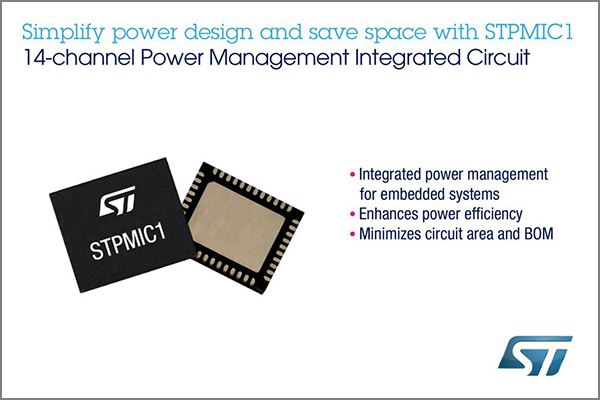
STPMIC1 is a companion power management IC optimized for ST’s STM32MP1 heterogeneous multi-core microprocessors, integrating single or dual Arm Cortex-A7 and Cortex-M4 cores, an optional 3D graphics processing unit, and a rich array of digital and analog peripherals to support a wide range of applications.
By using discrete components, board space and Bill of Materials can be reduced compared to products that use the same number of power rails. In addition, it provides power rail monitoring and protection functions, can process power up/down sequencing, and meets the accuracy and stabilization time specifications of the ST32MP1.
ST Authorized Partner Octavo Systems has developed the OSD32MP1x family of microprocessor System-in-Package (SiP) devices utilizing the STM32MP1 and STPMIC1. These products solve engineering challenges such as power sequencing while occupying a footprint up to 64% smaller than comparable systems implemented with discrete components.
Greg Sheridan, Vice President of System Strategy at Octavo, stated, “The STPMIC1 is a complete power management solution for the OSD32MP1x SiP device family,” adding, “It provides all the necessary power while offering sufficient options to drive the rest of the system within the SiP implemented in a small package, providing the flexibility to support a wide range of applications.”
STPMIC1 not only supplies power rails to the MPU and external system components but also provides DDR memory reference voltage, a 500mA USB OTG power switch, and a universal power switch. The I2C interface and additional pins allow the MPU to manage this PMIC.
The four buck converters built into the PMIC are designed for fast transient response and precise output voltage control to handle various operating conditions. Pulse-frequency modulation mode improves energy efficiency at low loads, and in normal operation mode, it minimizes Electro-Magnetic Interference (EMI) through Pulse-Width Modulation (PWM) synchronization.
The boost converter with bypass mode function can supply power to two USB ports and can be adjusted even when operating with a battery or a low-cost 5V AC/DC adapter.
One of the six LDO channels features DDR3 termination and operates in bypass mode for low-power DDR, while another provides automatic source detection to power the USB PHY. The remaining four LDOs are used as general-purpose outputs.
The STEVAL-PMIC1K1 evaluation board, which simplifies STPMIC1 prototyping, is also available for purchase. The board features a push button to trigger PMIC functions, digital I/O, and header connectors for accessing regulators and switches. A USB dongle for device register configuration is also included.
The STPMIC1, currently in mass production, is supplied in a 5×6×0.8mm WFQFN 44-lead package. Pricing starts at $1.70 for purchases of 1,000 units.
Comments
Related news
.jpg)
Launch of two PIMs for high-voltage automotive traction inverters
onsemi has launched two latest VE Trac power integrated modules with enhanced power and thermal performance for high-voltage automotive traction inverters. These are devices suitable for main traction inverters in all types of electric vehicles including battery electric vehicles, plug-in hybrid vehicles, and full hybrid vehicles. onsemi also unveiled the VE Trac Dual and VE Trac Direct design platforms.
2019.12.17by 최인영 기자
Maxim Launches MAX22701E Insulated Gate Driver
Many switch-mode power supply applications adopt wide-bandgap SiC transistors to improve power efficiency and transistor reliability. High switching frequencies induce noise-generating transient phenomena, which must be mitigated to prevent operational interruptions. The MAX22701E driver IC is used in switch-mode power supplies within industrial communication systems for high-output, high-efficiency power supplies.
2019.12.19by 이수민 기자
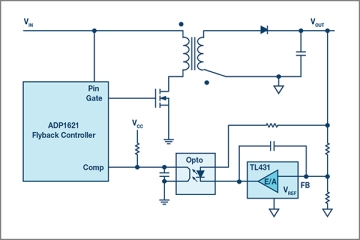
A flyback controller eliminates discrete, isolated feedback paths, simplifying design without optocouplers.
Isolated flyback converters are commonly used for power conversion of approximately 60W or less. This converter transmits information about the output voltage through a feedback path to the primary-side PWM generator to maintain the output voltage as stable as possible. If the output voltage is too high or too low, the duty cycle of the PWM generator is adjusted accordingly. This feedback path incurs additional cost, occupies space on the board, and determines the maximum isolation voltage of the circuit along with the transformer's isolation voltage. By using an optocoupler and a device that replaces the secondary-side control module of the optocoupler, the feedback signal can be transmitted through inductive coupling via galvanic isolation.
2020.01.03by 이수민 기자

Intel Unveils Next-Generation 'Core Ultra Series 3' and vPro Platform for Enterprise PCs
Intel has officially unveiled the "Intel Core Ultra Series 3" for next-generation enterprise PCs and the latest vPro platform, addressing a wide range of demands from enterprise notebooks to high-performance workstations.
2026.03.26by 배종인 기자

ROHM Launches ESD Protection Diode Compatible with High-Speed Interfaces of 10Gbps or Higher
Semiconductor specialist ROHM has developed the 'RESDxVx series' of ESD (electrostatic discharge) protection diodes capable of responding to next-generation high-speed data communication environments exceeding 10Gbps, simultaneously enhancing both signal quality maintenance required in high-speed interfaces and IC protection performance.
2026.03.26by 배종인 기자











