


CEVA's 'Sensing Q' Platform, Accelerating Context-Aware IoT Development, Scheduled for Release in Q2 of This Year
 Published2020.01.15 09:05
Integrated hardware IP and software platform
Context awareness technology is establishing itself as an essential feature of devices such as smartphones, laptops, AR/VR headsets, robots, hearables, and wearables.
Sensling Q Platform Launch (Image=CEVA)
CEVA announced on the 14th that it is launching 'SenslinQ,' an integrated hardware IP and software platform that enables IoT devices to recognize their context.
Sensling Q collects data from various sensors within the device, such as microphones, radar, Inertial Measurement Units (IMUs), and Time of Flight (ToF), and performs front-end signal processing, such as noise suppression and filtering of the collected data.
Next, advanced algorithms are applied to generate 'Context Enablers' such as activity classification, voice and sound detection, and object presence and proximity detection. The context enabler can be combined on-device or transmitted wirelessly (Bluetooth, Wi-Fi, NB-IoT) to a local edge computer or the cloud to determine and adjust the device to the operating environment.
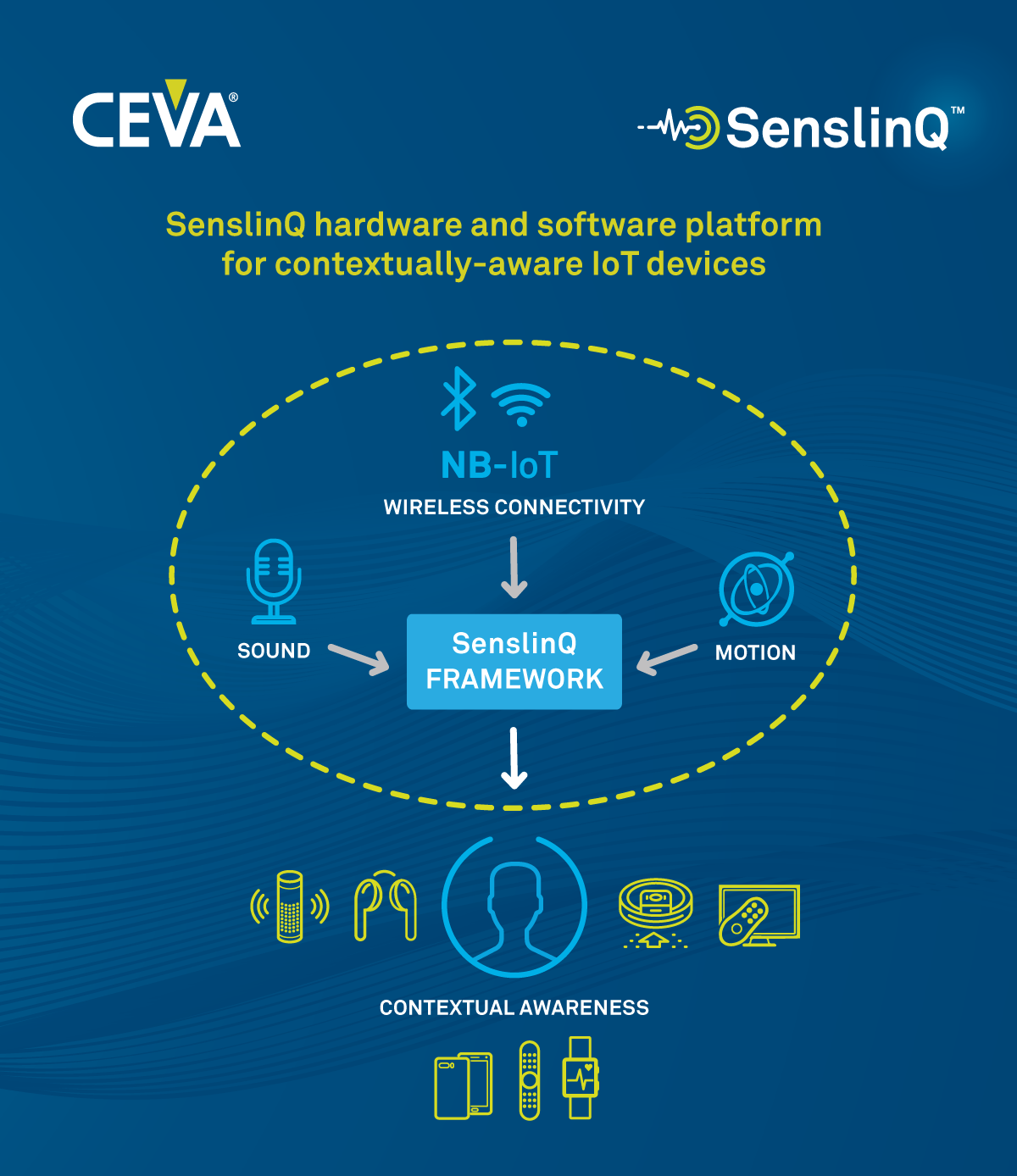
Sensling Q platform (Image=CEVA)
The Sensling Q platform integrates all the hardware IP and software components necessary to enable context-aware IoT devices. The customizable hardware reference design is configured along three axes: Arm or RISC-V MCUs connected via standard system interfaces, CEVA-BX DSPs, and Wireless Connectivity Islands such as RivieraWaves Bluetooth, Wi-Fi, or Dragonfly NB-IoT platforms, or other connectivity standards provided by customers or third parties.
Sensling Q software consists of an extensive portfolio of software libraries available for immediate use from CEVA and its ecosystem partners. These include ▲ Hillcrest Labs’ MotionEngine software package for sensor fusion and activity classification for mobile, wearable, hearable, and robots ▲ ClearVox front-end voice processing, WhisPro voice recognition, and comprehensive DSP and AI libraries ▲ and a wide range of third-party software components for Active Noise Cancellation (ANC), sound detection, 3D audio, etc.
The Sensling Q platform includes the Sensling Q framework, Linux-based Hardware Abstraction Layer (HAL) reference code, and APIs for data and control exchange between multiple processors and various sensors.
“Sensling Q allows customers to focus on applications and advanced services that support context-aware devices without having to understand the physical behavior of sensors and connectivity channels,” said CEVA CTO Erez Bar-Niv.
Sensing Q is scheduled to be released in the second quarter of 2020.
Comments
Related news
.png)
Immervision's wide-angle image processing capabilities are being ported to CEVA.
CEVA and Immervision have entered into a strategic partnership. Under this partnership, CEVA has made a technology investment of $10 million to secure exclusive licensing rights to Immervision's patented wide-angle image processing technology and software portfolio. Immervision's portfolio includes real-time adaptive dewarping, stitching, image color and contrast enhancement, and electronic image stabilization. The two companies plan to showcase an end-to-end solution featuring wide-angle panoramic optical lens design and complementary image enhancement software.
2019.08.07by 이수민 기자
Next-generation solution for mobile device motion control unveiled
Smart connected technology provider CEVA has launched MotionEngine Air software applicable to consumer portable devices and unveiled Hillcrest Labs' next-generation sensor fusion product line. It delivers low-power, motion-based gesture control, 3D motion tracking, and pointing functionality to smartphones, PC stylus pens, smart TVs, OTT remote controls, game controllers, AR and VR controllers, and PC peripherals.
2019.12.26by 최인영 기자
ST Supports LoRa IoT Connectivity with STM32WLE5 SoC
ST has announced a LoRa SoC that connects smart devices to IoT using long-range wireless connectivity. Product developers can use the STM32WLE5 SoC to develop devices such as remote environmental sensors, meters, trackers, and process controllers that support efficient management of energy and resources.
2020.01.09by 이수민 기자

Intel Unveils Next-Generation 'Core Ultra Series 3' and vPro Platform for Enterprise PCs
Intel has officially unveiled the "Intel Core Ultra Series 3" for next-generation enterprise PCs and the latest vPro platform, addressing a wide range of demands from enterprise notebooks to high-performance workstations.
2026.03.26by 배종인 기자

ROHM Launches ESD Protection Diode Compatible with High-Speed Interfaces of 10Gbps or Higher
Semiconductor specialist ROHM has developed the 'RESDxVx series' of ESD (electrostatic discharge) protection diodes capable of responding to next-generation high-speed data communication environments exceeding 10Gbps, simultaneously enhancing both signal quality maintenance required in high-speed interfaces and IC protection performance.
2026.03.26by 배종인 기자











