



AI Strategy to Drive R&D Innovation Will Determine the Outcome of the Global Hegemony Race
 Published2020.01.21 09:34
Presenting trends in politics , economics, and technology sectors to be created by AI
The outcome of the global hegemony competition will be decided by AI strategy
On the 20th, the Electronics and Telecommunications Research Institute (ETRI) published the '7 Major AI Trends of 2020' report, which analyzes the waves of the Fourth Industrial Revolution created by AI from political, economic, and technological perspectives.
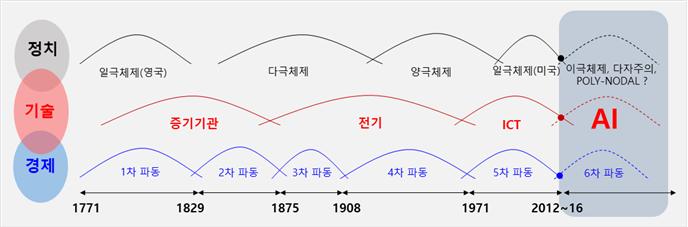
Existing AI was regarded merely as a technology that mimicked human perception.
The 7 major AI trends of 2020 explain that AI is leading business analysis and R&D innovation that humans have not been able to do, creating economic added value through creative activities that were once considered the exclusive property of humans, and acting as a new driving force for changes in global hegemony.
The seven major trends presented in the 2020 AI 7 Major Trends Report are as follows.
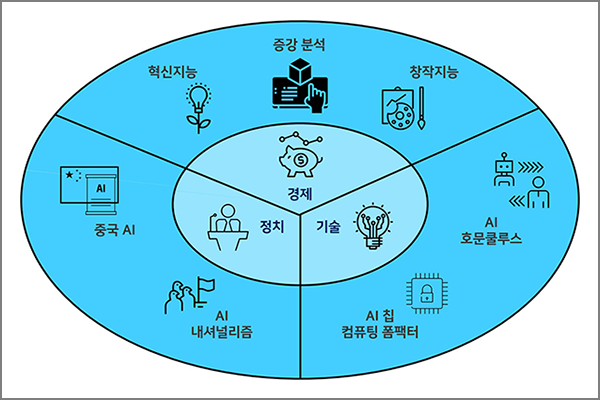
The first, and yet another option, is Chinese AI . Until now, the United States has been the leader in technology across many industries. However, China has begun to forge a new path with its own distinct AI identity by creating data value chains under government leadership. AI strategies are triggering a struggle for hegemony among great powers, extending beyond mere technological competition.
The second is AI nationalism. Recently, a new form of nationalism has emerged aimed at protecting domestic AI-related data and services while reducing the influence of other nations. Leading AI companies and services are facing difficulties crossing borders due to trade restrictions, tax systems, and personal data protection laws. The report points out that as AI technology intertwines with the political order, it can widen the technological gap between nations and potentially become a powerful weapon.
Third is augmented analytics and dark data . Through unprecedented analytical techniques, AI technology is eliminating the limitations of analysis and the scope of the majority of data that was previously possessed but unused. AI assists human decision-making and provides insights and new value.
Fourth is R&D innovation intelligence . Through autonomous vehicles and the AI doctor Watson, AI has demonstrated that it is revolutionizing industries on a massive scale. However, the greater value of utilizing AI lies in its ability to increase R&D productivity by changing the way humans think as researchers.
Fifth, the evolution of creative intelligence . Paintings, novels, and films created by AI demonstrate that AI is capable of creative work. Furthermore, attention is drawn to the potential for design and strategy derivation that surpasses human capabilities, going beyond the level of simple imitation.
Sixth is the AI Homunculus . The human brain is most active when sensory organs are functioning. Human intelligence has also evolved in connection with the form and function of the body. This suggests that, similarly, for AI to further advance technological capabilities and secure autonomy, the importance of researching interaction with the external environment through physical entities such as automobiles, drones, and robotic arms is growing.
Seventh, it is a new computing form factor required by the AI era . Just as Intel's chipsets defined the standard PC form factor, AI is deeply intertwined with GPUs, ASICs, and the like; therefore, we must pay close attention to the roles these new dedicated computing devices will play and how they will shape the market landscape.
Dr. Lee Seung-min of the Technology Economics Research Lab at ETRI, the lead author of the report, stated, “It is humans and AI that determine the future of humanity,” adding, “AI technology is highly likely to bring about a greater impact than the past three industrial revolutions.”
ETRI President Kim Myung-joon stated, “If the nation understands AI strategies in a localized manner or fails to properly define their scope, it could fall behind in the competition for global hegemony.”
The 2020 AI 7 Trends Report, authored by Principal Researchers Lee Seung-min and Jung Ji-hyung of the Technology Policy Research Division at ETRI, is available on the ETRI website .
Comments
Related news
TOP 9 Key ICT Trends in 2020, Opening a New Decade
As 2020 approaches, various institutions are releasing their outlooks for the new year. ICT has opened new eras on a decade-by-decade cycle. The 2020s are expected to become the AI era, with 2020 being its inaugural year. AI will serve as a new momentum for the global economy, which has been mired in low growth. 5G, which is undergoing commercialization worldwide, will connect the world, and autonomous driving will transform driving culture and logistics formats.
2020.01.13by 이수민 기자
2020 Manufacturing Digital Transformation Trend Forecast
Recently in the manufacturing industry, various proofs of concept are being attempted driven by expectations for the potential of technologies such as IIoT and AI. However, even if companies have identified approximately 100 IIoT use cases, realistically only 4 to 5 of them should be included in their priorities. In 2020, companies equipped with a value-oriented digital transformation mindset will be able to easily scale their digital transformation initiatives and shorten the time to value creation.
2020.01.13by 이수민 기자
.png)
Vertiv Announces Top 5 Data Center Technology Trends for 2020
Vertiv has announced the top 5 data center trends for 2020. In recent years, hybrid architecture integrating public and private cloud models and edge assets around the core network has been a frequent topic of conversation among enterprise executives. In 2020, corporate movements are expected to move beyond simple debates about enterprise or cloud deployments.
2020.01.16by 이수민 기자

[e4ds Tech Day 2026 ⑨] Sim Sang-gyu, Autocrypt CTO: "In the Physical AI Era, Automotive Security Must Extend Beyond the Vehicle"
At e4ds Tech Day 2026, Sim Sang-gyu, CTO of Autocrypt, explained automotive cybersecurity strategies in the era of Physical AI and SDV (Software-Defined Vehicle). Automobiles are evolving as part of an ecosystem connected to AI, cloud, chargers, IoT, and robots, and he emphasized that the scope of security must expand beyond the vehicle interior to the entire connected environment. In particular, AI model tampering, adversarial attacks, OTA updates, and EV charger hacking were identified as major threats. He explained that response measures require zero trust, AI model integrity protection, intrusion detection, Security by Design and Default, and full lifecycle security management, and that proactive security system establishment beyond regulatory compliance is critical for securing future mobility competitiveness.
2026.10.12by 배종인 기자
NVIDIA to Invest $1 Billion in U.S. Science Over Next Five Years
NVIDIA has announced plans to invest $1 billion over the next five years to strengthen U.S. scientific and technological competitiveness. The company will enhance cutting-edge artificial intelligence research and development capabilities in key areas including quantum computing, healthcare, and energy security, while expanding support for higher education research institutions and cloud service providers. NVIDIA is participating as a major industry partner in the White House Office of Science and Technology Policy's Genesis Mission, and is promoting supercomputer construction in collaboration with national laboratories including Argonne and Los Alamos.
2026.10.12by 배종인 기자











