



The Ministry of Trade, Industry and Energy is accelerating self-reliance among small and medium-sized businesses and exploring future food sources.
 Published2020.02.18 09:36
Promoting the domestic production of CNC, which is over 90% dependent on Japan.
Plans for a 100 billion won next-generation semiconductor mutual growth fund
The Ministry of Trade, Industry and Energy is promoting self-reliance in the materials, parts and equipment industries.
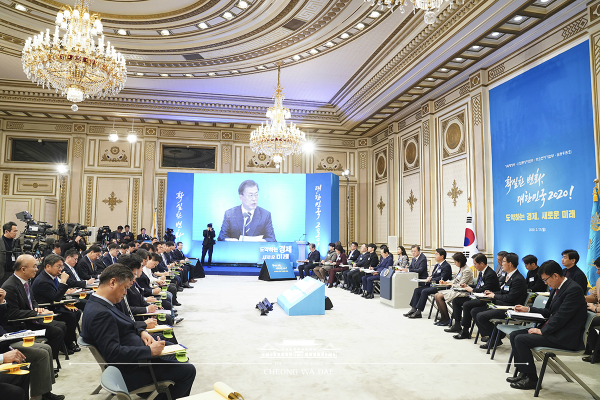
The Ministry of Trade, Industry and Energy announced this on the 17th at the Blue House State Guest House while reporting on the promotion plan for four key topics in the 2020 government work report held together with the Ministry of Strategy and Finance, the Ministry of SMEs and Startups, and the Financial Services Commission.
The four core themes are ▲ achieving self-reliance in materials, parts, and equipment, ▲ fostering the new industry of 'post-semiconductor,' ▲ leaping forward to become the world's leading hydrogen economy country, and ▲ transitioning to exports.
Stabilizing the supply of three major items and supporting technological independence in nine materials and components.
First, we will strive to stabilize the supply of three key items—hydrogen fluoride, EUV photoresist, and fluorinated polyimide—by the end of the year. We will also support technological independence in nine materials and components for sectors such as semiconductors and displays. We plan to issue emergency adjustment orders in the event of supply disruptions, and we will also support the return of materials and components companies operating overseas, including those in China, to Korea.
In accordance with the Special Act on Materials, Parts, and Equipment, which will be implemented in April, a specialized complex for small and medium-sized businesses in Yongin will also be designated. During the first half of the year, we will establish a specialized company with the participation of major domestic companies to promote the development of CNC (Computer Numerical Control) equipment for machine tools, which currently rely on Japan for over 90% of its production. CNC is a core component for machine tools, and Japan accounted for 93.7% (USD 134 million) of the total USD 143 million in imports in 2019.
Lastly, we plan to select the top 100 global small business masters and establish a global expansion strategy for small business masters within the first half of the year.
The memory semiconductor industry, a key export sector, is fostering a follow-up industry.
The Ministry of Trade, Industry and Energy also announced a plan to foster new industries as post-semiconductors based on the major new industries (future cars, system semiconductors, biohealth, robots, etc.) established jointly by the public and private sectors last year.
First, in the future vehicle sector, the goal is to export 300,000 eco-friendly vehicles and launch Korea's first commercial autonomous shuttle service. Starting in April of this year, commercial operation of Level 4 autonomous shuttle buses will begin on a 2.5km stretch within Alpha City in Suseong-gu, Daegu.
In the system semiconductor sector, we will invest 1 trillion won in next-generation semiconductor R&D and promote the construction of a symbiotic fab tailored to fabless demand. A 100 billion won symbiotic fund will also be operational within the first half of 2020. We also aim to achieve a 20% share of the global foundry market.
In the bio sector, we aim to achieve $10 billion in exports by becoming the world's second-largest bio-production hub and expand the commercialization of hospital-owned medical technologies.
In addition, the company plans to domestically produce gas turbines, which previously relied entirely on imports, to enter the 15 trillion won market in the future, and to lower the cost of purchasing electric vehicles through a battery leasing pilot project. We are also pursuing the enactment of a special law on industrial intelligence to make the country a leading industrial data powerhouse.
Activating the hydrogen economy and achieving export growth
The Ministry of Trade, Industry and Energy plans to distribute 10,000 hydrogen vehicles this year, install 100 new hydrogen charging stations, export 1,000 hydrogen vehicles, and reduce the wholesale price of hydrogen by 25%.
To increase exports, we will also support the diversification of export items, markets, and entities, as well as trade finance (KRW 257 trillion) and export marketing (KRW 511.2 billion).
We will also accelerate our New Northern and New Southern policies. To mark the 30th anniversary of the establishment of diplomatic relations between Korea and Russia, we plan to identify and promote New Northern cooperation projects and fully leverage the conclusion of New Southern FTAs, including the RCEP, as an opportunity to achieve $200 billion in New Southern trade.
Minister of Trade, Industry and Energy Sung Yun-mo said, “We have focused on the specific implementation of the various policies announced so far,” and added, “We plan to do our best to create results that the public and businesses can feel.”
Comments
Related news
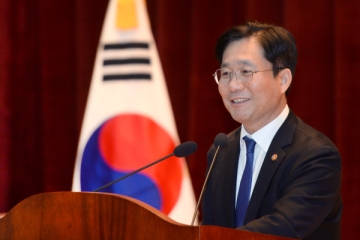
Minister of Trade, Industry and Energy Sung Yun-mo attends CES 2020… First government minister to do so since 2004
Minister Sung Yoon-mo of the Ministry of Industry, Trade and Energy will visit Las Vegas and San Francisco in the United States from the 6th to the 9th. In Las Vegas, he will attend CES 2020 to examine the latest technologies and future industry trends. In San Francisco, he plans to host an investment roundtable targeting U.S. innovative companies to attract investment in Korea across the semiconductor, hydrogen economy, and startup sectors.
2020.01.06by 이수민 기자
Smart gas meters to be demonstrated in 30,000 households nationwide
The Ministry of Industry has selected five pilot regions including Seoul, Gyeonggi, Gangwon, Daegu, and Gwangju for smart gas meter demonstration projects and plans to distribute a total of 15,000 smart gas meters by the end of this year. The smart gas meter demonstration project is being pursued to enhance the quality of city gas metering and meter reading services, including protecting gas users' privacy, improving meter readers' working conditions, and enhancing safety regarding gas leaks.
2020.01.20by 이수민 기자
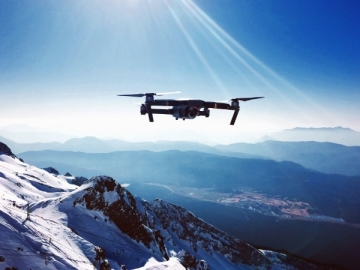
Domestic development of high-performance turbofan engines for unmanned aerial vehicles
The Ministry of Trade, Industry and Energy and the Defense Acquisition Program Administration will leverage their core capabilities to develop high-performance turbofan engines for future defense unmanned aircraft. On January 30th, the two agencies concluded a memorandum of understanding with key contents including the establishment of an inter-ministerial coordination body and intellectual property protection. They announced plans to invest approximately 88 billion won through 2025.
2020.01.30by 최인영 기자
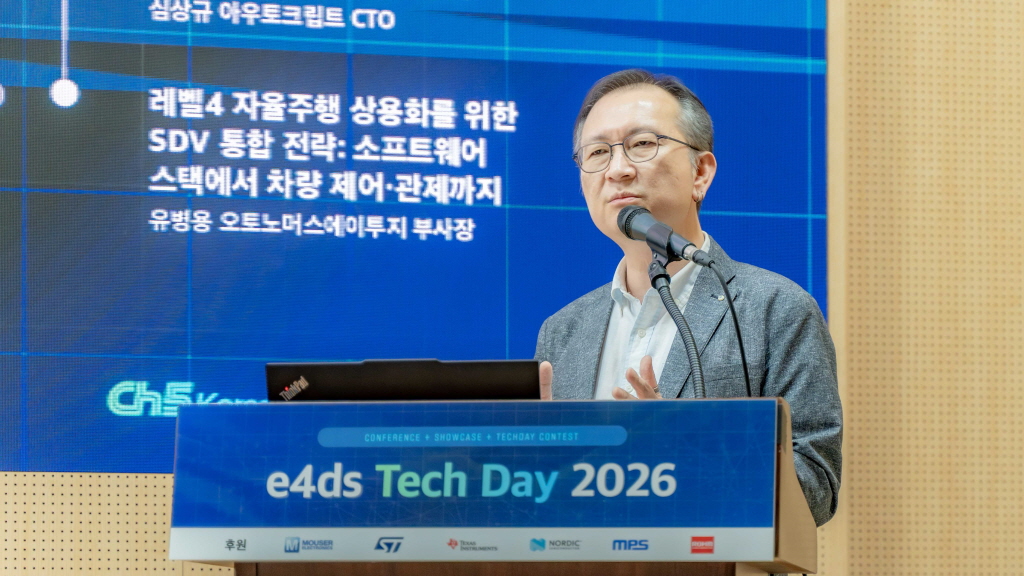
[e4ds Tech Day 2026 ⑨] Sim Sang-gyu, Autocrypt CTO: "In the Physical AI Era, Automotive Security Must Extend Beyond the Vehicle"
At e4ds Tech Day 2026, Sim Sang-gyu, CTO of Autocrypt, explained automotive cybersecurity strategies in the era of Physical AI and SDV (Software-Defined Vehicle). Automobiles are evolving as part of an ecosystem connected to AI, cloud, chargers, IoT, and robots, and he emphasized that the scope of security must expand beyond the vehicle interior to the entire connected environment. In particular, AI model tampering, adversarial attacks, OTA updates, and EV charger hacking were identified as major threats. He explained that response measures require zero trust, AI model integrity protection, intrusion detection, Security by Design and Default, and full lifecycle security management, and that proactive security system establishment beyond regulatory compliance is critical for securing future mobility competitiveness.
2026.10.12by 배종인 기자
Practical HIL Construction Strategy for Automotive and Off-Highway Controller Validation
As vehicle E/E architecture transitions to zonal structures and shifts to software-defined vehicles (SDV), the number of controllers (ECUs) requiring validation and software complexity are surging dramatically. Meanwhile, real vehicle testing cannot provide repeated verification under identical conditions and entails lead time and safety concerns. This white paper explains the principles of HIL (Hardware-in-the-Loop) validation and the structure of the NI platform composed of PXI, SLSC, and VeriStand, and through two actual implementation cases—Camera Record & Replay HIL for In-Cabin Monitoring Controller (ICMU) and Forklift Controller (VCU) HILS—describes how controller-level regression testing becomes possible. Additionally, it explicitly states application boundaries and limitations, such as lack of A2B support.
2026.10.12by 편집부











