


South Korea's IoT Sales Surpass 10 Trillion Won for the First Time in History in 2019
 Published2020.02.26 16:32
IoT Exports Show 46.3% Annual Growth
Approximately 4,300 personnel needed in the IoT sector in 2020
On the 25th, the Ministry of Science and ICT announced the results of the '2019 Internet of Things Industry Survey,' which covers the status of the domestic IoT industry over the past year.
The survey was conducted on 2,313 companies confirmed to be engaged in IoT business according to the Korean Standard Industrial Classification (10th) and the National Business Survey, of which 601 companies responded.
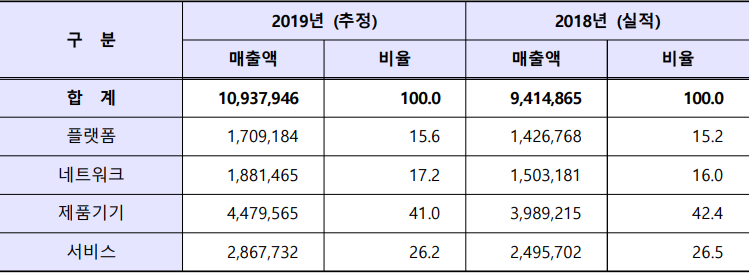
(Table = Ministry of Science and ICT)
The business sectors were surveyed by dividing them into four categories: service, platform, network, and device, and the service sector had the most businesses (1,226 companies, 53%).
IoT sales in 2019 amounted to 10,937.9 billion won, an increase of 16.2% from 9,414.9 billion won in 2018, surpassing 10 trillion won for the first time.
Domestic sales accounted for a large share of 89.0% of total sales, amounting to 9.734 trillion won, while exports showed rapid growth of 46.3% annually from 2015 to 2019.
By business sector, the product and equipment sector accounted for 41.0% of sales revenue with 4,479.6 billion won. In terms of year-over-year revenue, the network sector recorded the highest growth rate of 25.2% with 1.8815 trillion won. The platform sector followed with 1.7092 trillion won, recording a growth rate of 19.8%.
This appears to be because 5G mobile communication services were commercialized in early 2019, and various businesses linked to IoT were actively pursued, contributing to the growth of network revenue.
In the service sector, the construction, facility management, safety, and environment sectors accounted for the largest share at 38.1% due to the spread of smart city services through facility management.
The number of domestic IoT-related personnel is 77,734, an increase of 3,793 from 2018, and the workforce required according to employment plans for 2020 is approximately 4,300, indicating that the workforce in the IoT sector is expected to continue to grow.
The results of the survey can be downloaded from the Korea Information and Communication Industry Promotion Agency website .
Comments
Related news
ST Launches STSAFE-A110 Security Element for IoT Devices
ST's STSAFE-A110 protects IoT-connected consumer and industrial devices and prevents product counterfeiting through rigorous authenticity verification. It provides advanced authentication-based protection features and securely loads and enables access to cloud credentials. It enables large-scale registration of IoT devices and allows only authenticated devices to connect to online services, and security provisioning can be performed at ST factories at no additional cost for units exceeding 5,000 annually.
2020.02.21by 이수민 기자
.png)
[COVID-19] “5 IT Technologies” to Prevent Further Spread
With the recent surge in confirmed COVID-19 cases, efforts to minimize contact between people are spreading. Services utilizing advanced ICT technologies such as AI, IoT, big data, and autonomous driving are being utilized in various ways. Worldwide, the global community is actively responding to the unexpected COVID-19 crisis through algorithm-based medical AI platforms for determining infection status and autonomous mobility services that substitute for human presence.
2020.02.25by 최인영 기자

IoT Promotes Convergence Between Technologies, Considerations When Applying It to Industrial Sites
The Internet of Things, or IoT, is a technology that embeds sensors and communication capabilities into various objects to connect them to the internet, while simultaneously serving as a concept for connecting various objects through wireless communication and enabling mutual interaction. With advances in AI technology, IoT has recently evolved from simple control and monitoring functions into intelligent IoT based on cognitive technologies capable of learning, inference, and decision-making. Additionally, as the value of data increases, it is driving edge computing, processor optimization, and digital transformation.
2020.02.25by 이수민 기자
ESP32 Development Environment Selection and GPS Application Implementation
The ESP32 is a microcontroller that integrates Wi-Fi, Bluetooth, 12-bit ADC, capacitive touch, PWM, DAC, and UART in a single SoC. However, the abundance of features does not by itself solve the designer's problems. The real challenges lie in selecting the appropriate development environment, determining which pins can be used and which must be avoided, and converting raw data from modules into usable information. This document addresses ESP32 peripheral constraints (ADC2 and Wi-Fi coexistence limitation, UART1 occupancy, ADC non-linear regions), the trade-offs between Arduino IDE and ESP-IDF, and the process from connecting NEO-6M/NEO-M8N GPS modules to UART2, parsing NMEA sentences, and visualizing routes in Google Earth, all organized based on documented references.
2026.10.12by 편집부
MIPI CSI-2, DSI-2, C-PHY, D-PHY Test Solution Technical White Paper
The MIPI interface adopts a burst mode that transitions between low-power (LP) and high-speed (HS) states for low-power consumption, and in return, strict timing rules are imposed on state transitions. Additionally, the high-speed section operates as a packet-based protocol with headers, ECC, and CRC, so verification engineers must handle waveforms and protocols simultaneously. Traditional configurations combining general-purpose oscilloscopes and AWGs reveal limitations in setup complexity, measurement uncertainty, and lack of reproducibility when faced with these requirements. This white paper, based on webinar materials, organizes the structure of this problem and describes how the SV5C-DPTXCPTX generator for receiver testing and SV5C-DPRXCPRX analyzer for transmitter testing integrate state transition testing, stressed eye testing, and protocol analysis into a single bench, along with their application boundaries.
2026.10.12by 편집부











