



Maxim Launches MAX32520 Chip-DNA-Based Security Solution
 Published2020.02.28 09:20
A solution with built-in physical copy prevention technology for security modules
Maxim Integrated Korea has launched the MAX32520, a security solution based on ChipDNA for financial and government-grade security.
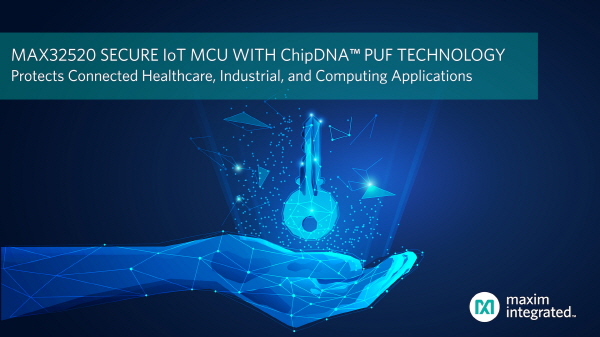
▲ MAX32520 <Image = Maxim Integrated Korea>
The MAX32520 is a secure Arm Cortex M44 MCU based on ChipDNA, featuring built-in physically unclonable function (PUF) technology for security modules. As a DeepCover security controller, it provides solutions including tamper resistance, IP protection, advanced encryption, large memory capacity, and improved cost efficiency.
It provides multi-layered defense by utilizing PUF, a cutting-edge key protection technology, to protect confidential information used in encrypted data operations.
This enables key protection solutions that deliver maximum efficiency at minimum cost in the IoT, healthcare, industrial, and computing systems sectors.
The encryption keys generated by the chip DNA PUF circuit exhibit high resistance to physical attacks, enabling enhanced tamper-evident capabilities. Protects sensitive information and provides strong IP security with flash encryption using PUF.
It also features a TRNG hardware accelerator that complies with SP 800-90A and SP 800-90B standards for AES 256, ECDSA P 521 SHA 512, enabling advanced encryption to protect user data.
It provides a large-capacity secure flash memory of up to 2 MB, enabling the execution of advanced applications in a secure environment, and eliminates the need for batteries, tamper detection ICs, and system management microcontrollers that are common in security-sensitive applications based on advanced process nodes.
Because hardware-based PUFs are tamper-proof, they can also support flash encryption, secure root-of-trust booting, and serial flash emulation.
While applications released to date have required battery power to provide cryptographic key protection solutions, PUF keys do not require power to erase the encrypted key protection structure in the event of an attack on the inherent physical security.
As the use of IoT applications increases, devices are exposed to uncontrolled risks and are also vulnerable to physical attacks. Because these threats are far more sophisticated than common software threats like weak password settings and factory reset password attacks, designers must also strengthen system security for critical core applications that can negatively impact daily life, including network collapse, damage to corporate reputation, and bankruptcy due to exposure of secret encryption keys.
“IoT developers want to bring advanced security to market with their designs built in, but they struggle to find the expertise to support it,” said Tanner Johnson, principal analyst at analyst firm Omdia. “If developers could include flash encryption PUFs and secure boot loading without redesigning their systems or developing internal code, time to market would be significantly reduced.”
“As threats to IoT systems grow, attack vectors are moving from the academic realm to open source,” said Chris Ardis, senior director of the Microsecurity Software Business Unit at Maxim Integrated. “The MAX32520, based on Chip DNA, includes cutting-edge key security technology that protects user data and IP while enabling future-proof designs.”
Comments
Related news
Launch of a bidirectional DC PLC IC that reduces the size of wireless earphones.
Maxim has introduced the MAX20340, a bidirectional DC power line communication (PLC) IC. Low-power portable device and wearable designers can use the MAX20340 to reduce power communication interface size when connected to chargers. The MAX20340 performs both power supply and communication functions over a single line. No additional pins or discrete components are required for communication between low-power products such as charging docks, wireless earbuds, and compact wearables.
2020.01.08by 이수민 기자
Mouser, ADI 16-bit AD7386 SAR High-Speed ADC Supply
Mouser Electronics announced that it supplies ADI's AD7386 SAR ADC. This 16-bit AD7386 is single-ended and functionally compatible with AD7380 and AD7381 ADCs. It features processing performance of 4MSPS and is produced in a compact 3×3mm LFCSP package. As a high-speed ADC with dual simultaneous sampling characteristics, it is suitable for motor control, ultrasonic detection, power management, and data acquisition applications.
2020.02.13by 이수민 기자

Maxim Launches Three Ultra-Small LiDAR ICs for High-Speed Autonomous Driving
Three types of ultra-compact automotive LiDAR ICs required for high-speed autonomous driving have been unveiled. Maxim has launched a package that can achieve twice the bandwidth compared to competitors within the same module size, as well as autonomous driving 16 km/h faster. More channels can be equipped on vehicle platforms with limited space, and current consumption can be reduced by more than 80% in low-power mode.
2020.02.26by 최인영 기자
Intel Unveils Next-Generation 'Core Ultra Series 3' and vPro Platform for Enterprise PCs
Intel has officially unveiled the "Intel Core Ultra Series 3" for next-generation enterprise PCs and the latest vPro platform, addressing a wide range of demands from enterprise notebooks to high-performance workstations.
2026.03.26by 배종인 기자
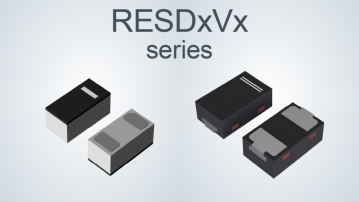
ROHM Launches ESD Protection Diode Compatible with High-Speed Interfaces of 10Gbps or Higher
Semiconductor specialist ROHM has developed the 'RESDxVx series' of ESD (electrostatic discharge) protection diodes capable of responding to next-generation high-speed data communication environments exceeding 10Gbps, simultaneously enhancing both signal quality maintenance required in high-speed interfaces and IC protection performance.
2026.03.26by 배종인 기자











