



Future vehicle specialists increase more than fivefold in 3 years
 Published2020.03.03 09:11
The development of electric and hydrogen vehicles leads to employment
Approximately 8,000 to 9,000 personnel are expected to be needed by 2028.
On the 2nd, the Ministry of Trade, Industry and Energy announced the results of a survey on the status of industrial technology personnel targeting businesses with 10 or more workers participating in the future automobile industry as of the end of 2018.
(Image = Ministry of Trade, Industry and Energy)
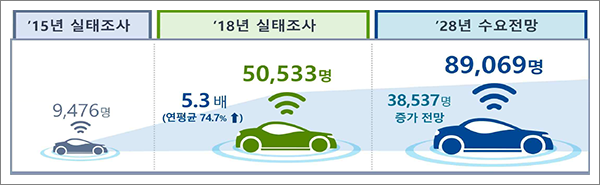
As of the end of 2018, the total number of industrial technology personnel employed in the future automobile industry was 50,533, which is 5.3 times higher than at the end of 2015 (9,467). This represents an annual average increase of 74.7%.
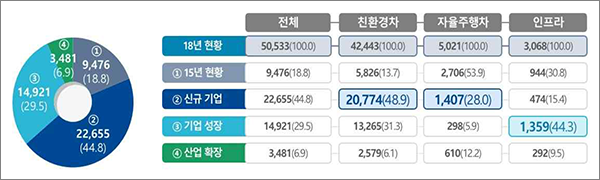
By sector, there were 42,443 people in eco-friendly vehicles, 5,021 in autonomous vehicles, and 3,068 in infrastructure, with the workforce in the eco-friendly vehicle sector increasing most significantly, reaching 7.3 times the level of the end of 2015.
By job function, production technology had 23,438 people, followed by research and development with 17,186 people, and research and development personnel (2,114 people) increased 8.1 times compared to the end of 2015.
The Ministry of Trade, Industry and Energy cited three factors for the increase: an increase in new companies participating in the future automobile industry since the end of 2015, growth in the future automobile business areas of existing companies, and expansion of the industrial scope due to inter-industry convergence.
As of the end of 2018, the shortage was 1,827 people, and the shortage rate was 3.5%. This figure is 1.6%p lower than at the end of 2015.
By sector, the shortage rate was high in the infrastructure and autonomous vehicle fields; by job function, in design and quality control; and by educational level, among university graduates.
The demand for future automotive industry technology personnel is expected to reach 89,069 by 2028.
By sector, there are 71,935 people in eco-friendly vehicles, 11,603 in autonomous vehicles, and 5,531 in infrastructure. Although eco-friendly vehicles account for a larger share (80.8%), the average annual growth rate is expected to be higher for autonomous vehicles (8.7%).
By job function, production technology accounts for 42,486 people, research and development for 29,117, and testing and verification for 3,393, and production technology personnel, who will support the expansion of production and distribution, are expected to show the highest average annual growth rate (6.1%).
(Image = Ministry of Trade, Industry and Energy)
According to the results of this survey, the workforce for future automobiles has surged due to an increase in R&D personnel driven by a focus on eco-friendly vehicles, increased participation of new companies, and sales growth of existing firms.
An official from the Ministry of Trade, Industry and Energy stated that based on these results, they plan to implement phased workforce training policies to resolve the workforce mismatch in the future automotive industry and support innovative growth.
Meanwhile, this survey covers the future automotive industry, including electric and hydrogen vehicles.In order to identify the changing workforce structure and current status, it has been conducted in collaboration with the Korea Institute for Industrial Technology Promotion and the Korea Institute for Industrial Economics and Trade since 2016 (survey reference point: end of 2015).
Comments
Related news

Technology Standards Forum to Promote Commercialization of Autonomous Vehicles Held
The National Institute of Standards and Technology under the Ministry of Trade, Industry and Energy held a plenary session of the autonomous vehicle standardization forum. At the plenary session, domestic R&D achievements were shared to implement standards-related initiatives of the future vehicle industry development strategy established by the ministry. Additionally, international standards candidate projects that could become global standards were identified and discussed.
2019.11.27by 이수민 기자

Domestic Technology Development for Key Green Vehicle Components Launches in Full Scale
The Ministry of Trade, Industry and Energy announced the market-autonomous 3rd generation xEV industry fostering project for developing key green vehicle components and will provide a total of 385.6 billion won through 2025. Aiming to accelerate the popularization of environmentally friendly vehicles such as electric vehicles, fuel cell vehicles, and plug-in hybrid vehicles, the project targets improving competitiveness of key components in the fields of energy storage and charging, driving and power conversion, air conditioning and thermal management, and hydrogen fuel cells.
2020.02.07by 최인영 기자
The Ministry of Trade, Industry and Energy is accelerating self-reliance among small and medium-sized businesses and exploring future food sources.
The Ministry of Trade, Industry and Energy is promoting the secure independence of the materials, components, and equipment industry. On the 17th, the Ministry reported its implementation plans for four key strategic themes at the 2020 Government Work Report held at the Cheong Wa Dae Reception Hall, together with the Ministry of Economy and Finance, the Ministry of SMEs and Startups, and the Financial Services Commission. The four key strategic themes are: ▲Realizing the secure independence of materials, components, and equipment, ▲Fostering the new industry of 'post-semiconductor' ▲Making a leap to become a global top-tier hydrogen economy nation ▲Converting to export plus growth.
2020.02.18by 이수민 기자

[e4ds Tech Day 2026 ⑨] Sim Sang-gyu, Autocrypt CTO: "In the Physical AI Era, Automotive Security Must Extend Beyond the Vehicle"
At e4ds Tech Day 2026, Sim Sang-gyu, CTO of Autocrypt, explained automotive cybersecurity strategies in the era of Physical AI and SDV (Software-Defined Vehicle). Automobiles are evolving as part of an ecosystem connected to AI, cloud, chargers, IoT, and robots, and he emphasized that the scope of security must expand beyond the vehicle interior to the entire connected environment. In particular, AI model tampering, adversarial attacks, OTA updates, and EV charger hacking were identified as major threats. He explained that response measures require zero trust, AI model integrity protection, intrusion detection, Security by Design and Default, and full lifecycle security management, and that proactive security system establishment beyond regulatory compliance is critical for securing future mobility competitiveness.
2026.10.12by 배종인 기자

Practical HIL Construction Strategy for Automotive and Off-Highway Controller Validation
As vehicle E/E architecture transitions to zonal structures and shifts to software-defined vehicles (SDV), the number of controllers (ECUs) requiring validation and software complexity are surging dramatically. Meanwhile, real vehicle testing cannot provide repeated verification under identical conditions and entails lead time and safety concerns. This white paper explains the principles of HIL (Hardware-in-the-Loop) validation and the structure of the NI platform composed of PXI, SLSC, and VeriStand, and through two actual implementation cases—Camera Record & Replay HIL for In-Cabin Monitoring Controller (ICMU) and Forklift Controller (VCU) HILS—describes how controller-level regression testing becomes possible. Additionally, it explicitly states application boundaries and limitations, such as lack of A2B support.
2026.10.12by 편집부











