



5G to Account for Over 10% of Global Mobile Connections in 2023
 Published2020.03.05 10:22
66% of the world's population is connected to the internet
5G to be 13 times faster than average mobile speed
It is projected that 5G will account for more than 10% of global mobile connections by 2023.

(Image = Cisco Systems)
Cisco Systems announced this on the 5th while releasing the 'Cisco Annual Internet Report'.
The report predicted that the average 5G speed in 2023 would be 575 Mb (megabits) per second, which is 13 times faster than a standard mobile connection. In addition, it was predicted that 5G would provide mobile infrastructure supporting AI and IoT applications such as autonomous vehicles, smart cities, connected health, and immersive video.
In addition, the report stated that over the past 50 years, new mobile technologies incorporating cutting-edge innovations have emerged every decade, and the demand for mobile bandwidth, which was previously limited to voice calls and text messages, has evolved into various forms such as ultra-high-definition video and AR/VR applications.
Demand for mobile networks from both general consumers and corporate users is also increasing, and this trend is expected to become even more pronounced with the growing use of mobile applications.
In particular, mobile application downloads are expected to reach approximately 300 billion by 2023, with social networking, video streaming and downloads, work productivity, e-commerce, and game-related applications driving continued growth.
The following are the key points of the report.
66% of the world's population uses the Internet.
It is predicted that by 2023, the number of global internet users will reach 66% (5.3 billion) of the world's population. Domestic internet users are projected to increase from 92% (46.8 million people) of the total population in 2018 to 95% (48.8 million people) in 2023.
In addition, with over 70% of the world's population (over 5.7 billion people) expected to use mobile networks via 2G, 3G, LTE, or 5G by 2023, the number of mobile users in Korea is projected to increase from 87% (44.3 million people) of the total population in 2018 to 88% (45.1 million people).
The number of network-connected devices per person continues to increase.
It is projected that in 2023, the global population will own 3.6 network-connected devices per person and 10 network-connected devices per household. In particular, 47% of all network-connected devices are expected to support video playback.
In Korea, the number of personal network-connected devices per person is expected to nearly double from 6.7 in 2018 to 12.1 in 2023.
Machine-to-machine (M2M) connections supporting IoT applications are expected to reach 50% (14.7 billion) of network-connected devices worldwide.
Demand for M2M is expected to increase in Korea as well, and the proportion of M2M modules among all network-connected devices in Korea is projected to rise from 55% (190 million units) in 2018 to 69% (430 million units) in 2023.
55% of network connections, wired or Wi-Fi
45% of network-connected devices worldwide are expected to be mobile connections such as Low Power Wide Area (LPWA) or 5G. The remaining 55% will use a wired or wireless Wi-Fi connection.
In Korea, it is projected that 34% of all network-connected devices will be mobile, while the remaining 66% will use wired or wireless Wi-Fi.
While global 5G connections are expected to account for 10.6% of total mobile connections, domestic 5G connections are projected to account for an even higher 17.1%.
The share of LPWA in total mobile connections worldwide is expected to rise from 2.5% in 2018 to 14.4% in 2023. Domestically as well, it is expected to rise sharply from 10.0% in 2018 to 42.4% in 2023.
Public Wi-Fi zones to increase fourfold compared to 2018
The number of public Wi-Fi hotspots worldwide is expected to quadruple from 169 million in 2018 to approximately 628 million in 2023.
In Korea, the total number of public Wi-Fi hotspot areas, including home spots, is expected to double from 8.1 million to 16 million during the same period.
Public Wi-Fi 6 hotspot areas worldwide are expected to grow approximately 13-fold from 2020 to 2023 and account for 11% of all public Wi-Fi hotspot areas.
Wired and wireless network speeds become more than twice as fast
The average global mobile connection speed is expected to more than triple from 13 Mbps in 2018 to 44 Mbps in 2023, and Korea is projected to reach 76.7 Mbps, a twofold increase from 38.9 Mbps during the same period.
The average speed of Wi-Fi connections worldwide is expected to more than triple from 30 Mbps in 2018 to 92 Mbps in 2023, and Korea is also projected to more than triple from 51.6 Mbps to 160 Mbps during the same period.
The average speed of wired broadband connections worldwide is expected to more than double from 46 Mbps in 2018 to 110 Mbps in 2023, and Korea is also expected to double from 105.7 Mbps to 220.6 Mbps during the same period.
Meanwhile, the Cisco Annual Internet Report is produced by the Cisco Visual Networking Index (VNI) report development team and provides assessments of digital transformation as well as forecasts and analyses at global, regional, and national levels.
Comments
Related news

Global Task Force Launched to Promote 5G MEC Commercialization and Interoperability
Nine global telecom operators, including SK Telecom, have launched a Telecom Edge Cloud Task Force with the goal of commercializing 5G MEC. The Telecom Edge Cloud Task Force aims to achieve global commercialization of 5G MEC technology through interoperability between edge clouds that each operator is separately building. To this end, participating companies plan to conduct demonstration tests including interworking and sharing of edge cloud technologies and services that each company possesses.
2020.03.02by 이수민 기자
Can 5G Give Wings to Smart Factories?
Smart factories are cited as a representative B2B sector where 5G can be applied. A smart factory is a facility equipped with intelligent and flexible production systems to manufacture customized products for customers. 5G, a high-capacity ultra-high-speed wireless communication technology, can implement intelligence in factories that need to change processes frequently, and can provide mobility and variability.
2020.03.03by 이수민 기자

Still an 'underdog' Samsung Electronics to supply 5G equipment to New Zealand
Samsung Electronics has concluded a 5G mobile communication equipment supply contract with Spark, New Zealand's largest mobile operator. Samsung Electronics plans to work with Spark to build 5G commercial networks in some regions of New Zealand within this year. Samsung Electronics will supply communication equipment including 5G base stations in the 3.5GHz frequency band, which has been commercialized domestically.
2020.03.05by 이수민 기자
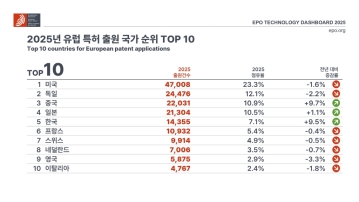
European Patent Applications Surpass 200,000 for the First Time… South Korea Maintains 5th Place, Led by Batteries and Telecommunications
According to the European Patent Office (EPO)'s 'Technology Dashboard 2025', European patent applications last year reached 201,974, surpassing 200,000 for the first time. Korean companies and inventors filed 14,355 applications, representing a 9.5% increase from the previous year and maintaining 5th place by country. Battery, digital communication, and semiconductor technologies led the growth, with Samsung ranking as the top EPO applicant for the second consecutive year and LG reaching 3rd place. The presence of major domestic cities such as Seoul, Suwon, and Yongin was also confirmed. It was also revealed that Korea's European patent strategy is expanding beyond individual technologies to span the entire industry.
2026.03.24by 명세환 기자

SK Telecom First Applies AI-Based Network Operations at Gwanghwamun K-Pop Concert
SK Telecom announced that it applied an AI-based network operation system for the first time at a large-scale K-pop concert held in the Gwanghwamun area of Seoul on March 21st, managing communication quality throughout the event. Mobile data usage during the three hours before and after the concert reached 12.15TB, approximately doubling compared to the same time slot the previous weekend. SK Telecom monitored traffic using the AI system 'A-One' in five-minute and 50-meter units to respond to potential overload situations, while also operating temporary communication facilities and on-site personnel in parallel. This case is interpreted as confirmation of the practical applicability of AI-based autonomous network operation in an environment where demand from dense events and foreign users increases simultaneously.
2026.03.23by 명세환 기자











