



Digital adaptability of vulnerable groups improves every year… recorded 69.9% in 2019
 Published2020.03.05 15:40
Continuous improvement of digital capabilities for people with disabilities, the elderly, farmers and fishermen, low-income groups, etc.
It was found that the level of digital literacy among vulnerable groups, including the disabled, the elderly, farmers and fishermen, and low-income groups, was 69.9%, an improvement of 1.0%p compared to last year.

The Ministry of Science and ICT announced the results of the 2019 survey on the digital divide.
According to the results of the 2019 Digital Information Gap Survey released by the Ministry of Science and ICT, the level of digital literacy among the information-vulnerable group compared to the general public was 69.9%, an improvement of 1.0%p from 68.9% in the previous year.
By sector, digital access for vulnerable groups was 91.7%, competency was 60.2%, and utilization was 68.8%, showing an improving trend year after year; in particular, the levels of competency and utilization increased by 1.1%p compared to the previous year (59.1% and 67.7%, respectively).
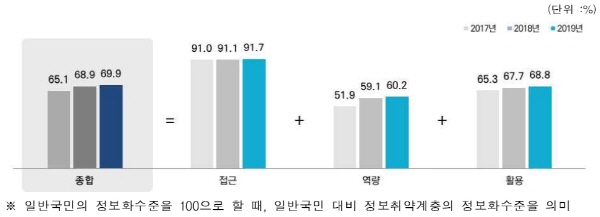
▲ Trends in the level of digitalization by survey sector <Source: Ministry of Science and ICT>
The level of digital literacy by vulnerable group compared to the general public is 87.8% for low-income groups, 75.2% for people with disabilities, and 70.9% for farmers and fishermen. The elderly population was recorded at 64.3%.
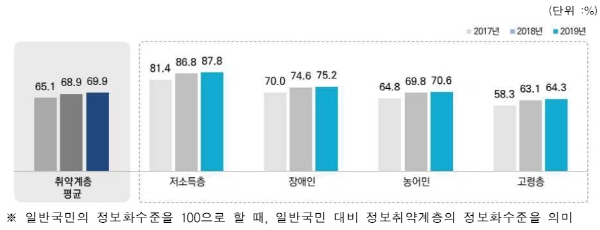
▲ Trends in Digital Informatization Levels by Information-Vulnerable Groups
Park Yoon-kyu, Director General of Information and Communication Policy at the Ministry of Science and ICT, stated, “With the introduction of artificial intelligence, big data technologies, and unmanned systems such as kiosks, it is necessary to be prepared to adapt to the rapidly changing digital environment.” He added, “We will strive to strengthen digital literacy and create a digital environment so that the information-vulnerable are not excluded or marginalized during the digital transition process.”
Meanwhile, this survey measured the level of access, capability, and utilization of digital information, such as wired and wireless information and communication devices like PCs and mobile phones, and internet usage among the information-vulnerable group, and was conducted through one-on-one interviews with 15,000 people in 17 metropolitan cities and provinces nationwide.
Comments
Related news
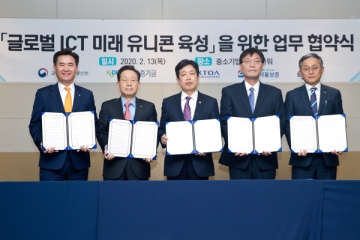
The Ministry of Science and ICT has launched a program to foster future unicorns in the ICT sector.
The Ministry of Science and ICT announced that it has signed a memorandum of understanding with four organizations—Korea Credit Guarantee Fund, Korea Telecommunications Business Association, Seoul Guarantee Insurance, and Born to Global Center—to promote ICT GROWTH, a global ICT future unicorn nurturing program. The ICT GROWTH program aims to create an ecosystem and establish a support system capable of fostering high-growth ICT companies by combining government and private resources. The plan is to select approximately 15 companies annually starting this year, with a total of 50 companies to be selected and supported by 2025.
2020.02.17by 이수민 기자
20% of smartphone users experience problems in daily life
According to a survey, 20% of smartphone users in our country have lost control over their smartphone usage and are experiencing problems in their interpersonal relationships, health, and daily life. The Ministry of Science and ICT announced the results of a smartphone overuse survey conducted on the 20th, targeting smartphone and internet users aged 3 to 69 from 10,000 households nationwide.
2020.02.20by 최인영 기자
Data centers to be included in broadcasting and telecommunications disaster management
A bill to amend the Broadcasting and Telecommunications Development Act has been proposed to include data businesses such as cloud services in the scope of broadcasting and telecommunications disaster management in order to protect data, which is a core resource of the digital economy. Legislator Park Sun-sook argued that institutional measures must be established to simultaneously satisfy both cyber security and physical security, citing the KT Ahyeon branch fire incident that occurred in 2018 as an impetus.
2020.03.04by 최인영 기자
European Patent Applications Surpass 200,000 for the First Time… South Korea Maintains 5th Place, Led by Batteries and Telecommunications
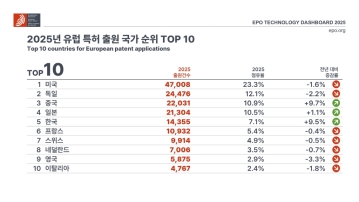
According to the European Patent Office (EPO)'s 'Technology Dashboard 2025', European patent applications last year reached 201,974, surpassing 200,000 for the first time. Korean companies and inventors filed 14,355 applications, representing a 9.5% increase from the previous year and maintaining 5th place by country. Battery, digital communication, and semiconductor technologies led the growth, with Samsung ranking as the top EPO applicant for the second consecutive year and LG reaching 3rd place. The presence of major domestic cities such as Seoul, Suwon, and Yongin was also confirmed. It was also revealed that Korea's European patent strategy is expanding beyond individual technologies to span the entire industry.
2026.03.24by 명세환 기자

SK Telecom First Applies AI-Based Network Operations at Gwanghwamun K-Pop Concert
SK Telecom announced that it applied an AI-based network operation system for the first time at a large-scale K-pop concert held in the Gwanghwamun area of Seoul on March 21st, managing communication quality throughout the event. Mobile data usage during the three hours before and after the concert reached 12.15TB, approximately doubling compared to the same time slot the previous weekend. SK Telecom monitored traffic using the AI system 'A-One' in five-minute and 50-meter units to respond to potential overload situations, while also operating temporary communication facilities and on-site personnel in parallel. This case is interpreted as confirmation of the practical applicability of AI-based autonomous network operation in an environment where demand from dense events and foreign users increases simultaneously.
2026.03.23by 명세환 기자











