



170 billion won invested over 7 years in the development of core technologies for unmanned vehicles
 Published2020.03.15 12:46
Development of technologies applicable to land, sea, and air, such as detection, recognition, and autonomous intelligence
The government is pursuing a mid-to-long-term source technology development project worth 170 billion won to leap forward as a technology powerhouse for unmanned vehicles.
The Ministry of Science and ICT announced on March 15 that it is proceeding with the selection of new projects with the goal of securing source technologies for unmanned vehicles and enhancing technological competitiveness by investing a total of 170.28 billion won over seven years from 2020 to 2027 to develop source technologies applicable to land, sea, and air, and to implement an integrated operation system through autonomous cooperation among multiple and heterogeneous types.
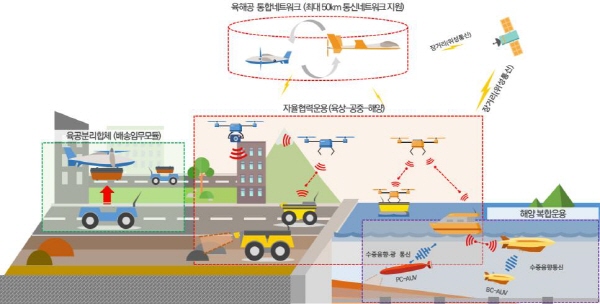
▲ The Ministry of Science and ICT to invest 170 billion won in the development of core technologies for unmanned vehicles <Source: Ministry of Science and ICT>
The investment scale for each project is 71.73 billion won for the development of common source technologies and 71.31 billion won for the development of integrated operation technology demonstrators over seven years, and this year, 12.5 billion won will be invested to select projects in 11 fields (9 research groups, 2 single projects).
The field of common source technology includes the Detection and Recognition Research Group (Navigation and Sensor Technology), Communication Research Group, Autonomous Intelligence Research Group, Power Source and Mobility (Single Project), Human-Mobile Interface Research Group, System Integration Framework (Single Project), and System Integration Hardware Research Group.
The Integrated Operational Technology Demonstrator includes ▲ Development of autonomous cooperative unmanned vehicles for land, sea, and air (Autonomous Cooperation Research Group) ▲ Development of separable and combinable delivery unmanned vehicles for land and air (land and airComplex Research Group) ▲ Development of a complex system for unmanned surface vessels and autonomous underwater vehicles (Marine Complex Research Group) is included.
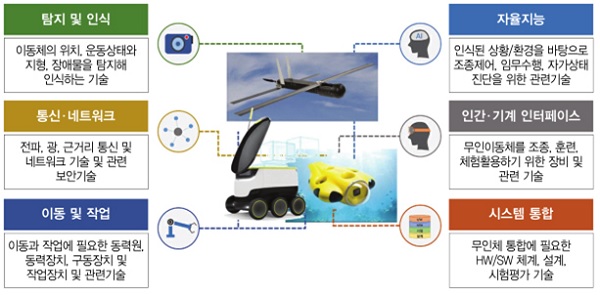
▲ Common Technology for Unmanned Vehicles <Source: KARI>
Previously, in January, the Ministry of Science and ICT selected the Korea Aerospace Research Institute (hereinafter KARI) as the project team for the development of source technologies for unmanned vehicles, and laid the foundation for expanding the industrial and research base through the management of the entire project process, including project planning, execution management, and evaluation, as well as technology transfer of deliverables, integrated technology workshops, and sharing of results.
In addition, in January 2019, detailed planning for each project was completed through consultations with experts from industry, academia, and research institutes based on the key contents of the projects and sub-projects that passed the preliminary feasibility study. After selecting the research team and project leaders through this open call, the project is scheduled to begin in earnest.
Ko Seo-gon, Director General of Basic and Original Research Policy at the Ministry of Science and ICT, said, “We expect the unmanned vehicle source technology development project to serve as a catalyst for small and medium-sized domestic unmanned vehicle industries to lead the future global market,” adding, “We will continue to provide support to ensure that the results of technology development lead to tangible outcomes such as technology transfer and commercialization.”
Meanwhile, the Ministry of Science and ICT is holding an online business briefing via YouTube live streaming, taking into account the situation where it is becoming difficult to hold offline business briefings for institutions wishing to participate in projects due to the recent spread of COVID-19.
Applications for new projects will be accepted from March 30 to April 16, and questions and answers regarding the project details and application procedures can be obtained through an online business briefing.
Comments
Related news
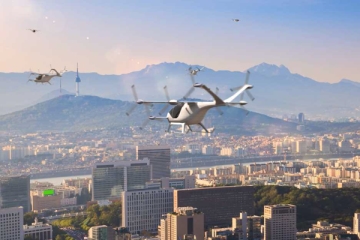
What are the key issues that determine success and failure for PAV (Personal Air Vehicle), the future transportation means taking to the skies?
Drones utilizing ICT technologies such as artificial intelligence, embedded sensors, software, hardware, 5G communication, and cloud have recently garnered attention for their growth potential in the personal aircraft market. Mobility Foresignts predicted that the PAV market value will grow to approximately 400 million dollars by 2025, while Morgan Stanley forecasted growth to 2.9 trillion dollars by 2040.
2020.02.18by 최인영 기자
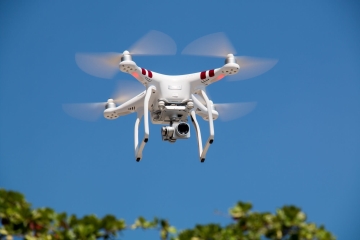
Ministry of Land, Infrastructure and Transport to Secure Public Safety with Drone Real-Name System
Starting in 2021, drones exceeding a maximum takeoff weight of 2kg must be registered with the aircraft authority, and operators must complete prior online training to fly drones exceeding 250g. The Ministry of Land, Infrastructure and Transport will classify drones into toy model aircraft, low-risk unmanned aerial vehicles, medium-risk unmanned aerial vehicles, and high-risk unmanned aerial vehicles based on performance and risk level, while implementing a real-name registration system for drones.
2020.02.18by 최인영 기자
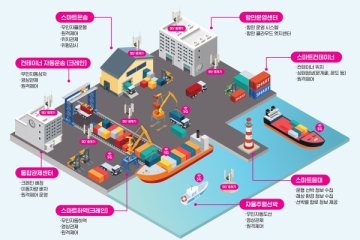
5G-based autonomous driving will be used in port logistics transport.
LG Uplus has signed a memorandum of understanding with Potent for cooperation on 5G-based smart port logistics automation business. This collaboration focuses on the logistics automation field of 5G smart ports, integrating unmanned and automated technologies for logistics equipment that Potent possesses with LG Uplus's 5G technology to build solutions, and will jointly advance related projects.
2020.03.11by 이수민 기자
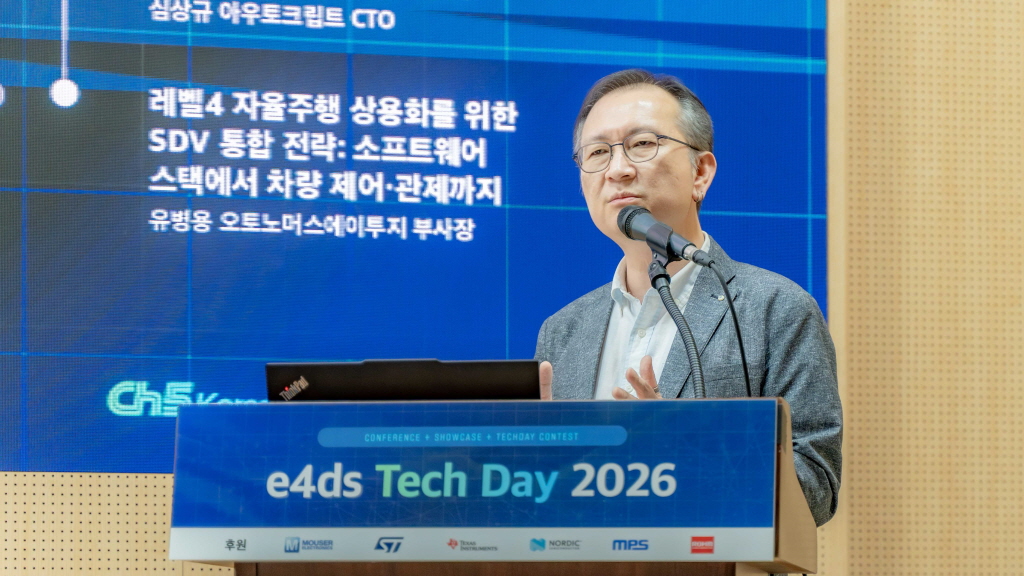
[e4ds Tech Day 2026 ⑨] Sim Sang-gyu, Autocrypt CTO: "In the Physical AI Era, Automotive Security Must Extend Beyond the Vehicle"
At e4ds Tech Day 2026, Sim Sang-gyu, CTO of Autocrypt, explained automotive cybersecurity strategies in the era of Physical AI and SDV (Software-Defined Vehicle). Automobiles are evolving as part of an ecosystem connected to AI, cloud, chargers, IoT, and robots, and he emphasized that the scope of security must expand beyond the vehicle interior to the entire connected environment. In particular, AI model tampering, adversarial attacks, OTA updates, and EV charger hacking were identified as major threats. He explained that response measures require zero trust, AI model integrity protection, intrusion detection, Security by Design and Default, and full lifecycle security management, and that proactive security system establishment beyond regulatory compliance is critical for securing future mobility competitiveness.
2026.10.12by 배종인 기자

Practical HIL Construction Strategy for Automotive and Off-Highway Controller Validation
As vehicle E/E architecture transitions to zonal structures and shifts to software-defined vehicles (SDV), the number of controllers (ECUs) requiring validation and software complexity are surging dramatically. Meanwhile, real vehicle testing cannot provide repeated verification under identical conditions and entails lead time and safety concerns. This white paper explains the principles of HIL (Hardware-in-the-Loop) validation and the structure of the NI platform composed of PXI, SLSC, and VeriStand, and through two actual implementation cases—Camera Record & Replay HIL for In-Cabin Monitoring Controller (ICMU) and Forklift Controller (VCU) HILS—describes how controller-level regression testing becomes possible. Additionally, it explicitly states application boundaries and limitations, such as lack of A2B support.
2026.10.12by 편집부











