


Intel Unveils 'Pohoiki Springs' Providing 100 Million Neuron Computations
 Published2020.03.19 15:13
Process workloads up to 1,000 times faster than existing processes
Intel has revealed the status of its latest neuromorphic research system, Pohoiki Springs, which provides 100 million neuron computing power.
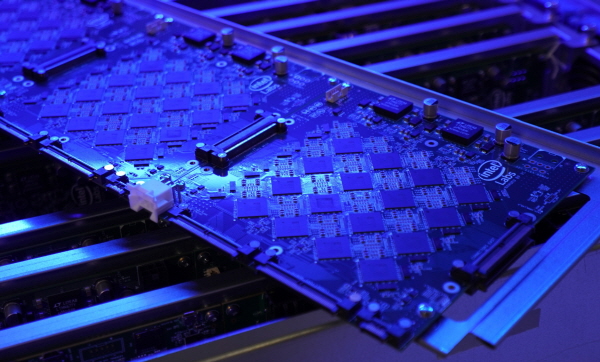
▲ Pohoiki Springs <Photo by Intel>
Pohoiki Springs is a rack-mounted system for data centers and is the largest neuromorphic computing system developed by Intel to date. It is a system that embeds 769 Loihi neuromorphic chips inside a physical frame (chassis) the size of five standard servers.
Inspired by the human brain, the Loihi processor can handle demanding workloads that operate like the human brain, not only up to 1,000 times faster than existing processors but also with up to 10,000 times greater efficiency.
Poiki Springs is a system that extends the Loihi architecture to verify its potential to solve a wide range of difficult computational tasks, including artificial intelligence-related problems.
Intel's smallest neuromorphic system, Kapoho Bay, consists of two Loihi chips with 262,000 neurons and supports real-time edge workloads.
_3(1).jpg)
▲ Pohoiki Springs <Photo by Intel>
Pohoiki Springs, with 100 million neurons, is an important step in increasing Loihi's neural capacity to the level of a small mammalian brain, enabling it to process larger and more sophisticated neuromorphic workloads.
Intel's neuromorphic system is similar to Pohoiki Springs and is currently in the research phase, providing tools to develop and characterize neural network-inspired algorithms.
Traditional general-purpose processors such as CPUs and GPUs are particularly adept at tasks that are difficult for humans to perform, such as precise mathematical calculations, but the role and application of recent technologies are expanding to become more sophisticated.
From automation to artificial intelligence, computers are like humansThis demands the emergence of an architecture that adapts to change while processing more active, unstructured, and noisy data in real time.
Neuromorphic computing fundamentally redesigns computer architecture. It applies the latest insights from neuroscience to create chips that are more similar to the human brain. Neuromorphic systems implement the organization, communication, and learning capabilities of neurons at the hardware level.
Mike Davis, Director of Intel’s Neuromorphic Computing Lab, stated, “Pohoiki Springs can scale the Loihi neuromorphic research chip by more than 750 times while consuming less than 500 watts of power,” adding, “Research partners can use this system to process workloads that run slowly on existing architectures, including high-performance computing (HPC) systems, faster.”
Comments
Related news
AI device operating at the speed of light has been developed
A research team led by Professor Park Nam-gyoo, Dr. Yu Seon-gyoo, and Dr. Park Hyun-hee at Seoul National University has successfully demonstrated the simulation of neuron operations—the basic units of the brain—through the flow of light for implementing high-speed AI computation. As semiconductor electronic circuits have recently undergone miniaturization to several nanometers in nanotechnology processes, heat generation and speed limitations have become fundamental constraints on performance enhancement of semiconductor devices, and these are expected to be ultimate limiting factors in the implementation of neuromorphic semiconductor electronic circuits. By contrast, neuromorphic devices that perform computation using light rather than electrons are being researched at research institutions worldwide, including MIT and Stanford University, due to their capability for low-power operation without heat generation and ultra-high-speed operation. The research team successfully simulated and reproduced various computational functions of unit neurons through optical signal processing by utilizing metamaterials that satisfy parity-time symmetry, an unusual physical symmetry, with amplification and loss materials, to which nonlinearity controlling temporal symmetry was added.
2019.06.08by 이수민 기자

Can 256GB of ultra-large data processing in the AI era become a reality with FPGA accelerators?
Recent strength in the mobile market has led to an expansion in investment scale for data center servers. As technology enabling multiple users to simultaneously use various applications without latency gains attention, data transmission and reception of 256GB/s is expected to be realized by 2022. We heard from a current Intel engineer about methods to optimize server performance in preparation for the PCIe Gen6 era.
2020.03.17by 최인영 기자
AI Talent Demand Higher in Non-IT Departments
From 2015 to 2019, departments seeking talent with AI technical capabilities were not IT departments but rather marketing, sales, customer service, finance, and research and development departments. According to Gartner's Talent Neuron data, AI applications were being widely utilized in asset-intensive industries such as predictive maintenance, workflow, production optimization, quality control, and supply chain optimization.
2020.03.19by 최인영 기자

Camera for Both Humans and Machines: ST BrightSense 5MP Dual Shutter Image Sensor
Video consumed by humans and imagery analyzed by machines impose different requirements on the sensor in terms of shutter method and wavelength band. Until now, sensors had to be separated or supplemented with companion chips and high-performance processors, and this cost and complexity became a bottleneck in vision system design. The ST BrightSense next-generation 5MP image sensor (VD5943, VD1943, VB5943, VB1943) with 2.25 µm pixels supports both global and rolling shutters, and through on-chip staggered HDR (up to 100 dB), on-chip RGB-IR separation and 5MP NIR smart upscaling, and frame-by-frame context switching, absorbs both requirements internally at the sensor level. This white paper describes the rationale, choices, trade-offs, and results of each design decision based on presentation slides and technical Q&A, and specifies application boundaries. The product is scheduled for mass production in February 2026, and evaluation and sampling are currently available.
2026.10.13by 편집부

AI-based Universal Robots Automation Solution
In manufacturing environments where declining labor populations overlap with frequent production item changes, existing programming-based robot automation requires reconfiguration from weeks to several months each time product models change. This white paper takes this flexibility gap as its starting point and synthesizes, based on webinar presentation materials and technical Q&A, what collaborative robots gain and forfeit compared to industrial robots, why process automation is transitioning from rule-based to learning-based (4th generation) approaches, and how Universal Robots' hardware, software, and partner ecosystem implement this. Additionally, it clarifies the application boundaries and limitations, including that AI Accelerator is still at the development kit stage.
2026.10.13by 편집부











