



Markbase Time Series DBMS v6.0 Announced, Targeting 100 Million IIoT Sensor Data Transactions Per Second
 Published2020.03.24 10:31
Core technologies in smart X fields such as smart factories
v6.0, disk compression ratio increased by 3 times compared to previous versions
A time series DBMS is a special purpose DBMS for processing time series data generated at regular time intervals.
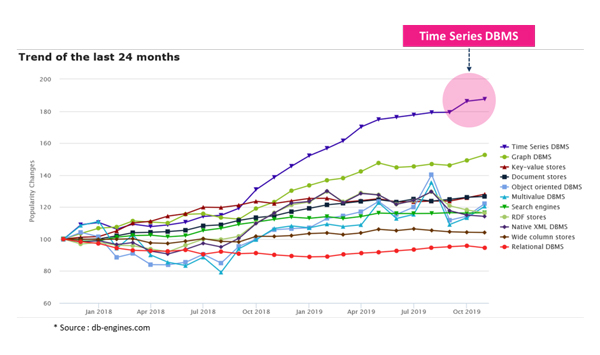
It is emerging as a core technology in smart X fields such as smart factories, smart cities, and smart grids, as it enables processing of hundreds of thousands to millions of sensor data per second, which was impossible with existing RDBMS and big data solutions.
On the 24th, Markbase announced 'MACHBASE v6.0', a time-series DBMS that supports real-time processing of ultra-large volumes of sensor data generated from IIoT devices.
In November of last year, Markbase ranked first in the TPCx-IoT field test conducted by TPC, a global accredited certification body, and was listed as an international standard. Instead of omitting the functions of existing RDBMS such as transactions and data changes, it adopted tag (sensor) and time-based index configuration and high-efficiency compression technology for real-time input and retrieval of large amounts of data reaching millions of records per second.
Kim Seong-jin, CEO of Markbase, said, “Until recently, it was not uncommon for smart factories to process tens to hundreds of thousands of sensor data per second.” He added, “This year, companies that require processing more than 70 million data per second have emerged, and the amount of sensor data that needs to be processed in the IIoT environment is exploding.”
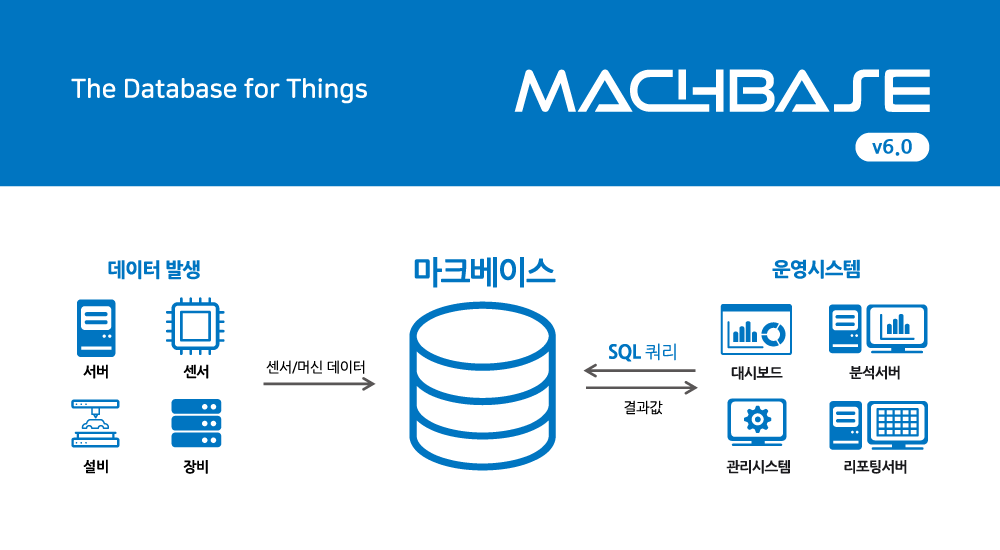
The most notable feature improvement in v6.0, which was announced with the goal of storing, analyzing, and utilizing up to 100 million data records per second, is the Tag Table compression function to minimize disk usage, which is directly related to performance and cost. To improve price-to-performance ratio, it is important to maximize the number of transactions per second and minimize disk usage. By improving tag table compression efficiency, disk compression is possible up to three times compared to existing methods.
A new incremental backup method has also been added, allowing backups to be made only for data that has occurred since the last backup, reducing backup time and storage space. This can be applied to the entire database, tags, logs, and tables.
To ensure customer-required DBMS availability, we've also added multi-connection support for automatic failover in clustered environments. If the connection to the primary server is lost due to various reasons, including server failure, you can connect to a pre-configured server and restore the status of any queries being processed on the previous server.
Comments
Related news

Processing massive IIoT data requires a time-series database, as the cloud alone struggles to handle it.
Cases of integrating cloud into smart factories are increasing. However, since the data volume generated by various sensors and equipment installed in smart factories reaches millions of tags per second, cloud alone has its limitations. Therefore, a data repository capable of collecting and storing vast amounts of data at ultra-high speed and a solution that can compress and store data are necessary.
2020.01.13by 이수민 기자
Domestic manufacturing industry emerges as a global IIoT powerhouse with digital twin strategy
Global manufacturing enterprises are focusing on IoT technology as a new growth driver, and attention is being directed toward OPC UA platform utilization strategies that enable real-time CPS data provision beyond data sharing and integration within a single factory. A smart factory market valued at over $7.8 billion is being analyzed from a CPS perspective.
2020.03.03by 최인영 기자

Silicon Labs Expands IoT Wireless Platform Business
Silicon Labs is entering into an asset purchase agreement for RedPine Signals' Wi-Fi and Bluetooth business, a development center in Hyderabad, India, and patent portfolio to expand its platform in the IoT wireless technology field. Through connected devices supporting Wi-Fi functionality, Silicon Labs has enhanced its prospects for market entry into smart home and IIoT commercial sectors.
2020.03.16by 최인영 기자
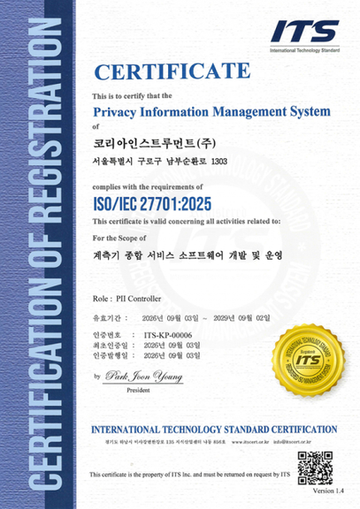
Korea Instrument, KOLAS Accredited Calibration Agency First to Simultaneously Acquire ISO/IEC 27,001·27,701
Korea Instrument has become the first among KOLAS accredited calibration agencies to simultaneously acquire ISO/IEC 27,001 and ISO/IEC 27,701 certifications. Through its proprietary platforms CWIZ Enterprise and CWIZ Partners, the company has embedded information security and personal data protection requirements across all business processes including customer information, equipment data, and calibration reports, with plans to continuously advance its management system through regular audits and security inspections.
2026.10.12by 배종인 기자
TeamViewer One, IT Incident Automation Workflow and Resolution Center Enhanced
TeamViewer has added IT incident automation capabilities and an advanced Resolution Center to its integrated digital workplace management platform 'TeamViewer ONE'. Recurrent service disruptions, configuration errors, and capacity shortages are automatically handled according to preset policies, and device status verification through script deployment can be managed in a unified interface, significantly reducing repetitive tasks for IT teams.
2026.10.12by 배종인 기자











