


Hyundai Motor and Seoul City to Supply Over 4,000 Commercial Hydrogen Electric Vehicles
 Published2020.04.01 16:22
Infrastructure expansion through the expansion of hydrogen refueling stations and securing sites
Deployment of hydrogen electric vehicles across the transportation sector
Hyundai Motor Company announced on the 1st that it signed an MOU with the Seoul Metropolitan Government on the 31st of last month, with the main content being the strengthening of mutual cooperation to promote the supply of hydrogen electric vehicles.
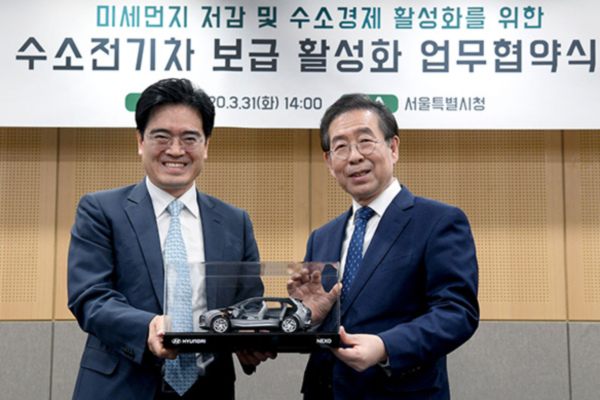
[Photo = Hyundai Motor Company]
Through this collaboration, Hyundai Motor accelerates the diversification of its hydrogen fuel cell system business and the revitalization of the hydrogen economy. The Seoul Metropolitan Government also expands the supply of hydrogen electric vehicles to improve the air environment, including the reduction of fine dust.
Cooperation will take place across the entire hydrogen industry ecosystem, including ▲expanding the production and distribution of hydrogen electric vehicles ▲expanding charging infrastructure such as hydrogen charging stations ▲measures to promote hydrogen electric vehicles ▲and expanding public awareness of hydrogen energy and hydrogen electric vehicles.
The Seoul Metropolitan Government plans to significantly raise its existing deployment targets for hydrogen electric vehicles and hydrogen charging stations. The previous targets were to deploy over 4,000 hydrogen electric vehicles and build more than 15 hydrogen charging stations by 2022.
Hyundai Motor and the Seoul Metropolitan Government agreed that the establishment of infrastructure, such as hydrogen charging stations, must be prioritized for the full-scale popularization of hydrogen electric vehicles, and decided to proceed with expanding charging infrastructure, including increasing the number of charging stations and securing sites.
The expansion of hydrogen electric vehicle adoption is taking place across the entire transportation sector. Hyundai Motor and the Seoul Metropolitan Government are promoting the expansion of production and distribution of passenger hydrogen electric vehicles, commercial hydrogen electric vehicles such as vans, buses, and trucks, and construction machinery equipped with hydrogen fuel cell systems such as forklifts and excavators.
The Seoul Metropolitan Government is taking steps to improve regulations, such as expanding purchase subsidies and tax incentives for passenger hydrogen electric vehicles and hydrogen electric buses. Hyundai Motor is also strengthening services, including maintenance and repair systems, to support the city in expanding the introduction of hydrogen electric vehicles and buses and ensuring stable operation and management.
We will also promote awareness and familiarity with hydrogen energy and hydrogen electric vehicles. We plan to operate hydrogen experience centers and hydrogen-related campaigns, as well as establish hydrogen pilot villages.
Comments
Related news

Domestic Technology Development for Key Green Vehicle Components Launches in Full Scale
The Ministry of Trade, Industry and Energy announced the market-autonomous 3rd generation xEV industry fostering project for developing key green vehicle components and will provide a total of 385.6 billion won through 2025. Aiming to accelerate the popularization of environmentally friendly vehicles such as electric vehicles, fuel cell vehicles, and plug-in hybrid vehicles, the project targets improving competitiveness of key components in the fields of energy storage and charging, driving and power conversion, air conditioning and thermal management, and hydrogen fuel cells.
2020.02.07by 최인영 기자
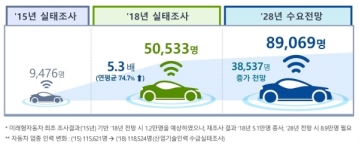
Future Automotive Industry Workforce Demand to Reach Approximately 89,000 by 2028
Industrial technology workforce engaged in future automotive industries such as electric vehicles, hydrogen vehicles, and autonomous vehicles reached a total of 50,533 as of the end of 2018, a 5.3-fold increase from 2015. According to the results of an industrial technology workforce survey conducted by the Ministry of Industry, participating companies are investing 22.9% of total sales in future automotive vehicles, and the autonomous vehicle sector is expected to show the highest annual average growth rate at 8.7%.
2020.03.11by 최인영 기자
ROHM's 'SiC Power Device' Installed in OBC for Chinese Electric Vehicles
Rohm's SiC MOSFET has been adopted in the on-board charger (OBC) for electric vehicles by UAES, a comprehensive automotive equipment Tier 1 supplier in China. Compared to existing products, the solution achieves 1% higher efficiency in unit terms and reduces power loss by approximately 20%. Rohm plans to design the OBC for UAES's automotive manufacturers in October.
2020.03.17by 최인영 기자

[e4ds Tech Day 2026 ⑨] Sim Sang-gyu, Autocrypt CTO: "In the Physical AI Era, Automotive Security Must Extend Beyond the Vehicle"
At e4ds Tech Day 2026, Sim Sang-gyu, CTO of Autocrypt, explained automotive cybersecurity strategies in the era of Physical AI and SDV (Software-Defined Vehicle). Automobiles are evolving as part of an ecosystem connected to AI, cloud, chargers, IoT, and robots, and he emphasized that the scope of security must expand beyond the vehicle interior to the entire connected environment. In particular, AI model tampering, adversarial attacks, OTA updates, and EV charger hacking were identified as major threats. He explained that response measures require zero trust, AI model integrity protection, intrusion detection, Security by Design and Default, and full lifecycle security management, and that proactive security system establishment beyond regulatory compliance is critical for securing future mobility competitiveness.
2026.10.12by 배종인 기자

Practical HIL Construction Strategy for Automotive and Off-Highway Controller Validation
As vehicle E/E architecture transitions to zonal structures and shifts to software-defined vehicles (SDV), the number of controllers (ECUs) requiring validation and software complexity are surging dramatically. Meanwhile, real vehicle testing cannot provide repeated verification under identical conditions and entails lead time and safety concerns. This white paper explains the principles of HIL (Hardware-in-the-Loop) validation and the structure of the NI platform composed of PXI, SLSC, and VeriStand, and through two actual implementation cases—Camera Record & Replay HIL for In-Cabin Monitoring Controller (ICMU) and Forklift Controller (VCU) HILS—describes how controller-level regression testing becomes possible. Additionally, it explicitly states application boundaries and limitations, such as lack of A2B support.
2026.10.12by 편집부











