


An AI semiconductor capable of 40 trillion calculations per second has been developed using domestic technology.
 Published2020.04.08 09:29
A total of 1.096 trillion won will be invested in the field over the next 10 years.
The foundation for technological independence in the AI semiconductor field has been laid.
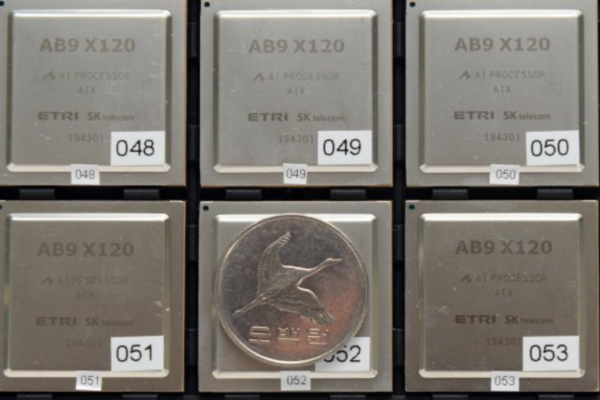
The Electronics and Telecommunications Research Institute (ETRI) and SK Telecom announced that they will develop an NPU-based AI semiconductor, 'AB9', through joint research and promote verification through application to AI infrastructure and products.
AI semiconductors are optimized for intelligent services such as complex situation recognition, learning, and inference by quickly processing large amounts of data with low power consumption.
Since 2016, the Ministry of Science and ICT has been promoting the development of AI semiconductor technology through national research and development, and as a result, ETRI and SKT have successfully developed the first AI semiconductor in Korea that can be used in high-performance servers.
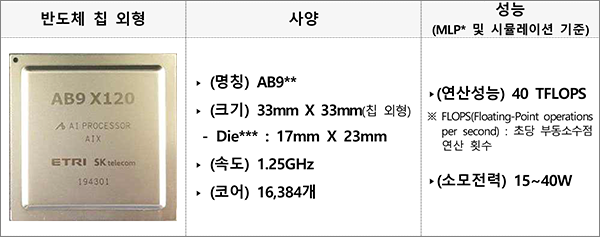
The research team integrated 16,384 cores into an area the size of a coin (17 mm x 23 mm) and applied software technology that can turn the power of each computing device on and off.
Through this, an AI semiconductor capable of processing data 40 trillion times per second (40TFLOPS) and consuming low power of 15 to 40W was developed.
Starting in the second half of this year, the research team plans to demonstrate the developed chip at SKT's data center and begin commercialization in earnest.
Visual intelligence AI semiconductors for mobile and IoT devices
A visual intelligence AI semiconductor that can recognize objects like humans and can be applied to intelligent CCTVs and drones was also developed in collaboration with ETRI, the Electronics and Telecommunications Research Institute (KETI), and fabless companies such as FA Linux, Nextchip, and AD Technology.
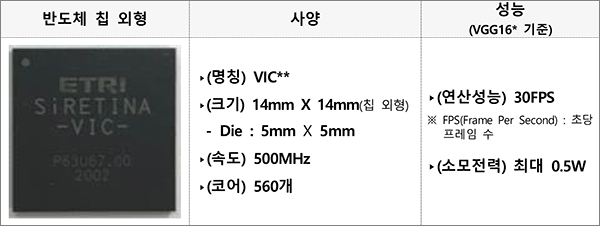
[Table = Ministry of Science and ICT]
The research team succeeded in developing a small chip that enables various mobile and IoT devices to recognize objects at a human level by applying high-efficiency design and software technology that achieves high accuracy even at low power.
Cut to half the size of an adult fingernail (5mm x 5mm)While minimizing the area, it has achieved performance capable of recognizing objects 30 times per second with 0.5W of power, which is less than 1/10 of that of existing semiconductors.
The research team plans to pursue verification and commercialization linked to the commercialization of AI-based intelligent devices in fields such as video surveillance and reconnaissance starting in the second half of this year.
Meanwhile, the Ministry of Science and ICT plans to support the revitalization of the domestic AI semiconductor ecosystem through technology transfer of research results and distribution of source software, and to support the international standardization of domestic technologies.
The Ministry of Science and ICT and the Ministry of Trade, Industry and Energy plan to invest a total of 1.096 trillion won in next-generation intelligent semiconductor technology development projects from this year to 2029.
Minister of Science and ICT Choi Ki-young said, “We will also support challenging research such as semiconductor technology that integrates memory and computation (Processing-In-Memory (PIM)).”
Comments
Related news
SKT Strengthens Support for Independent Corporations Based on Promising In-House Technologies
SK Telecom has signed a business agreement with Alpha Holdings to cooperate on technology commercialization and investment attraction, including AI semiconductors, for the separate commercialization of promising technologies it possesses. As their first collaboration, the two companies will proceed with investment and nurturing of Brighten, a laser optics technology specialist established through the Stargate Program.
2020.03.25by 이수민 기자
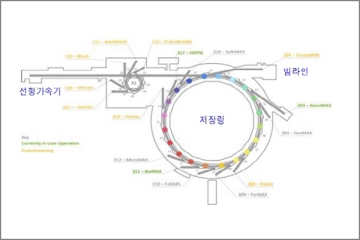
Promoting the construction of a new synchrotron accelerator to be used for semiconductor development, etc.
A project to build a multipurpose synchrotron radiation accelerator for use in advanced industries such as semiconductors, biotechnology, and energy will be promoted in earnest. The Ministry of Science and ICT announced a long-term roadmap and operational strategy for large-scale accelerators, and revealed plans to conduct a preliminary feasibility study this year for support in the localization of core fundamental technologies, with the aim to commence the project in 2022.
2020.03.26by 최인영 기자
The semiconductor materials market size decreased by 1.1% last year compared to the year before.
In 2019, the global semiconductor materials market size recorded $52.1 billion, down 1.1% compared to 2018. According to SEMI, the materials used in the front-end in 2019 decreased from $33.0 billion in 2018 to approximately $32.8 billion, while packaging materials declined 2.3% from $19.7 billion in 2018 to approximately $19.2 billion in 2019. Materials that increased in 2019 were found to be only substrates and other packaging materials.
2020.04.01by 이수민 기자
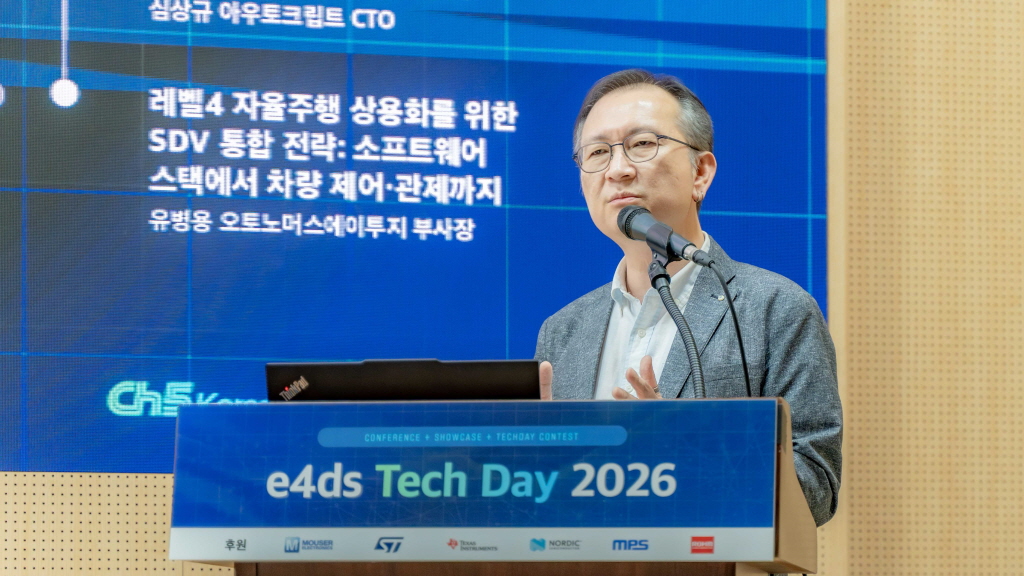
[e4ds Tech Day 2026 ⑨] Sim Sang-gyu, Autocrypt CTO: "In the Physical AI Era, Automotive Security Must Extend Beyond the Vehicle"
At e4ds Tech Day 2026, Sim Sang-gyu, CTO of Autocrypt, explained automotive cybersecurity strategies in the era of Physical AI and SDV (Software-Defined Vehicle). Automobiles are evolving as part of an ecosystem connected to AI, cloud, chargers, IoT, and robots, and he emphasized that the scope of security must expand beyond the vehicle interior to the entire connected environment. In particular, AI model tampering, adversarial attacks, OTA updates, and EV charger hacking were identified as major threats. He explained that response measures require zero trust, AI model integrity protection, intrusion detection, Security by Design and Default, and full lifecycle security management, and that proactive security system establishment beyond regulatory compliance is critical for securing future mobility competitiveness.
2026.10.12by 배종인 기자
NVIDIA to Invest $1 Billion in U.S. Science Over Next Five Years
NVIDIA has announced plans to invest $1 billion over the next five years to strengthen U.S. scientific and technological competitiveness. The company will enhance cutting-edge artificial intelligence research and development capabilities in key areas including quantum computing, healthcare, and energy security, while expanding support for higher education research institutions and cloud service providers. NVIDIA is participating as a major industry partner in the White House Office of Science and Technology Policy's Genesis Mission, and is promoting supercomputer construction in collaboration with national laboratories including Argonne and Los Alamos.
2026.10.12by 배종인 기자











