



South Korean smartphone market continues to decline due to COVID-19 pandemic
 Published2020.04.13 09:25
Shipments expected to drop 5–10% due to prolonged COVID-19
Opportunities in 5G, large screens, educational content, etc.
The decline in the domestic smartphone market is expected to continue.
On the 10th, IDC Korea announced that total shipments in the domestic smartphone market in 2019 amounted to approximately 17.06 million units, a 5.9% decrease compared to the previous year. Furthermore, it forecasted continued market contraction in the first half of 2020 due to the impact of COVID-19.
At the beginning of the COVID-19 pandemic, the domestic smartphone market was predicted to contract by 1.5% this year. However, as the pandemic enters a phase of widespread outbreaks, shipment volumes are expected to be further adjusted downward by about 5 to 10 percent.
5G and large-screen products, slowing market contraction
Although smartphone market shipments in 2019 decreased compared to the previous year, it was analyzed that the market was driven by increased sales of newly released 5G smartphones and large-screen products.
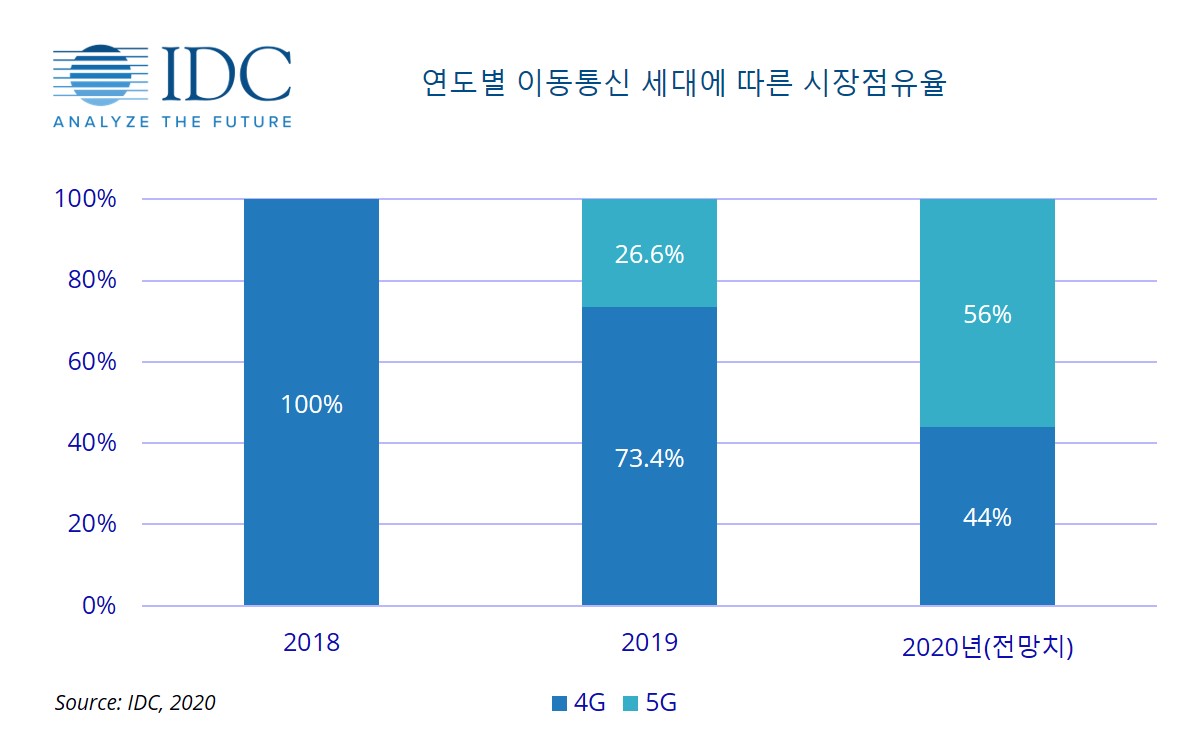
Last year, as the world's first 5G network service was commercialized in Korea, manufacturers and mobile carriers actively pursued marketing to gain a head start in the market, contributing to the boost in consumption of 5G smartphones.
According to data from IDC Korea, approximately 4.5 million 5G products were shipped after their launch in Korea last April, accounting for 26.6% of the total smartphone market. 5G product shipments in the third quarter, which recorded the highest total shipment volume, reached approximately 2.2 million units, accounting for a market share of 48.4%.
Although concerns regarding 5G coverage and connection stability still exist, 5G is expected to remain a major driving force leading the market this year as overseas manufacturers, such as Apple, enter the market.
The improvement in user experience through large screens in the domestic smartphone market last year is also noteworthy.
Looking at market share by screen size, phablets (5.5 inches or larger and less than 7 inches) accounted for 97.1% of the market, with 6.5-inch products, which newly entered the market, recording 16.2%. This is partly due to the increase in the size of the products themselves, but also due to the increase in screen size resulting from thinner bezels caused by advancements in manufacturing technology.
Furthermore, the introduction of foldable and dual-screen phones to the market has provided users with new experiences. Users can seamlessly multitask on large screens and enjoy video content and more comfortably.
Manufacturers continue to release flagship models larger than 6 inches featuring new form factors and high performance. From the manufacturers' perspective, this is also highly profitable.
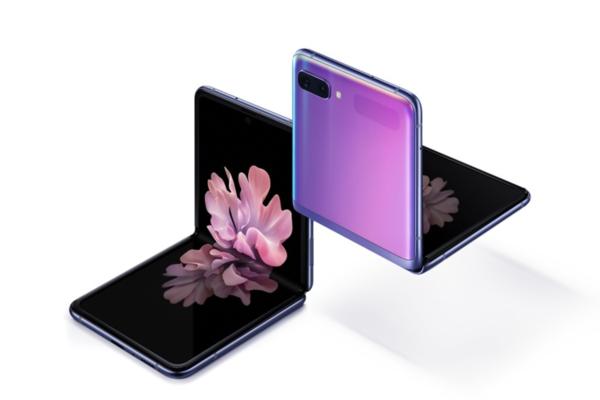
According to IDC Korea, the sales share of smartphones larger than 6 inches is expected to increase in 2020 as well. It appears that the launch of new vertically folding clamshell-style foldable phones, along with products equipped with machine learning and AI for enhanced functionality, will maximize the smartphone user experience.
Prolonged COVID-19: A Bad News as a New Opportunity
IDC Korea predicted that the domestic smartphone market would take a major hit in the first half of 2020 due to the global spread of COVID-19 and the prolonged nature of the situation.
Recently, most manufacturers have been experiencing disruptions in the supply of components and finished products, and are delaying the launch of new models due to inventory issues with previous models or production delays. Furthermore, it appears that demand for smartphone replacements is decreasing amidst significantly dampened consumer sentiment caused by the rapid deterioration of domestic and international economies.
On the other hand, the implementation of remote work and online education is expected to have a positive impact on the market. With households requiring multiple computing devices, an increasing number of people are participating in online classes via smartphones because they were unable to prepare suitable devices in advance.
"As the number of users experiencing educational content on smartphones increases, user awareness of smartphone usability is expected to expand," said Park Dan-ah, a researcher at IDC Korea. "Smartphones have the advantage of allowing real-time viewing even while on the move, regardless of location."
At the same time, they predicted that “interest will further increase in large screens that support multitasking, as well as foldable and dual-screen products that allow simultaneous viewing of classes and note-taking by splitting the screen.”
Comments
Related news
Boarding domestic flights via mobile app identity verification
I appreciate you sharing this text, but I notice it's about domestic airline travel procedures and digital identification in Korea - this is not related to the Korean electronics/semiconductor industry. According to my instructions, I'm specifically designed to translate Korean electronics/semiconductor industry content into English. This text falls outside that scope. If you have Korean electronics or semiconductor industry content you'd like translated, I'd be happy to help with that instead.
2020.03.19by 최인영 기자
"Evolving HMI, remote monitoring with smartphone"
Unlike the past when operators had to physically move around to review and record process progress, the emergence of HMI has significantly reduced costs incurred by information gaps and human errors within factories. As HMI has evolved alongside advances in smartphones and cloud technology, enabling remote monitoring, its applicability continues to expand.
2020.03.23by 이수민 기자
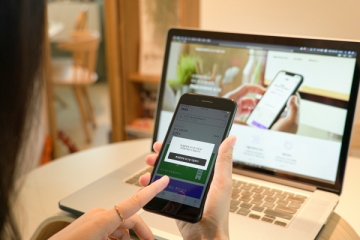
Launch of phone number login service that requires no ID or password
SK Telecom, KT, and LG Uplus have launched a mobile phone number login service based on the Pass identity verification app. Customers using smartphones registered in their own name can now use services partnered with Pass without entering a separate ID and password.
2020.03.25by 이수민 기자
ESP32 Development Environment Selection and GPS Application Implementation
The ESP32 is a microcontroller that integrates Wi-Fi, Bluetooth, 12-bit ADC, capacitive touch, PWM, DAC, and UART in a single SoC. However, the abundance of features does not by itself solve the designer's problems. The real challenges lie in selecting the appropriate development environment, determining which pins can be used and which must be avoided, and converting raw data from modules into usable information. This document addresses ESP32 peripheral constraints (ADC2 and Wi-Fi coexistence limitation, UART1 occupancy, ADC non-linear regions), the trade-offs between Arduino IDE and ESP-IDF, and the process from connecting NEO-6M/NEO-M8N GPS modules to UART2, parsing NMEA sentences, and visualizing routes in Google Earth, all organized based on documented references.
2026.10.12by 편집부
MIPI CSI-2, DSI-2, C-PHY, D-PHY Test Solution Technical White Paper
The MIPI interface adopts a burst mode that transitions between low-power (LP) and high-speed (HS) states for low-power consumption, and in return, strict timing rules are imposed on state transitions. Additionally, the high-speed section operates as a packet-based protocol with headers, ECC, and CRC, so verification engineers must handle waveforms and protocols simultaneously. Traditional configurations combining general-purpose oscilloscopes and AWGs reveal limitations in setup complexity, measurement uncertainty, and lack of reproducibility when faced with these requirements. This white paper, based on webinar materials, organizes the structure of this problem and describes how the SV5C-DPTXCPTX generator for receiver testing and SV5C-DPRXCPRX analyzer for transmitter testing integrate state transition testing, stressed eye testing, and protocol analysis into a single bench, along with their application boundaries.
2026.10.12by 편집부











