



KT Selected as Korea's First Public Sector Quantum Cryptography Network Operator
 Published2020.04.13 14:01
Used by researchers at public institutions that are key to security
Korean companies are laying the groundwork for entering the global quantum cryptography market.
KT has taken its first step toward building a public quantum cryptography network.
KT announced on the 13th that it had been selected as the operator of the quantum cryptography communication network for the 'Hyper-connected Intelligent Research and Development Network (KOREN)' commissioned by the National Information Society Agency (NIA).
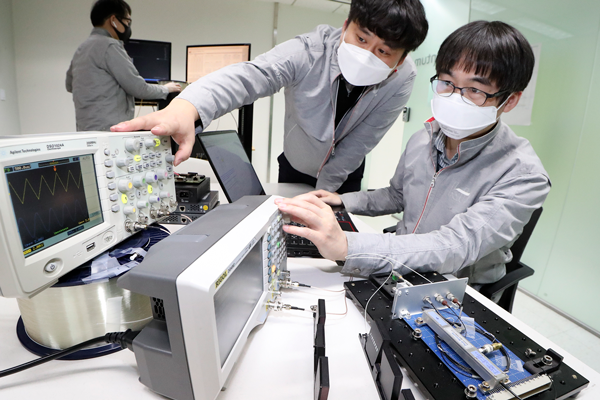
Quantum cryptography is a communication technology that transmits information using photons, which are quantum particles of light.
Quantums possess superposition, the ability to simultaneously hold both 0 and 1 information, and irreversibility, meaning that once measured, they cannot be restored to their original state. Applying this to communication allows data to be transmitted in an undetectable manner.
The quantum cryptography network being built by KT is the Seoul-Suwon section of the hyper-connected intelligent research and development network. This section will feature various devices, including quantum cryptography systems and encryption equipment, installed according to the International Telecommunication Union (ITU) Open Hierarchical Architecture (ITU-T Y.3800) standard.
The open hierarchical architecture standard was proposed by KT to the ITU in 2018 and was adopted as an official standard in October 2019. The main content is that the structure for building a quantum cryptography communication network is defined in an expanded form that allows domestic and foreign businesses to freely participate at various levels.
This quantum cryptography network is planned to be used by researchers at public institutions such as the government, finance, and defense, as well as local governments, to develop, test, and verify key ICT technologies, including networks.
Comments
Related news
Four ITU-T security standards proposed by Korea have been pre-adopted.
Four recommendations for intelligent vehicle security, quantum cryptographic communications, and smart grid, developed under Korea's leadership, have been pre-adopted as international standards at the ITU-T SG17 international conference. The first recommendation, the 'V2X Communication Environment Security Guideline (X.1372)' international standard, defines security technologies for vehicle communications, which form the foundation of autonomous vehicle services. The second recommendation, the 'Connected Car Security Threat Definition (X.1371)' international standard, defines use cases for providing intelligent vehicle security services and identifies and defines security threats that may occur in each use case. The third recommendation, the 'Quantum Noise Random Number Generator Architecture (X.1702)' international standard, defines a random number generation method that applies quantum technology from a security perspective for the first time in the world. The fourth recommendation, the 'Smart Metering Service Security Guideline (X.1332)' international standard, defines security measures for safely utilizing data collected from users' smart meters in smart grid environments.
2019.09.09by 이수민 기자
ETRI and the Three Major Mobile Carriers Push for International Standardization of Quantum Cryptography Transmission Systems
Quantum key distribution transmission systems are network security technologies that protect customer data transmission from hackers by combining quantum key distribution technology and optical transmission network technology based on SDN technology. Domestic telecommunications operators have been enhancing their technical capabilities for commercialization of quantum key distribution technology. However, to combine quantum key distribution systems and optical transmission systems composed of multiple units and commercialize them as universally applicable technology, international standardization work was necessary. Accordingly, ETRI held SDN/NFV forum and international standardization meetings on the 21st. Currently, ETRI and the three telecommunications operators are pursuing domestic proprietary standardization of quantum key distribution transmission systems to provide commercial quantum key distribution services, with plans to link with international standardization in the future.
2019.10.31by 이수민 기자
SKT's proposed quantum cryptography communication 'QKD' technology, approved by ITU-T
SK Telecom announced that a technical report on "Required Security Considerations for Networks Applying Quantum Key Distribution," which it proposed, was finalized as an international standard at the ITU-T conference held online from the 17th to 26th of last month. This standard is the first quantum key distribution (QKD)-related standard completed by SG17, a specialized research organization for communication security within ITU-T.
2020.04.02by 이수민 기자
.png)
Databricks Unveils Open AI Security Monitoring 'Lakewatch'
Databricks entered the security market on March 24 by unveiling LakeWatch, an open-source agentic SIEM. The core functionality of this product is to integrate and analyze security, IT, and business data in a single environment to support AI-based threat detection and investigation. The company explained that it reduces the limitations of existing security operations centers, which have had to forgo some data due to high cost structures, and enables large-scale data analysis and automation based on open formats and ecosystems. LakeWatch is currently offered as a private preview, with Adobe and Dropbox mentioned as early customers. Databricks also announced an expanded partnership with Anthropic as well as the acquisition of Antimatter and SiftD.ai.
2026.03.26by 배종인 기자
Kaspersky Unveils Revamped 'NEXT' Combining SOC Integrated Management and AI Analytics
As enterprises increase demand for integrated management and automation in the construction and operation of Security Operations Centers (SOC), Kaspersky has disclosed updates to its B2B security product suite 'Kaspersky Next'. This update expands EPP, EDR, XDR, and SIEM integration through a single console based on OSMP, incorporates AI capabilities such as DLL hijacking detection and suspicious account takeover behavior identification, and includes integration with generative AI assistant tool KIRA. The company stated that in large-scale deployment environments, EDR Expert can reduce resource requirements by up to 30%, and XDR Expert by up to 60%.
2026.03.25by 배종인 기자











