


We will train 480 master's and doctoral students in system semiconductors by 2025.
 Published2020.04.28 09:19
480 System Semiconductor Master's and Ph.D. Graduates by 2025
Approximately 48 billion won is scheduled to be invested from this year until the project concludes.
The Ministry of Science and ICT announced on the 28th that it has selected three consortia to participate in the system semiconductor convergence specialized workforce training project.
This project is designed to foster high-level design personnel by having a university collaborate with other universities, research institutes, and companies to implement a convergence education program in the system semiconductor field for its graduate students.
Following a call for proposals and evaluations conducted from February 10 to April 10, three consortia led by Seoul National University (AI semiconductor), Sungkyunkwan University (IoT semiconductor), and POSTECH (biomedical semiconductor) were selected as project implementing organizations out of a total of six applicant universities.
Each center will develop and operate customized educational curricula and courses for specialized fields, categorized into Semiconductor Basics, Semiconductor Advanced, Convergence Advanced, and PBL (Project Based Learning), based on a 4-semester master's program and a 6-semester doctoral program.
It fosters an understanding of high-level system semiconductor systems and practical capabilities through the completion of courses outside of one's major in basic and advanced programs, the development of industry-demand-based curricula, and the implementation of chip manufacturing projects, while also operating student support programs such as education and career counseling and startup mentoring.
Based on the recruitment of at least 20 master's students and 10 doctoral students in the fall semester of the first year of the project and in the spring semester starting from the second year, a total of 140 students, including 100 master's students and 40 doctoral students, will be produced over 6 years (4+2 years), and the project will receive government funding of approximately 9.6 billion won at a rate of 1.6 billion won per year.
"width: 600px; height: 664px;" />
The Seoul National University consortium, selected as the AI Semiconductor Workforce Training Center, plans to operate customized educational programs by establishing specialized fields for each participating university, taking into account the fact that AI semiconductors are utilized in various sectors such as autonomous vehicles, medical devices, and image processing.
The Sungkyunkwan University consortium, selected as the IoT semiconductor workforce training center, plans to focus on PBL education in seven fields subdivided by functional units such as sensors and signal processing, memory, security, and system applications, and to establish a cooperative cluster through linkages with local governments, companies, and research institutes in the Gyeonggi and Chungcheong regions.
The POSTECH consortium, selected as the Biomedical Semiconductor Human Resource Development Center, operates three majors including Biomedical Sensors and Devices, Biomedical Convergence Circuit Design, and Biomedical System Design, and has set a goal to generate research results such as 100 papers and 45 patents based on PBL.
The three centers plan to develop the curriculum, organize subjects and instructors, and recruit new students by August of this year, and start the semester in September to produce a total of 480 personnel, including 335 master's degree holders and 145 doctoral degree holders, by 2025.
Meanwhile, two more centers are scheduled to be selected next year.
Comments
Related news
In the 2019 semiconductor equipment market, Taiwan rose, while Korea fell.
Global semiconductor equipment sales in 2019 totaled $59.8 billion, representing approximately a 7% decline from $64.5 billion in 2018. Taiwan emerged as the largest market with $17.12 billion, recording approximately 68% growth compared to 2018, while China maintained its second-place position with $13.45 billion, up 3% year-over-year. Korea declined 44% to $9.97 billion, falling from the largest market position in 2018 to third place in 2019.
2020.04.16by 이수민 기자
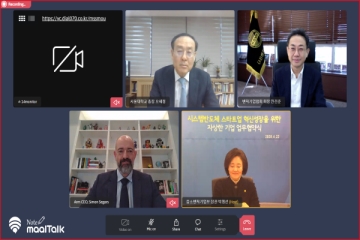
Ten Korean fabless companies will be granted free access to Arm IP.
The Ministry of SMEs and Startups and Arm have concluded a comprehensive business agreement to support the growth of domestic semiconductor startups and venture companies. Under the agreement, Arm will provide Arm Flexible Access to the Ministry of SMEs and Startups for the next three years, while the Ministry will select ten startups and venture companies annually and provide support for them to utilize Arm's IP for one year.
2020.04.22by 이수민 기자
Four Consortia Launch Full-Scale Developing Domestic AI Semiconductors
To secure AI semiconductor technological capabilities, the Ministry of Science and ICT selected 28 organizations to conduct new projects in the AI semiconductor design sector of the Next-Generation Intelligent Semiconductor Technology Development project in 2020. SK Telecom, Telechips, and NextChip will participate as consortium lead organizations in the server, mobile, and edge sectors respectively, and are expected to play roles including SoC fabrication and demonstration by integrating field-specific development results.
2020.04.24by 이수민 기자

[e4ds Tech Day 2026 ⑨] Sim Sang-gyu, Autocrypt CTO: "In the Physical AI Era, Automotive Security Must Extend Beyond the Vehicle"
At e4ds Tech Day 2026, Sim Sang-gyu, CTO of Autocrypt, explained automotive cybersecurity strategies in the era of Physical AI and SDV (Software-Defined Vehicle). Automobiles are evolving as part of an ecosystem connected to AI, cloud, chargers, IoT, and robots, and he emphasized that the scope of security must expand beyond the vehicle interior to the entire connected environment. In particular, AI model tampering, adversarial attacks, OTA updates, and EV charger hacking were identified as major threats. He explained that response measures require zero trust, AI model integrity protection, intrusion detection, Security by Design and Default, and full lifecycle security management, and that proactive security system establishment beyond regulatory compliance is critical for securing future mobility competitiveness.
2026.10.12by 배종인 기자
NVIDIA to Invest $1 Billion in U.S. Science Over Next Five Years
NVIDIA has announced plans to invest $1 billion over the next five years to strengthen U.S. scientific and technological competitiveness. The company will enhance cutting-edge artificial intelligence research and development capabilities in key areas including quantum computing, healthcare, and energy security, while expanding support for higher education research institutions and cloud service providers. NVIDIA is participating as a major industry partner in the White House Office of Science and Technology Policy's Genesis Mission, and is promoting supercomputer construction in collaboration with national laboratories including Argonne and Los Alamos.
2026.10.12by 배종인 기자











