


'Galaxy A Quantum' Unveiled, First to Equip Quantum Random Number Generation Chipset
 Published2020.05.15 08:34
Extract random numbers using quantum randomness
Extracted random number used as security service encryption key
Will quantum security features be added to the Galaxy Note?
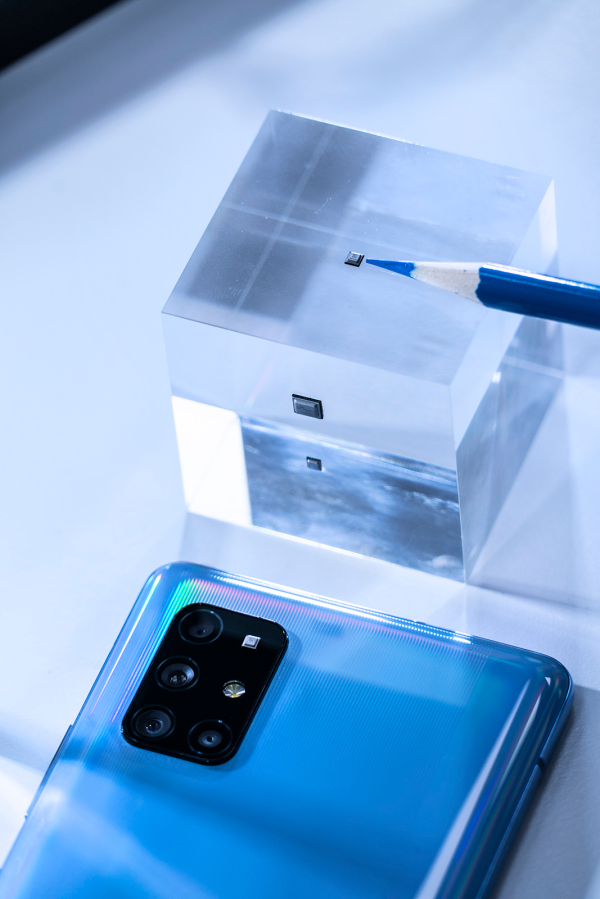
Testing a quantum random number generation chipset [Photo = SK Telecom]
On the 14th, SK Telecom unveiled the 'Galaxy A Quantum,' a 5G smartphone equipped with a quantum random number generation chipset, in collaboration with Samsung Electronics. Priced at 649,000 won, it will be officially launched on the 22nd following pre-orders from May 15 to 21. The Galaxy A series is a product line in which Samsung Electronics showcases technologies that will be applied to flagship models such as the Galaxy S series or Galaxy Note series.
The Galaxy A Quantum is equipped with a 2.5×2.5mm Quantum Random Number Generator (QRNG) chipset. Inside the quantum random number generation chipset, a CMOS image sensor detects light (photons) emitted by an LED light source, and extracts random numbers using the quantum randomness that 'the number of photons detected within a certain sensor area over a certain period of time is unpredictable.'
The extracted random numbers are used as encryption keys for T ID dual login, SK Pay biometric authentication protection, and the blockchain mobile electronic certification service 'Initial'. All services undergo encryption and decryption processes when storing or exchanging data, and encryption keys are essential for this process.
When logging in with a T ID on the Galaxy A Quantum, users undergo a dual security process of '1st ID login → 2nd Quantum OTP authentication.' Quantum security-based OTP (One-Time Password) authentication is added to the existing ID login, providing safer protection for the user's account.
When making payments at offline merchants such as convenience stores and restaurants using the SK Pay app, previously stored biometric authentication information (fingerprints) is used, and this process is also protected by quantum security. SK Telecom is currently developing the application of quantum security to online merchant app payments as well in the future.
Initial is a personal certificate storage service that prevents forgery and tampering using blockchain DID (Decentralized Identifier) technology. When Galaxy A Quantum users save various personal certificates to Initial, a 'Quantum Wallet' is automatically created, allowing them to store them securely.
Existing quantum security technologies have so far been primarily applied to communication networks and servers. An SK Telecom official stated that the company plans to expand the related ecosystem so that quantum security can be applied to more services in the future. The company intends to support technology development by sharing open APIs for developers on the SK Open API website. In addition, we plan to continuously expand quantum security-based services in various areas such as 5G networks, IoT, autonomous driving, and cloud.
Gregoire Ribordy, CEO of IDQ, explained, “Quantum random number generation chipsets are ultra-compact, low-power products optimized for smartphones,” adding, “The launch of the Galaxy A Quantum is significant as it marks the first application of quantum security technology to the mass market.”
Comments
Related news
KT Selected as Korea's First Public Sector Quantum Cryptography Network Operator
KT has been selected as the operator for the quantum cryptography communication network construction and operation project of the hyper-connected intelligent research and development network commissioned by the Korea Information Society Development Institute. The quantum cryptography communication network constructed by KT covers the Seoul-Suwon section of the hyper-connected intelligent research and development network. Various equipment such as quantum cryptography systems and encryption devices will be installed in this section according to the ITU open hierarchical structure (ITU-T Y.3800) standard.
2020.04.13by 이수민 기자
Quantum computing at high temperatures possible
Intel and QuTech have published a research paper in Nature demonstrating that qubits, the fundamental units of quantum computing, can be controlled at temperatures above 1 Kelvin. The research also verified that controlling two qubits through a single electron control device can be achieved while maintaining maximum fidelity of 99.3% for each qubit respectively.
2020.04.17by 이수민 기자
Successful 5G data transmission using domestically developed quantum cryptography technology
KT has successfully demonstrated encrypting and transmitting 5G data using quantum cryptography communication technology developed domestically. KT applied its proprietary quantum key distribution system and encryption equipment developed by a domestic small and medium-sized enterprise to the 5G network actually being used by customers in some regions of Gyeonggi Province, in accordance with open hierarchical international standards.
2020.05.11by 이수민 기자
ESP32 Development Environment Selection and GPS Application Implementation
The ESP32 is a microcontroller that integrates Wi-Fi, Bluetooth, 12-bit ADC, capacitive touch, PWM, DAC, and UART in a single SoC. However, the abundance of features does not by itself solve the designer's problems. The real challenges lie in selecting the appropriate development environment, determining which pins can be used and which must be avoided, and converting raw data from modules into usable information. This document addresses ESP32 peripheral constraints (ADC2 and Wi-Fi coexistence limitation, UART1 occupancy, ADC non-linear regions), the trade-offs between Arduino IDE and ESP-IDF, and the process from connecting NEO-6M/NEO-M8N GPS modules to UART2, parsing NMEA sentences, and visualizing routes in Google Earth, all organized based on documented references.
2026.10.12by 편집부
MIPI CSI-2, DSI-2, C-PHY, D-PHY Test Solution Technical White Paper
The MIPI interface adopts a burst mode that transitions between low-power (LP) and high-speed (HS) states for low-power consumption, and in return, strict timing rules are imposed on state transitions. Additionally, the high-speed section operates as a packet-based protocol with headers, ECC, and CRC, so verification engineers must handle waveforms and protocols simultaneously. Traditional configurations combining general-purpose oscilloscopes and AWGs reveal limitations in setup complexity, measurement uncertainty, and lack of reproducibility when faced with these requirements. This white paper, based on webinar materials, organizes the structure of this problem and describes how the SV5C-DPTXCPTX generator for receiver testing and SV5C-DPRXCPRX analyzer for transmitter testing integrate state transition testing, stressed eye testing, and protocol analysis into a single bench, along with their application boundaries.
2026.10.12by 편집부











