



"The Era of General Communication via Satellite Begins": KT SAT Launches Platform-Based Satellite Service Business
 Published2020.06.19 16:25
Research on satellite-5G interoperability technology underway... Demonstration planned for '21
With the advent of the New Space era, where private companies lead space development, the role and importance of satellite communication in providing seamless networks are growing.
.jpg)
Inspecting [Photo=KT]
On the 18th, KT SAT held a vision declaration ceremony at the KT SAT Geumsan Satellite Center, marking its 50th anniversary, and announced that it would leap forward as a platform-based comprehensive satellite service company.
◇ Next-generation satellite Mugunghwa Satellite 6A targeted for 2024 launch
At the proclamation ceremony, KT SAT announced plans for the Mugunghwa Satellite 6A. Mugunghwa Satellite 6, launched in 2010, has an expected lifespan of 15 years and is scheduled to reach the end of its service life in 2025. Satellite 6A is the successor to Satellite 6. It is scheduled to be launched as early as 2024.
KT SAT plans to apply High Throughput Satellite (HTS) technology, which has a data transmission throughput more than 10 times greater than existing satellites, to 6A, and is considering equipping it with Software Defined Sat (S/W Defined Sat) technology, which allows for coverage changes even after launch.
When equipped with variable beam technology, beam coverage can be changed even after launch, enabling the provision of communication services in accordance with changing customer requests. It is also possible to install a transponder that will function as an auxiliary satellite for the Korean Advanced Sensor System (KASS).
◇ Transition to a satellite-based platform operator
KT SAT, which has previously viewed satellite communication as a complement to terrestrial networks and focused on providing relay services, announced at the declaration ceremony that it would leap forward as a satellite-based platform operator providing services and solutions to the communication blind spots of the ocean and space.
KT SAT has achieved an average annual growth of 20% in the MVSAT (maritime satellite communication) sector and secured a market share of over 70% in the domestic merchant shipping market. Based on this, the company plans to launch an integrated maritime platform in the first half of 2021. Once the integrated platform is established, various solutions currently provided—such as ship internet, email, CCTV, and ship operation management—can be combined with MVSAT and implemented on a single server.
In addition, leveraging the characteristics of satellites, it is expanding into overseas countries where wired communication is difficult. In particular, it is providing broadcasting and telecommunications services in Southeast Asia, which has many islands. KT SAT plans to expand its influence to regions such as the Arab world and Mongolia in the future.
◇ Providing services to 5G-underserved areas and mobile devices via satellite
KT SAT is researching technology for integrating satellites and 5G. Last November, together with the KT Convergence Technology Institute, it successfully developed technology to integrate commercial 5G networks with satellite communication networks. On the 15th, it established a satellite environment-based testbed at the Geumsan Satellite Center in collaboration with the KT Convergence Technology Institute.
Starting in the second half of the year, KT SAT will conduct a Korea-EU joint research project at the Geumsan Satellite Center testbed. Through this, they will carry out a task to link satellites with 5G terminals and plan to demonstrate video transmission via satellite 5G at the French Open tennis event next May.
When satellite and 5G interworking technology is commercialized, the bandwidth of the 5G network will be expanded. As a result, it is expected that seamless 5G services will be provided via satellite in overseas regions where it is difficult to build terrestrial networks, as well as in mobile devices such as vehicles.
◇ Participation in national projects such as KASS and Korean GPS
KT SAT is participating in the 'Korea Augmentation Satellite System (KASS)' project promoted by the Ministry of Land, Infrastructure and Transport.
Once KASS is established, the current GPS error of 30m will be reduced to 1m, requiring two geostationary satellites and a ground station system. KT SAT is currently manufacturing one KASS main satellite. It is scheduled to be launched in the second half of 2021, and pilot services are set to begin in 2022.
In addition, KT SAT plans to participate in national projects such as the Korea Positioning System (KPS) and public multi-purpose communication satellites.
Comments
Related news
5G service continues to face persistent complaints, necessitating absolute quality assurance.
Domestic 5G service quality ranks high globally. However, this represents a relative advantage, not an absolute standard. If consumers cannot be provided with quality they can appreciate, dissatisfaction with 5G will turn into distrust. 5G must now find quality that satisfies consumers and establish a solid revenue model.
2020.06.02by 이수민 기자
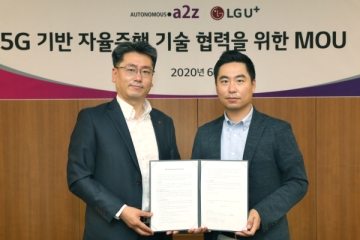
U+ Signs MOU with a2z for 5G-Based Autonomous Vehicle Demonstration
LG Uplus and Autonomous A2G are launching an autonomous driving service demonstration project together. The two companies have signed an MOU and agreed to establish detailed cooperation plans, including the formation and operation of a working-level consultative group. Under this agreement, LG Uplus will provide V2X technology support, while Autonomous A2G will supply the autonomous vehicle platform.
2020.06.14by 명세환 기자
.jpg)
TTA Finalizes Open 5G Fronthaul Interface Standard, Making 5G Equipment Development Easier
TTA has confirmed a draft standard for an open 5G fronthaul interface that was jointly proposed by SK Telecom, KT, LG U+, ETRI, and others at the 97th Information and Communications Standards Conference, establishing it as an official TTA standard. The standard addresses fronthaul specifications, which are wired network connections linking RU and DU components of 5G base stations, standardizing what had previously varied by manufacturer. With this standardization, small and medium-sized equipment manufacturers can now easily participate in the development of related equipment.
2020.06.17by 이수민 기자
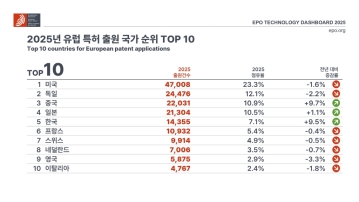
European Patent Applications Surpass 200,000 for the First Time… South Korea Maintains 5th Place, Led by Batteries and Telecommunications
According to the European Patent Office (EPO)'s 'Technology Dashboard 2025', European patent applications last year reached 201,974, surpassing 200,000 for the first time. Korean companies and inventors filed 14,355 applications, representing a 9.5% increase from the previous year and maintaining 5th place by country. Battery, digital communication, and semiconductor technologies led the growth, with Samsung ranking as the top EPO applicant for the second consecutive year and LG reaching 3rd place. The presence of major domestic cities such as Seoul, Suwon, and Yongin was also confirmed. It was also revealed that Korea's European patent strategy is expanding beyond individual technologies to span the entire industry.
2026.03.24by 명세환 기자

SK Telecom First Applies AI-Based Network Operations at Gwanghwamun K-Pop Concert
SK Telecom announced that it applied an AI-based network operation system for the first time at a large-scale K-pop concert held in the Gwanghwamun area of Seoul on March 21st, managing communication quality throughout the event. Mobile data usage during the three hours before and after the concert reached 12.15TB, approximately doubling compared to the same time slot the previous weekend. SK Telecom monitored traffic using the AI system 'A-One' in five-minute and 50-meter units to respond to potential overload situations, while also operating temporary communication facilities and on-site personnel in parallel. This case is interpreted as confirmation of the practical applicability of AI-based autonomous network operation in an environment where demand from dense events and foreign users increases simultaneously.
2026.03.23by 명세환 기자











