


Broadband Network Industry at a Crossroads Due to COVID-19
 Published2020.06.23 12:16
Downstream 50Mb/s, upstream speed 15Mb/s required
As countries around the world implemented lockdown measures to prevent the spread of COVID-19, fixed broadband networks took on the role of connecting the entire world.

Increased by 30~40% [Photo = Nokia Blog]
According to Nokia's survey on global network usage following COVID-19, worldwide network traffic increased by approximately 30–40% after lockdown measures. This is attributed to the increase in remote work, online education, and entertainment usage.
Comparing data from countries around the world before and immediately after lockdown measures, fixed broadband traffic increased by approximately 30–60%, fixed voice traffic increased by 50–130%, and calls using Wi-Fi increased by 70–80%.
While traffic has increased, it has been revealed that nearly one billion households worldwide remain excluded from fixed broadband connections. For households living cut off from the outside world without the internet amidst lockdown measures, access to potentially life-saving information is impossible. Furthermore, they are inevitably excluded from information regarding family health and education.
Given that COVID-19 will continue to have a lasting impact on global society until a vaccine is developed, there are calls for such marginalized households to be given priority consideration. However, simply connecting to the internet cannot be considered a proper measure.
According to an analysis using Nokia's bandwidth modeling tool, it was found that a minimum downstream speed of 50 Mb/s and a minimum upstream speed of 15 Mb/s must be maintained to comfortably work, study, and enjoy entertainment during lockdown measures. These figures represent the minimum level required for disconnected individuals to remain connected to society and online.
Nokia’s CTO Stefaan Vanhastel advised, “Telecom operators must now actively consider not only the transition to NG-PON FTTH technology to address the surge in upstream bandwidth, but also 100G aggregation links and terabit switching capacity.”
Comments
Related news
Nokia Unveils New Portfolio Strengthening 400G Ethernet
Nokia has announced its WaveFabric Elements portfolio, comprising photonic chips, devices, and subsystems, including PSE-V, its fifth-generation coherent DSP product line. Focused on end-to-end 400G applications, this portfolio combines digital signal processing equipment and optical technology to meet the unique technical requirements and cost considerations demanded by data centers, rail, long-haul, and submarine networks.
2020.06.01by 이수민 기자

SG-3061TIL board capable of remotely controlling equipment power supply launched
Systembased has launched the remote power control board SG-3061TIL. The SG-3061TIL is a device server module that enables connection and use of relay ports anytime and anywhere over a network. It provides six contact relay ports for controlling external devices, offering signal transmission and circuit switching functions.
2020.06.09by 강정규 기자
Optimizing 5G network equipment is made possible by drones and AI.
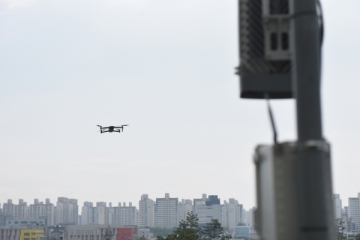
Samsung Electronics has unveiled a solution that optimizes 5G network performance by analyzing the installation status of base stations and antennas using drones and AI. The solution, which is scheduled for official launch by the end of this year, allows equipment installed at high altitudes such as on buildings to be easily inspected without safety concerns for workers.
2020.06.23by 명세환 기자
European Patent Applications Surpass 200,000 for the First Time… South Korea Maintains 5th Place, Led by Batteries and Telecommunications
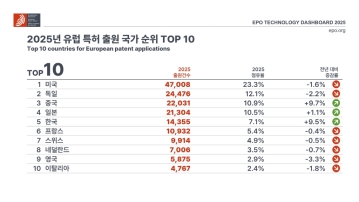
According to the European Patent Office (EPO)'s 'Technology Dashboard 2025', European patent applications last year reached 201,974, surpassing 200,000 for the first time. Korean companies and inventors filed 14,355 applications, representing a 9.5% increase from the previous year and maintaining 5th place by country. Battery, digital communication, and semiconductor technologies led the growth, with Samsung ranking as the top EPO applicant for the second consecutive year and LG reaching 3rd place. The presence of major domestic cities such as Seoul, Suwon, and Yongin was also confirmed. It was also revealed that Korea's European patent strategy is expanding beyond individual technologies to span the entire industry.
2026.03.24by 명세환 기자

SK Telecom First Applies AI-Based Network Operations at Gwanghwamun K-Pop Concert
SK Telecom announced that it applied an AI-based network operation system for the first time at a large-scale K-pop concert held in the Gwanghwamun area of Seoul on March 21st, managing communication quality throughout the event. Mobile data usage during the three hours before and after the concert reached 12.15TB, approximately doubling compared to the same time slot the previous weekend. SK Telecom monitored traffic using the AI system 'A-One' in five-minute and 50-meter units to respond to potential overload situations, while also operating temporary communication facilities and on-site personnel in parallel. This case is interpreted as confirmation of the practical applicability of AI-based autonomous network operation in an environment where demand from dense events and foreign users increases simultaneously.
2026.03.23by 명세환 기자











