



The government is accelerating the digital transformation amid the spread of contactless culture due to COVID-19.
 Published2020.06.23 16:41
300 types of electronic certificates that can be issued by the end of 2021
The Government Integrated Data Analysis Center will be established by the end of this year.
Starting next year, all government service processes, including identity verification, application, payment, and confirmation of processing results, will be available via smartphone.
On the 23rd, the Ministry of the Interior and Safety jointly reported to relevant ministries the "Post-COVID-19 Digital Government Innovation and Development Plan." The plan's key elements include: expanding non-face-to-face services, innovating customized services, leveraging data and public-private cooperation, and expanding digital infrastructure.
This plan is an evolution of the "Digital Government Innovation Promotion Plan" announced in October of last year, taking into account the widespread adoption of a non-face-to-face culture across society due to COVID-19.
Strengthening non-face-to-face services, including mobile ID cards
First, we will accelerate the introduction of mobile ID cards to expand non-face-to-face services. The pilot introduction of mobile civil servant ID cards will be implemented this year, and the introduction of mobile driver's licenses, which were originally planned for the year after next, will be brought forward to next year.
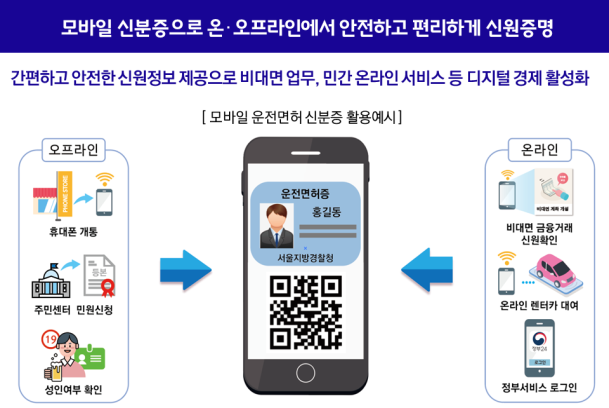
The "Mobile Driver's License Verification Service" via the "PASS" app provided by the three major mobile carriers and the National Police Agency will be available starting on the 24th. This service differs somewhat from the mobile driver's license in its effectiveness, as its use is restricted.
The MyData service, which allows users to search and download personal information held by public institutions and easily send it directly to government offices or banks, will also be introduced this year.
Since February, 13 types of documents, including resident registration copies, driver's licenses, and military service certificates, can be issued as electronic certificates. This number is expected to increase to 100 types by the end of this year and 300 types by the end of next year.
We will transition to a blended online and offline education model, including installing Wi-Fi in elementary, middle, and high school classrooms and expanding the availability of online textbooks. Civil service training will also be expanded to include non-face-to-face training, including video conferencing and partnerships with the private sector. This year, some of the industrial technician exams will be conducted online (CBT), and next year, the entire exam will be expanded.
◇ Personalized service overhaul
People who use the "National Secretary" feature, which will be introduced this year, will receive notifications about health checkups, national scholarship applications, civil defense training, and tax payments, and can also apply or pay through messenger chatbots or AI speakers.
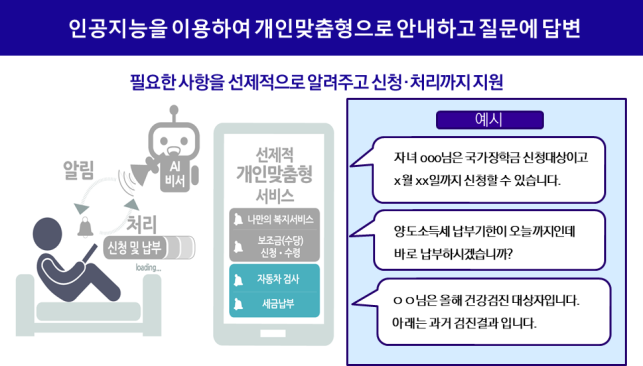
This year, we will be displaying various subsidies provided by central government ministries in a single location, ‘Government 24’, so that individuals can check and apply for all the benefits they can receive. Next year, we will expand to services provided by local governments, and the year after that, we will also expand to services provided by public institutions and private organizations.
So far, there are three types of customized services for each life cycle: childbirth, inheritance, and moving in. However, by the end of this year, pregnancy, care, and veterans' benefits will be added, increasing the number to six, and by the year after next, it will expand to 11.
We will also establish a government-wide integrated call center to resolve civil complaints with a single call. The information provided by the complainant to the counselor is shared between agencies, so even if the call is transferred to another agency depending on the jurisdiction, it does not need to be repeated.
Starting with the integration of 11 central government call centers next year, a total of 156 call centers will be integrated, including those of local governments and public institutions.
◇ Expanding and opening data with a focus on utilization.
The government will improve the entire process of data disclosure and utilization from a user perspective and lay the foundation for the creation of new industries such as autonomous driving and healthcare. Following the enactment of the Data-Based Administrative Act last May, the government will establish an integrated government data analysis center by the end of this year to jointly utilize data across the government to address pressing social issues.
Additionally, the government will open its services to the private sector, allowing citizens to apply for government services, such as access to public facilities or addressing inconveniences in their daily lives, through private apps. By migrating public sector information resources to private or public clouds, security will be improved, costs will be reduced, and emergency response capabilities will be enhanced.
◇ Expanding digital infrastructure in the public sector
IoT-based forecasting and warning systems will be installed in areas such as steep slopes to prevent damage from disasters. Government networks will be converted from wired to 5G wireless networks to support rapid processing and field-centered administration. We are building an integrated security control system utilizing AI technology to proactively respond to cyber threats.
To ensure that all citizens can enjoy government services, Wi-Fi will be installed in approximately 40,000 public spaces, including libraries, by 2022. For those who have difficulty using the internet or smartphones, educational courses will be held at local welfare centers and community centers on topics such as how to reserve train tickets using smartphones.
To ensure that all public servants participate in digital government innovation and actively engage in digital transformation, we will revise the civil service training curriculum and expand the training of public sector experts in emerging technologies such as AI and data analysis.
Minister of the Interior and Safety Jin Young said, “We will work with relevant ministries to expedite digital government innovation to make people’s lives more convenient, including by expanding non-face-to-face services and innovating customized services.”
Comments
Related news

KETI Hosts Online Matchmaking Event for "Technology Transfer Untact"
KETI will hold the 38th Digital Technology Innovation Matchmaking event on the 15th. This event is the first online technology transfer briefing session attempted by a public research institute in response to the recent increase in non-contact necessity, and was organized around strategic patent technologies that KETI filed in 2019.
2020.05.12by 이수민 기자

"Platform to be Established for Providing Personal Information and Receiving Compensation": Ministry of Science and ICT Selects 8 MyData Demonstration Projects
The Ministry of Science and ICT, which has been promoting the MyData business since last year to establish a personal data utilization system centered on data subjects, has selected 8 MyData pilot service projects across 6 sectors including healthcare, finance, and public services. Through this project implementation, the Ministry of Science and ICT plans to strengthen individuals' information decision-making rights and create an open MyData ecosystem where any interested companies can participate.
2020.06.12by 이수민 기자

KDHC and LH Selected for This Year's Asia-Pacific Smart City Project
IDC selected a total of 19 outstanding smart city projects as this year's winners at the 6th Smart City Asia Pacific Awards (SCAPA). Domestically, Korea District Heating Corporation's IoT-based thermal transmission pipeline monitoring and management system and Korea Land & Housing Corporation's platform-based crime safety city service were each selected in the Smart Water category and the Public Safety category, respectively.
2020.06.13by 이수민 기자
.png)
Databricks Unveils Open AI Security Monitoring 'Lakewatch'
Databricks entered the security market on March 24 by unveiling LakeWatch, an open-source agentic SIEM. The core functionality of this product is to integrate and analyze security, IT, and business data in a single environment to support AI-based threat detection and investigation. The company explained that it reduces the limitations of existing security operations centers, which have had to forgo some data due to high cost structures, and enables large-scale data analysis and automation based on open formats and ecosystems. LakeWatch is currently offered as a private preview, with Adobe and Dropbox mentioned as early customers. Databricks also announced an expanded partnership with Anthropic as well as the acquisition of Antimatter and SiftD.ai.
2026.03.26by 배종인 기자

Kaspersky Unveils Revamped 'NEXT' Combining SOC Integrated Management and AI Analytics
As enterprises increase demand for integrated management and automation in the construction and operation of Security Operations Centers (SOC), Kaspersky has disclosed updates to its B2B security product suite 'Kaspersky Next'. This update expands EPP, EDR, XDR, and SIEM integration through a single console based on OSMP, incorporates AI capabilities such as DLL hijacking detection and suspicious account takeover behavior identification, and includes integration with generative AI assistant tool KIRA. The company stated that in large-scale deployment environments, EDR Expert can reduce resource requirements by up to 30%, and XDR Expert by up to 60%.
2026.03.25by 배종인 기자











