



What IoT Devices Need to Prepare for the Post-Corona Era
 Published2020.06.30 17:51
Data protection requires security integration from the design stage.
Consider a future-proof, cloud-based framework
As of July 1, the start of the second half of 2020, the cumulative number of confirmed COVID-19 cases worldwide exceeded 10 million. The cumulative death toll has surpassed 500,000.
To prevent the spread of COVID-19, governments around the world are implementing social distancing campaigns to minimize face-to-face interactions. Some companies are canceling scheduled events and encouraging employees to work from home or remotely.
Kwon Jun-wook, Deputy Director of the Korea Centers for Disease Control and Prevention, said in April, "The world before COVID-19 will never return." Even if the situation subsides, the threat of infectious disease spread will never disappear, just as SARS was followed by MERS, and MERS followed by COVID-19.
In these circumstances, a growing number of companies are adopting IoT technologies in their businesses to minimize economic losses and prepare for the post-COVID-19 era. This incident has made it clear to the world that non-face-to-face and remote-based IoT devices will continue to be necessary as long as humanity exists.

So, what should engineers consider when developing effective IoT devices? In its white paper, "Ensuring IoT Success: The 7 Most Critical Decisions," Arm outlines seven key factors engineers should consider when developing IoT devices.
In this article, we will look at the remaining six elements, following the first element, ' Hardware and Software Options '.
Connecting and managing IoT devices
There are many ways to connect your devices to a network, including cellular, satellite, Wi-Fi, Bluetooth, RFID, NFC, LPWAN, and Ethernet.
When a device needs to transmit large amounts of data over long distances, it requires significant power. In such cases, it's best to use cellular communications when a base station is available, or satellites when one isn't. For relatively small data transmissions over long distances, LPWAN can save energy and extend battery life.
To transfer large amounts of data over short distances, you can minimize power consumption by choosing a wireless connection such as Bluetooth, Wi-Fi, or Ethernet. All three methods have lower power consumption and higher bandwidth than mobile or satellite communications.
Transmitting data over a network can be expensive. Many IoT applications collect massive amounts of data, but only a portion of it is of interest. In these cases, local algorithms can limit the data transmitted, reducing costly energy and data consumption. Instead of transmitting the massive amount of data to be processed over a network, you can choose to process it on the gateway or on the device itself.
To transmit data, a device must first be connected to a network. IoT devices can be located in numerous environments, utilizing a variety of protocols across multiple domains. Maintaining connectivity under these conditions requires support for a variety of communication technologies and protocols.
Developers should consider an IoT device management platform that can manage the connectivity of all devices regardless of location or network. Persistent connectivity across all major protocols and domain boundaries ensures continuous data access while reducing costs.
Solutions that enable IoT devices to be deployed, discover networks, authenticate themselves, automatically provision, and connect to the lowest-cost channel reduce time to market, cost, and complexity, while also enabling additional scalability.
Achieving System-Level IoT Security
Cyberattacks exploiting vulnerable IoT devices are a threat.
The 2016 Mirai botnet attack exploited insecure IoT devices by scanning the internet for open ports and logging in with default passwords. As a result, the botnet launched a distributed denial-of-service (DDoS) attack, rendering many internet services inaccessible.
Mirai was possible because of the lax security of IoT devices. Defending against potential hacks requires a system-wide approach that protects both physical devices and networks.
IoT device developers must take all necessary measures to protect their devices, the networks they connect to, and the data they share. IoT security must be planned for from the initial design stage and integrated into every stage of the development, deployment, and management process.
Data extraction and integration
Many organizations simply collect data without planning or purpose. To go beyond simply creating consumer profiles and detecting anomalies, companies must fully understand the value of IoT-generated data.
The key to effective data management is easy access and seamless integration. Companies must be able to identify new opportunities from their data, improve business efficiency, and gain insights that enable rapid, critical decision-making.
Applications must be developed to collect and integrate diverse data sets from various devices, enterprise data, and external data sources. Furthermore, these must be connected to an expanded data integration system.
Furthermore, data must be protected using appropriate levels of encryption, regardless of whether it is stored or in transit. Access to data must be controlled and monitored using identity and access management solutions. Additionally, the platform must be fully redundant through ISO/IEC certification.
A data management platform that can integrate and transform massive amounts of disparate and siloed data from all sources (IoT devices, CRM, e-commerce systems, external data) can reduce complexity while providing meaningful, actionable insights.
Building an IoT infrastructure with expansion in mind
Many companies are struggling to fully embrace the digital transformation necessary to fully leverage the benefits of IoT at scale. Remotely managing application updates, deploying security patches, and operating and maintaining thousands of devices requires a plan that involves all relevant departments and functional groups.
Ensuring the long lifespan and high usability of IoT devices requires first implementing the right hardware and software. To achieve true scalability, a holistic approach is necessary. Planning and implementing ongoing support measures for local networks to proactively prevent issues arising from multiple devices deployed across different locations will help ensure geographic scalability.
Designing an infrastructure that can scale to meet increasing processing capacity will help ensure project success. This requires building a support framework that includes scalable cloud-based services. It's also important to consider how manual processes will increase as the solution scales and how automation can help reduce manual intervention.
Building a network requires a flexible and scalable design. Scalability must be a top priority, ensuring everything is considered upfront, from the type of device and network design best suited for a specific use case to ensuring the right engineering resources are available.
As more IoT devices are added, data and computing resources increase. Considering this early in the IoT infrastructure design will ensure successful system scaling when needed. For highly scalable infrastructure, consider edge computing, where computing tasks are performed at the periphery or internet gateways, rather than in a central cluster of servers or cloud services. This allows for more data to be processed at the edge, utilizing abundant computing resources.
Cloud vs. On-Premises? Cloud & On-Premises!
Some companies prefer the cloud for hosting their IoT solutions, while others prefer on-premise solutions. Both have their pros and cons.
Leveraging the cloud allows you to move some functions closer to the customer's edge network, providing the compute, storage, and network resources necessary for a robust architecture for successful IoT deployments. The cloud offers virtually unlimited scalability.
On the other hand, organizations and businesses that are concerned about the risk of sensitive data being exposed when migrating existing systems to the cloud prefer on-premise IoT solutions.
For critical data in existing systems, consider an on-premises solution that provides management and monitoring capabilities within the firewall. However, this requires a significant initial investment. Because you need to manage your own data centers and ensure continuous availability while maintaining a lot of control features and a high level of security.
The choice between an on-premises or cloud-based solution fundamentally boils down to a risk/cost analysis that considers the importance of your business, data characteristics, scalability, and availability. When evaluating IoT solution partners, it's important to select one that can support both solutions.
Partners with a solid partner ecosystem
The IoT market is rapidly growing. New products, software, and technologies emerge daily. Industry standards and government regulations are constantly changing. Therefore, a partner is needed who can navigate this rapidly evolving landscape and deliver flexible, functional, and scalable IoT solutions quickly, cost-effectively, and with minimal risk.
You need to find suppliers with access to a wide ecosystem of industry-wide partners and collaborate with them to facilitate IoT software development and device lifecycle management with a variety of solutions that meet your needs.
This ecosystem should prioritize ensuring global interoperability with other technologies within the system, improving communication, and providing effective security options. A proven ecosystem is flexible and flexible, helping build future-proof IoT solutions.
The more preparatory work done, the greater the likelihood of success for an IoT project. Therefore, companies should take the time to develop a comprehensive plan that identifies and documents the specific requirements for their product.
Comments
Related news

"The importance and value of IoT security solutions will increase further"
Many companies are viewing the adoption of IoT technology as the starting point for digital transformation. However, IoT devices are connected to networks, which creates the possibility that anonymous attackers could steal control authority and misuse corporate assets. IoT security has now become a critical consideration that must be addressed during the development of related applications.
2020.06.05by 이수민 기자

IoT product security certification process to be simplified and improved.
The Ministry of Science and ICT convened an IoT Security Certification System Improvement Research Group on May 29th and held its first meeting to improve and activate the IoT security certification system. The research group discussed development measures for the IoT security certification system through review of domestic and international trends in systems and standardization, examination of improvements such as the scope of IoT devices, certification targets, and classification types, linkage with domestic and international mutual recognition and standardization, and activation measures including mandatory certification requirements.
2020.06.01by 이수민 기자

KDHC and LH Selected for This Year's Asia-Pacific Smart City Project
IDC selected a total of 19 outstanding smart city projects as this year's winners at the 6th Smart City Asia Pacific Awards (SCAPA). Domestically, Korea District Heating Corporation's IoT-based thermal transmission pipeline monitoring and management system and Korea Land & Housing Corporation's platform-based crime safety city service were each selected in the Smart Water category and the Public Safety category, respectively.
2020.06.13by 이수민 기자
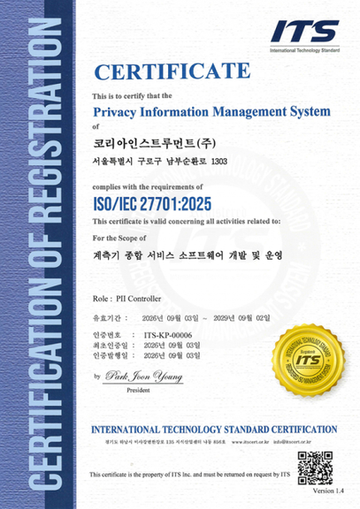
Korea Instrument, KOLAS Accredited Calibration Agency First to Simultaneously Acquire ISO/IEC 27,001·27,701
Korea Instrument has become the first among KOLAS accredited calibration agencies to simultaneously acquire ISO/IEC 27,001 and ISO/IEC 27,701 certifications. Through its proprietary platforms CWIZ Enterprise and CWIZ Partners, the company has embedded information security and personal data protection requirements across all business processes including customer information, equipment data, and calibration reports, with plans to continuously advance its management system through regular audits and security inspections.
2026.10.12by 배종인 기자

TeamViewer One, IT Incident Automation Workflow and Resolution Center Enhanced
TeamViewer has added IT incident automation capabilities and an advanced Resolution Center to its integrated digital workplace management platform 'TeamViewer ONE'. Recurrent service disruptions, configuration errors, and capacity shortages are automatically handled according to preset policies, and device status verification through script deployment can be managed in a unified interface, significantly reducing repetitive tasks for IT teams.
2026.10.12by 배종인 기자











