


Arm Unveils Mali DDK to Expand In-Vehicle Display Capabilities
 Published2020.07.06 12:26
Cockpit domain controller enables in-vehicle graphics implementation
Demand for in-vehicle displays is growing as many consumers want smartphone-like experiences in their vehicles. As a result, the possibility of running advanced applications on in-vehicle displays is increasing in the future.
Arm, which has technological prowess in digital cockpit solutions and smartphones, unveiled a new version of the 'Arm Mali DDK (Driver Development Kit)' on the 6th to enhance the driver experience of next-generation vehicles.
Mali DDK works with GPU products belonging to the Valhall and Bifrost architecture GPU families. Based on GPU capabilities, DDK enables APIs such as OpenGL® ES 1.1, 2.0, 3.2, Vulkan® 1.1, OpenCL™ 1.1, 2.0 full profile, and Renderscript (Android only).
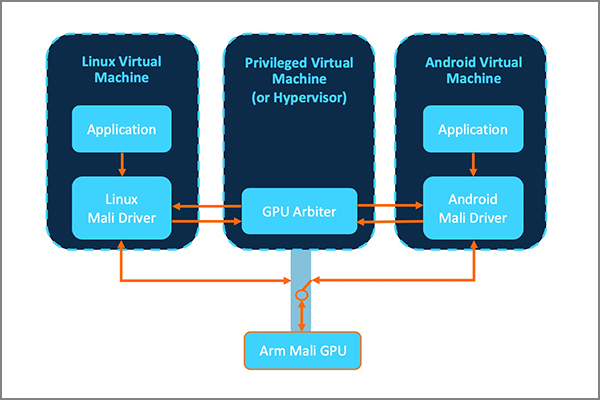
Here, Arm has added new virtualization support, allowing GPU resources to be shared between multiple applications running different virtual machines.
Mali DDK virtualization is designed to be completely invisible to applications, running entirely within the driver and system software, with no need for developers to modify their applications to support it.
This enables in-vehicle graphics to be implemented in the cockpit domain controller, which allows multiple electronic control units (ECUs) to be integrated into a single ECU or single SoC.
In the past, a single ECU might perform one function, such as a digital instrument cluster displaying speed and warning lights to the driver, but now cockpit domain controllers can perform multiple functions by flexibly allocating resources to multiple workloads on a single SoC.
For example, a single SoC using the Mali DDK can allocate compute resources to the instrument cluster, IVI, and navigation systems rather than requiring one SoC or ECU per application.
Mali DDK supports Linux and Android. Virtualization capabilities can be used across multiple OSs and hypervisors, ensuring a smooth user experience, such as fast touchscreen response times, in virtualized systems.

Comments
Related news
U+ Signs MOU with a2z for 5G-Based Autonomous Vehicle Demonstration
LG Uplus and Autonomous A2G are launching an autonomous driving service demonstration project together. The two companies have signed an MOU and agreed to establish detailed cooperation plans, including the formation and operation of a working-level consultative group. Under this agreement, LG Uplus will provide V2X technology support, while Autonomous A2G will supply the autonomous vehicle platform.
2020.06.14by 명세환 기자
Microchip Announces Two Automotive Ultra-Small Touch Controllers
Microchip announced the MXT288UD-AM and MXT144UD-AM touch controllers. The two devices provide low-power mode, weather-resistant operation, and gloved touch detection capabilities for multifunctional displays, touch pads, and smart surfaces used in various mobility applications.
2020.06.30by 명세환 기자
Byco Joins GSA, Focusing on Development of Automotive Power Modules
Baico has become a member of the Global Semiconductor Alliance (GSA). The GSA is an alliance dedicated to building an efficient, profitable, and sustainable global ecosystem of semiconductors and advanced technologies encompassing semiconductors, software, solutions, systems, and services. Baico plans to participate in the GSA Automotive Interest Group and focus its efforts on developing compact, lightweight, and integrated power modules required in the emerging vehicle electrification sector.
2020.07.03by 이수민 기자
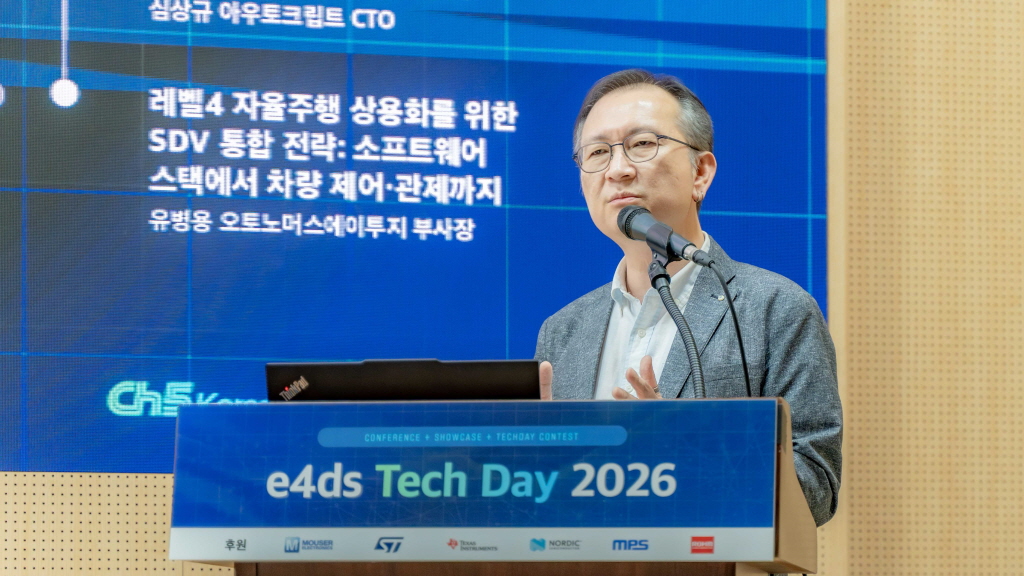
[e4ds Tech Day 2026 ⑨] Sim Sang-gyu, Autocrypt CTO: "In the Physical AI Era, Automotive Security Must Extend Beyond the Vehicle"
At e4ds Tech Day 2026, Sim Sang-gyu, CTO of Autocrypt, explained automotive cybersecurity strategies in the era of Physical AI and SDV (Software-Defined Vehicle). Automobiles are evolving as part of an ecosystem connected to AI, cloud, chargers, IoT, and robots, and he emphasized that the scope of security must expand beyond the vehicle interior to the entire connected environment. In particular, AI model tampering, adversarial attacks, OTA updates, and EV charger hacking were identified as major threats. He explained that response measures require zero trust, AI model integrity protection, intrusion detection, Security by Design and Default, and full lifecycle security management, and that proactive security system establishment beyond regulatory compliance is critical for securing future mobility competitiveness.
2026.10.12by 배종인 기자

Practical HIL Construction Strategy for Automotive and Off-Highway Controller Validation
As vehicle E/E architecture transitions to zonal structures and shifts to software-defined vehicles (SDV), the number of controllers (ECUs) requiring validation and software complexity are surging dramatically. Meanwhile, real vehicle testing cannot provide repeated verification under identical conditions and entails lead time and safety concerns. This white paper explains the principles of HIL (Hardware-in-the-Loop) validation and the structure of the NI platform composed of PXI, SLSC, and VeriStand, and through two actual implementation cases—Camera Record & Replay HIL for In-Cabin Monitoring Controller (ICMU) and Forklift Controller (VCU) HILS—describes how controller-level regression testing becomes possible. Additionally, it explicitly states application boundaries and limitations, such as lack of A2B support.
2026.10.12by 편집부











