


They say the 28GHz band 5G mobile phone launch period will be shortened... "Will it be effective?"
 Published2020.07.14 15:33
US 28GHz 5G service achieves only 0.5% connection time
Expanding existing 3.5GHz 5G infrastructure is more important.
Before the launch of 5G mobile phones using the millimeter wave (mmWave) band (28GHz), the electromagnetic wave measurement time will be shortened to the level of LTE mobile phones.
The National Radio Research Agency announced on the 14th that it will shorten the time required for electromagnetic wave measurements, which are essential for launching 5G mobile phones, to the level of LTE.
Accordingly, the launch of new 28GHz and 3.5GHz 5G mobile phones is expected to accelerate.
Before mobile phones can be released, they must be tested for electromagnetic radiation exposure to ensure compliance with EMF human protection standards. Unlike LTE, 5G uses multiple antennas and multiple beams, making certification testing time-consuming.
Therefore, rather than measuring all scenarios, measurement guidelines have been developed to protect the human body and simplify measurement by identifying and measuring conditions where electromagnetic waves are at their peak. Applying these improved guidelines is expected to shorten measurement times for 28 GHz 5G mobile phones to around 40 days, similar to LTE, and consequently reduce costs.
The measurement time for the already simplified 3.5GHz 5G mobile phone will also be shortened from two weeks to one week. 3.5GHz 5G phones take a long time to measure for similar reasons to 28GHz phones, but the first simplification was already carried out in March of last year.
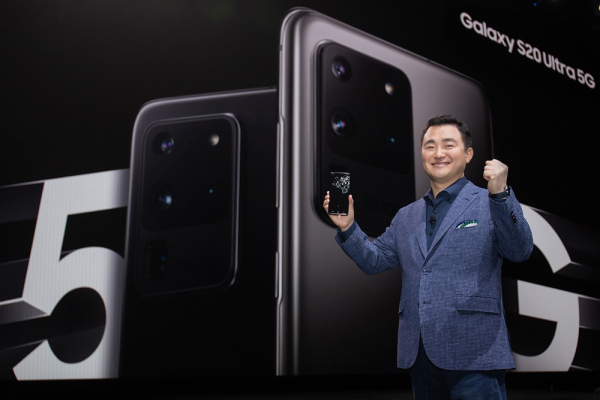
It was equipped. The photo is Samsung Electronics President Roh Tae-moon [Photo = Samsung Electronics]
The National Radio Research Agency stated, “We expect that with these measurement guidelines, the 28GHz 5G mobile phone scheduled to be released in the second half of this year will be commercialized without a hitch.”
However, the 28GHz 5G phones that will benefit from this simplification are unlikely to be available until at least this year, as the 28GHz infrastructure has not yet been built.
“The 28GHz 5G equipment and service ecosystem has not yet been established,” SK Telecom CFO Yoon Poong-young said during the first-quarter earnings conference call.
Samsung and LG added 28GHz 5G modules only to their 5G phones sold in the US market because the relevant infrastructure isn't built outside the US. However, the situation in the US is also challenging.
Verizon, the leading mobile carrier in the United States, already built 28GHz infrastructure and launched 5G service last year. The download speed was about twice as fast as the 3.5GHz 5G service of the three domestic mobile carriers, but the connection time was only 0.5%.
Considering that the 5G connection time of the three domestic mobile carriers is around 12-15%, Verizon's commercialization of 28GHz 5G service is significant only in that it has built the infrastructure ahead of others.
Related Article: 5G Service Continues to Demand Absolute Quality, Despite Persistent Complaints
Complaints about domestic 5G service are rising daily, with claims like "there aren't many places with coverage," "it doesn't work indoors," and "we're paying a lot for LTE service." However, quality is relatively among the best in the world. Absolute standards simply don't meet consumer expectations.
The government will invest 40 billion won this year in developing 5G convergence services. This marks the third consecutive year of the project, bringing the total investment to 120 billion won. This is evidence that the mobile communications industry has yet to find a suitable business model for 5G.
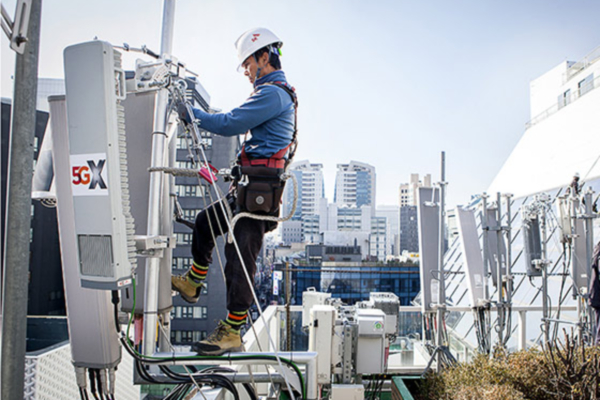
While finding a 5G B2B business model is certainly beneficial, shouldn't the priority be to improve the quality of the currently commercialized 3.5GHz 5G service to a satisfactory level to restore public trust in 5G technology?
On the 8th, the three mobile carriers were fined a total of 51.2 billion won for illegally subsidizing competing 5G networks. This amount was lower than the projected 70 billion won. The reduction was due to the COVID-19 pandemic, the strengthening of financial support for small businesses, and the recognition of their contributions as the world's first commercialized 5G network.
Furthermore, the securities industry predicts that the three mobile carriers will achieve a combined revenue of 14.0172 trillion won and operating profit of 863.1 billion won in the second quarter of this year. This is due to an increase in subscribers to high-priced 5G services, leading to an increase in average revenue per user (ARPU). While SK Telecom's operating profit slightly declined (down 0.4%) compared to the same period last year, KT (up 16.9%) and LG Uplus (up 37.7%) saw significant increases.
In response to concerns that 5G plans are expensive and slow to expand, the government announced that it would introduce a universal 5G plan priced at less than 40,000 won to reduce household telecommunications costs, but the three major mobile carriers strongly opposed the plan.
If we can't introduce a low-cost 5G plan, there's only one answer left.
The goal is to further expand the number of 3.5GHz 5G base stations to improve 5G quality. If 5G quality cannot be improved, the reliability of 5G standalone (SA) mode, 28GHz band 5G, and even 6G technologies in the future will be questioned.
Comments
Related news

"Wi-Fi will be as fast as 5G" Government allows limited use of 6GHz band
Next-generation unlicensed communication technologies such as Wi-Fi 6E and 5G NR-U are receiving attention as supporting technologies for 5G. To implement these, the 6 GHz band must be utilized. Accordingly, the Ministry of Science and ICT has finalized a plan to supply a 6 GHz band with a 1.2 GHz bandwidth as unlicensed spectrum. With this supply, Wi-Fi speeds are expected to accelerate by up to five times.
2020.06.26by 이수민 기자
3.5GHz band 5G radio waves are not harmful to the human body
The Ministry of Science and ICT announced that measurements of electromagnetic wave exposure from 5G mobile phones and base stations conducted by the National Radio Research Agency all met the electromagnetic wave protection standards for human bodies. Measurements of the specific absorption rate (SAR) of 5G mobile phones in real-world usage environments, including voice calls, large-capacity email transmission, and video viewing, showed levels of 1.5~5.8% compared to the standard (1.6W/Kg).
2020.07.09by 이수민 기자

Intel and ADI Partner to Develop Wireless Platform for 5G Network Design
ADI announced that it will collaborate with Intel to develop a wireless platform for 5G network design. The wireless platform to be developed will combine ADI's RF transceiver technology with Intel's low-power FPGA technology, and plans to also provide a new set of design tools to enable developers to more easily implement optimized 5G solutions.
2020.07.14by 강정규 기자
European Patent Applications Surpass 200,000 for the First Time… South Korea Maintains 5th Place, Led by Batteries and Telecommunications
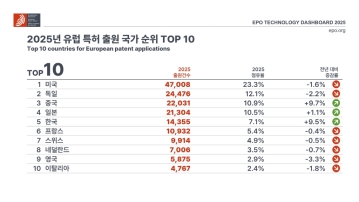
According to the European Patent Office (EPO)'s 'Technology Dashboard 2025', European patent applications last year reached 201,974, surpassing 200,000 for the first time. Korean companies and inventors filed 14,355 applications, representing a 9.5% increase from the previous year and maintaining 5th place by country. Battery, digital communication, and semiconductor technologies led the growth, with Samsung ranking as the top EPO applicant for the second consecutive year and LG reaching 3rd place. The presence of major domestic cities such as Seoul, Suwon, and Yongin was also confirmed. It was also revealed that Korea's European patent strategy is expanding beyond individual technologies to span the entire industry.
2026.03.24by 명세환 기자
SK Telecom First Applies AI-Based Network Operations at Gwanghwamun K-Pop Concert
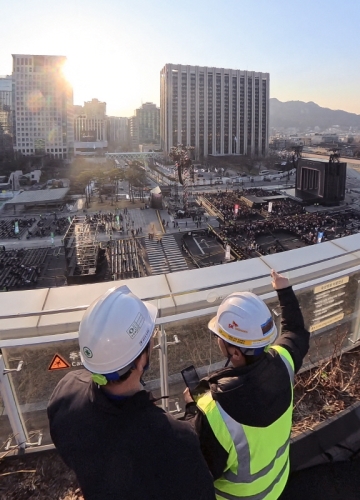
SK Telecom announced that it applied an AI-based network operation system for the first time at a large-scale K-pop concert held in the Gwanghwamun area of Seoul on March 21st, managing communication quality throughout the event. Mobile data usage during the three hours before and after the concert reached 12.15TB, approximately doubling compared to the same time slot the previous weekend. SK Telecom monitored traffic using the AI system 'A-One' in five-minute and 50-meter units to respond to potential overload situations, while also operating temporary communication facilities and on-site personnel in parallel. This case is interpreted as confirmation of the practical applicability of AI-based autonomous network operation in an environment where demand from dense events and foreign users increases simultaneously.
2026.03.23by 명세환 기자











