


How the TSN Standard Accelerates Industry 4.0?
 Published2020.07.21 10:35
TSN, guaranteeing universal access to industrial site data
Providing a common framework and language to IT and OT professionals
Many companies around the world continue to make massive investments to realize Industry 4.0. This new paradigm, which accelerates connectivity, is bringing about changes across the manufacturing sector, from leading automotive companies to startups.
This transition is expected to enhance corporate productivity, efficiency, adaptability, and profitability, and the benefits will extend not only to the company but also to employees, shareholders, and customers.
Industry 4.0 will bring flexibility that was previously unimaginable. For example, manufacturers can agilely adjust production volumes in response to seasonal demand changes. Furthermore, it can increase uptime, efficiently utilize resources, time, and personnel, and enhance corporate reputation and customer trust.
All of these are merely some of the achievements expected of the Fourth Industrial Revolution.
To realize the aforementioned goals, it is necessary to capture, exchange, and analyze data. Data and the insights derived from it are like the currency required to achieve all these improvements.
However, in today's factories, data is merely accumulating but is not being fully utilized. For several years, manufacturing companies have been trying to solve this problem.
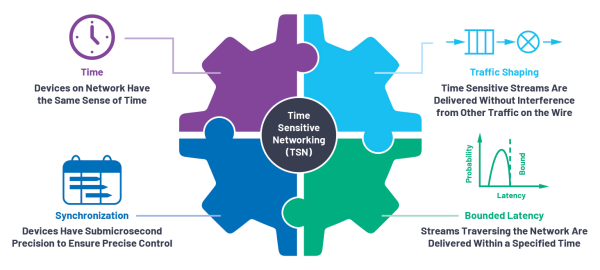
Meets four key requirements [Figure=ADI]
Time-sensitive networking (TSN) is a series of IEEE Ethernet standards that provides the foundation for realizing the promises of Industry 4.0. By adopting TSN, all data can coexist and communicate across the entire corporate organization, including the factory floor, servers, headquarters, and everywhere in between.
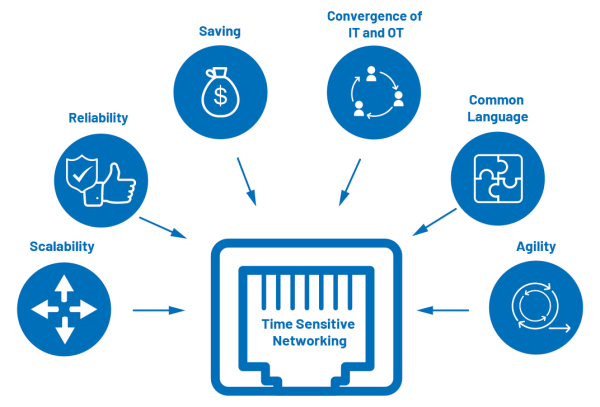
TSN removes communication barriers in industrial settings and enables universal access to data useful for decision-making. TSN will contribute to the realization of Industry 4.0 in five aspects, the foundation of which is to enhance data accessibility.
The first benefit is the provision of a common language. TSN enables data to communicate in a common language by synchronizing time and consistently handling all data packets and information. While equipment interoperability issues may remain, manufacturers will be able to derive greater value from data coexisting on the same Ethernet path.
The second is enhanced scalability and agility. TSN enables the management of various transmission speeds to maximize data throughput at all priority levels during data transmission over Ethernet. Ultimately, companies can more easily increase or decrease capacity and respond agilely to customers' changing priorities and requirements.
The third is the achievement of more reliable automation. TSN provides the real-time deterministic data required for accuracy and precision. If data points, such as the timing of signals, are delayed or interrupted in any way, machinery will fail to operate properly, leading to downtime, reduced productivity, and ultimately, loss of revenue.
For example, precise movements are required for robots to collaborate with humans. If a robot's movement deviates even slightly from a defined range, it can threaten the safety of workers. TSN enables immediate communication in such applications, thereby enhancing safety and quality.
The fourth point is bridging the gap between Information Technology (IT) and Operational Technology (OT) experts. TSN provides a common framework for both camps, enabling it to meet the diverging needs of IT and OT teams. It offers a common framework and language that allows the two teams to collaborate.
Meanwhile, as many experienced OT professionals reach retirement age, the expertise accumulated regarding fieldbuses is disappearing along with them. TSN can also resolve this shortage of skilled personnel in the future, as it provides a common framework that enables IT professionals to support Industrial Ethernet. This can save resources and increase productivity.
The fifth point is that a company's R&D budget can be diverted to other areas. As TSN resolves bandwidth constraints, companies no longer need to build new facilities when expanding or adding bandwidth capacity.
So far, we have seen many instances where companies invest tens of millions of dollars in infrastructure, only for the equipment to quickly become outdated or inefficient within a little over a decade.
Adopting TSN can significantly reduce the need to build new facilities, allowing the resulting investment capacity to be used to invest more in technologies to enhance automation levels. For example, additional funds can be invested in employee training to manage and operate complex robotic systems.
Analog Devices (ADI) offers a comprehensive portfolio of TSN Ethernet solutions. Visit the relevant webpage to see how ADI’s Chronous™ products support a rapid transition to real-time industrial Ethernet networks.
The TSN standard will serve as the foundation necessary to realize Industry 4.0 and bring about fundamental changes to the manufacturing environment. However, this is merely one part of the entire ecosystem required to realize the Fourth Industrial Revolution.
To complete this ecosystem, elements such as software, middleware, enhanced silicon components, competent developers and engineers, skilled technicians and workers, education, and time are required. New technologies hold tremendous potential and will bring countless opportunities and possibilities.
This article is a summary of a piece titled 'Time Sensitive Networking: Five Ways the IEEE Standards Will Advance Industry 4.0' by Jordan Woods, Director of the Deterministic Ethernet Technology Group at ADI.
Comments
Related news

A Look at Five Key Industrial Automation Issues in 2019
2019 was a year of heightened interest in smart factories. In June, the government announced a manufacturing renaissance vision and strategy for leapfrogging into the world's top four manufacturing powers. To achieve this strategy, the government decided to supply 30,000 smart factories to small and medium-sized enterprises by 2022, and to establish 20 smart industrial complexes by 2030. The industry is also focusing on developing and implementing new technologies such as CPS and MEC, while dedicating considerable effort to establishing standards that enhance IoT connectivity, including the OPC-UA protocol and TSN specifications.
2019.12.18by 이수민 기자
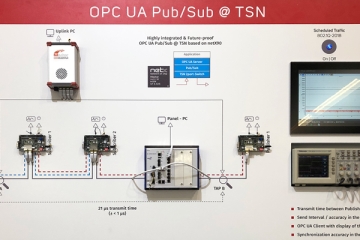
Hilscher Implements 100Mbit/s TSN Standard with NetX90 SoC
Hilscher has completed the implementation of a 100Mbit/s TSN standard based on its latest multiprotocol SoC, the netX90 device. Although the TSN profile scheduled for disclosure in 2021 has not yet been officially finalized, some companies are already announcing TSN-enabled products. Hilscher is also continuously collecting all requirements that will need to be supported in future SoCs.
2020.03.03by 이수민 기자

Analog semiconductor industry's 2nd-ranked ADI acquires 7th-ranked Maxim
ADI is acquiring Maxim Integrated. The combined company is valued at approximately $68 billion, including debt. ADI's current market capitalization is approximately $48 billion, and Maxim's is approximately $17 billion. ADI previously acquired Linear Technology in 2016.
2020.07.14by 이수민 기자
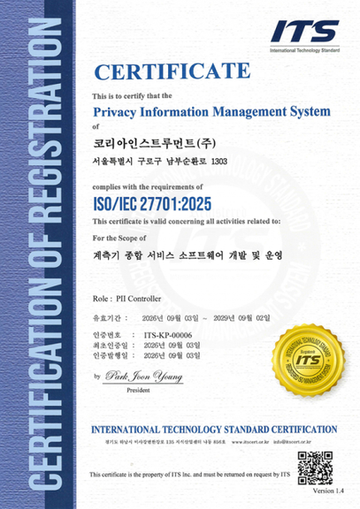
Korea Instrument, KOLAS Accredited Calibration Agency First to Simultaneously Acquire ISO/IEC 27,001·27,701
Korea Instrument has become the first among KOLAS accredited calibration agencies to simultaneously acquire ISO/IEC 27,001 and ISO/IEC 27,701 certifications. Through its proprietary platforms CWIZ Enterprise and CWIZ Partners, the company has embedded information security and personal data protection requirements across all business processes including customer information, equipment data, and calibration reports, with plans to continuously advance its management system through regular audits and security inspections.
2026.10.12by 배종인 기자
TeamViewer One, IT Incident Automation Workflow and Resolution Center Enhanced
TeamViewer has added IT incident automation capabilities and an advanced Resolution Center to its integrated digital workplace management platform 'TeamViewer ONE'. Recurrent service disruptions, configuration errors, and capacity shortages are automatically handled according to preset policies, and device status verification through script deployment can be managed in a unified interface, significantly reducing repetitive tasks for IT teams.
2026.10.12by 배종인 기자











