



Data breaches per Korean company increased by 7% compared to last year.
 Published2020.07.30 10:01
South Korea ranks 10th among 17 countries surveyed for data breaches.
The gap in damages between companies that leverage security automation technologies in their businesses and those that don't continues to widen.
On the 30th, IBM, in collaboration with the Ponemon Institute, released the "2020 Global State of Corporate Data Breach" report , which analyzed the data breaches of 524 companies in 17 countries around the world. Following last year's survey, 24 Korean companies were included in the report, providing information on the current state of data breach damage in Korea.
According to the report, the average cost per company from a data breach worldwide was $3.86 million, a decrease of approximately 1.5% from last year's $3.9 million. Factors contributing to the decline include the rise of companies and industries with mature security automation and incident response processes, the stabilization of GDPR, and the availability of cyber insurance.
However, among the 16 countries or regions surveyed in 2019 and 2020, the average damage amount increased in 12 of them, including South Korea.
An in-depth analysis of all data breaches revealed that 80% involved the leak of personally identifiable information (PII) from customers. In terms of the scale of damage, data breaches involving customer PII were the most damaging to companies. IP leaks followed at 30%.
As corporate remote work has increased in recent years, critical data has tended to migrate to environments with less stringent controls, reducing network visibility and making them more vulnerable to breaches.
One of the notable findings from this report is that the average loss for companies that utilize security automation technology is $2.45 million, while the average loss for companies that do not is $6.03 million, resulting in a cost gap of approximately $3.85 million.
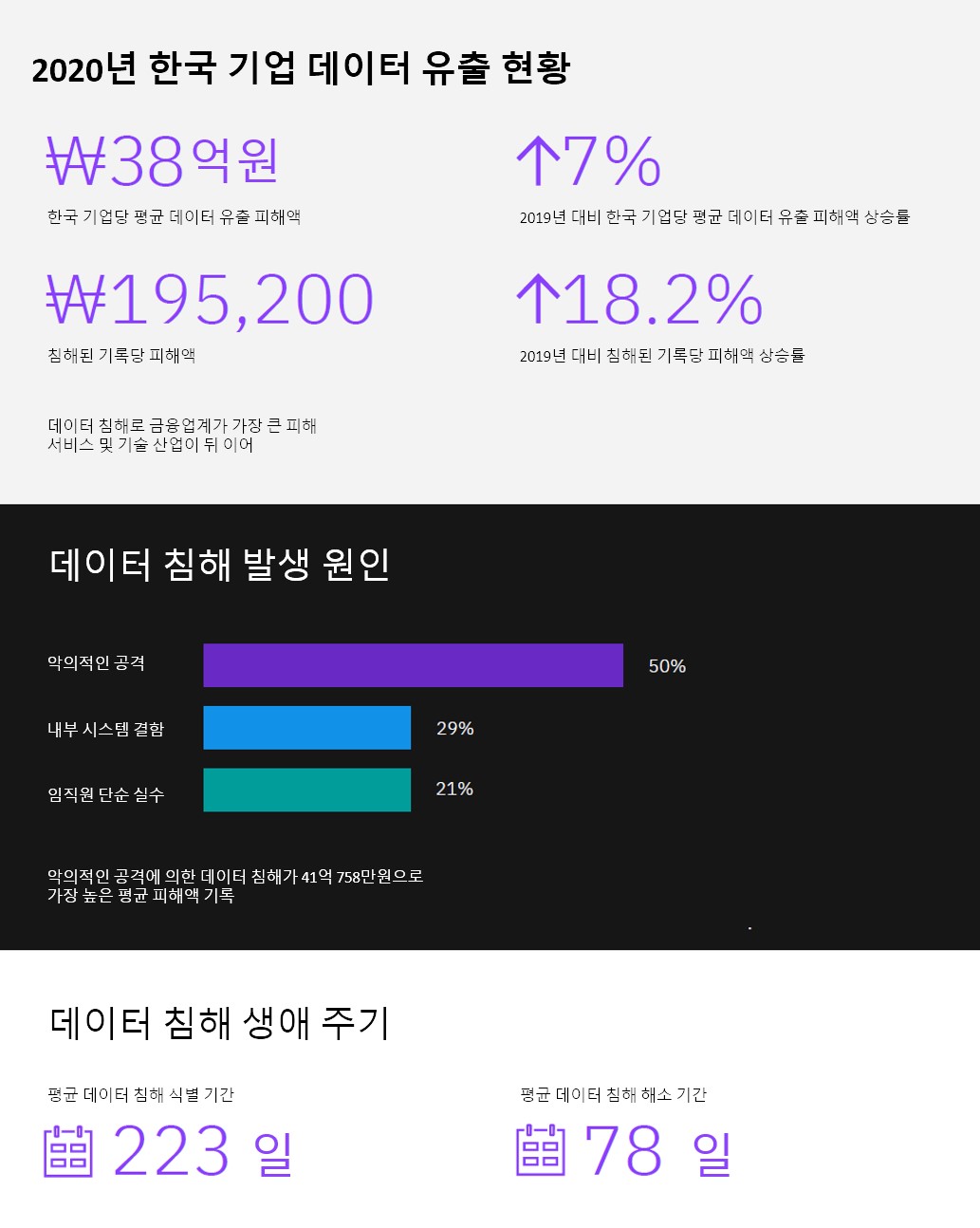
(Open in a new tab to enlarge)
Companies leveraging security automation technologies like AI and machine learning were able to detect and contain breaches approximately 27% faster. Looking at the cost gap between 2018 ($1.51 million) and 2019 ($2.51 million), the gap in damages between companies with and without the adoption of the latest security technologies continues to grow.
◇ 24 domestic companies report increased spending per data breach.
According to a survey of 24 domestic companies, data breaches resulted in financial losses of 3.8 billion won per company, a 7% increase from the previous year (3.553 billion won). This ranked 10th among the 17 countries or regions surveyed. Additionally, it was found that 195,200 won was spent per data breach, an 18.2% increase from the previous year (165,100 won).
Half of data breaches at domestic companies were caused by malicious or criminal attacks. Internal system flaws (29%) and simple employee errors (21%) followed. The average time to identify the cause of a data breach increased from 216 days in 2019 to 223 days in 2020, and the average time to remediate a data breach increased from 71 days in 2019 to 78 days in 2020.
IBM's report also revealed differences in the scale of damage depending on mean time to breach (MTTI) and mean time to breach (MTTC).
According to the report, data breaches that took less than 100 days to identify their cause resulted in an average of 2.61 billion won in damages, while breaches that took more than 100 days incurred a significant loss of 4.998 billion won. Data breaches that took less than 30 days to resolve resulted in 3.31 billion won in damages, but this figure jumped sharply to 4.299 billion won for breaches that took more than 30 days.
Meanwhile, the industry that suffered the most damage from data breaches globally was healthcare, and domestically, it was finance. The service sector ranked second, and the technology industry, which suffered the most damage last year, ranked third this year.
Kim Yong-tae, managing director of IBM Korea's security business division, emphasized, "The recent major direction of domestic security control is advancement through AI and SOAR," and "Security automation is expected to become a key technology that accelerates the transition to the cloud, resolves the shortage of security personnel, and supports business agility."
Comments
Related news

6 Security Rules to Protect Corporate Assets in the Cloud Era
As the prolonged COVID-19 pandemic drives a sharp increase in cloud adoption and utilization among enterprises, IBM X-Force Security Research has released a cloud security report introducing various forms of cloud security threats. The report cautions that when enterprises adopt cloud services without adequate prior security preparation, responsibility for cloud security can become unclear and risk response becomes difficult to manage.
2020.06.15by 이수민 기자
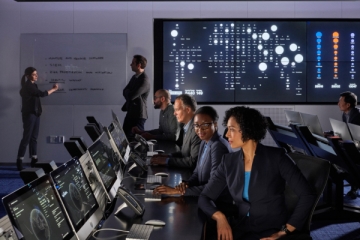
The more you use cybersecurity tools, the more counterproductive it is.
IBM Security conducted a survey of approximately 3,400 security and IT professionals worldwide and found that over the past five years, while enterprises' capabilities in preparation, detection, and response to cyberattacks have improved, their ability to deter attacks has actually decreased by 13%. The analysis revealed that the excessive use of security tools and the lack of specific action plans for major attack types are hindering enterprises' security response activities.
2020.07.02by 이수민 기자
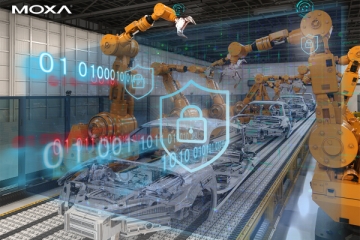
Mossa Announces Security Solution to Protect Manufacturing Equipment OT Systems
As interconnection between OT and IT increases, vulnerable areas susceptible to attacks are also expanding. The possibility of cyber threats targeting previously isolated industrial networks is growing. In response, Moxa has launched an industrial cybersecurity solution that proactively protects OT systems.
2020.07.14by 이수민 기자
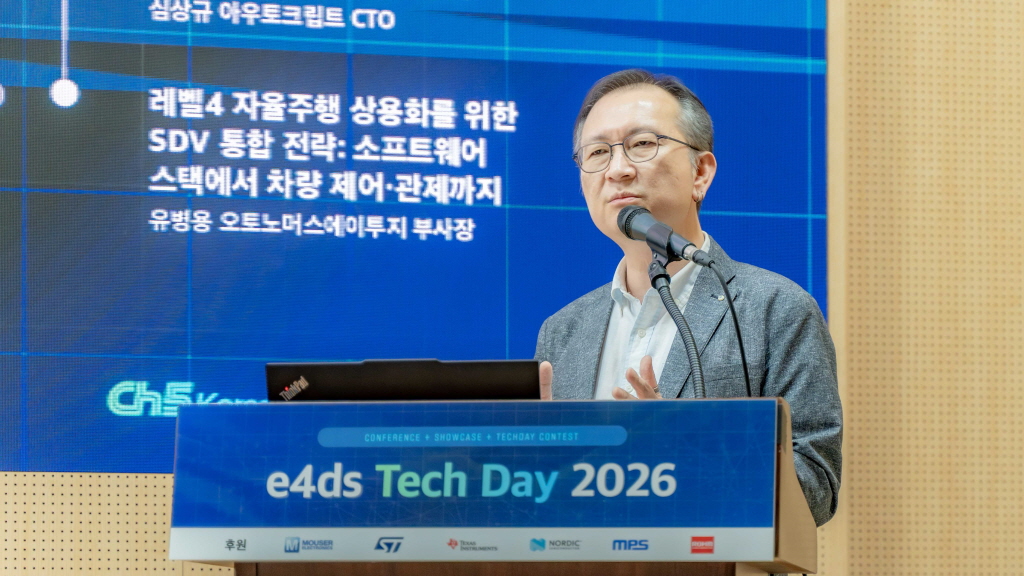
[e4ds Tech Day 2026 ⑨] Sim Sang-gyu, Autocrypt CTO: "In the Physical AI Era, Automotive Security Must Extend Beyond the Vehicle"
At e4ds Tech Day 2026, Sim Sang-gyu, CTO of Autocrypt, explained automotive cybersecurity strategies in the era of Physical AI and SDV (Software-Defined Vehicle). Automobiles are evolving as part of an ecosystem connected to AI, cloud, chargers, IoT, and robots, and he emphasized that the scope of security must expand beyond the vehicle interior to the entire connected environment. In particular, AI model tampering, adversarial attacks, OTA updates, and EV charger hacking were identified as major threats. He explained that response measures require zero trust, AI model integrity protection, intrusion detection, Security by Design and Default, and full lifecycle security management, and that proactive security system establishment beyond regulatory compliance is critical for securing future mobility competitiveness.
2026.10.12by 배종인 기자
NVIDIA to Invest $1 Billion in U.S. Science Over Next Five Years
NVIDIA has announced plans to invest $1 billion over the next five years to strengthen U.S. scientific and technological competitiveness. The company will enhance cutting-edge artificial intelligence research and development capabilities in key areas including quantum computing, healthcare, and energy security, while expanding support for higher education research institutions and cloud service providers. NVIDIA is participating as a major industry partner in the White House Office of Science and Technology Policy's Genesis Mission, and is promoting supercomputer construction in collaboration with national laboratories including Argonne and Los Alamos.
2026.10.12by 배종인 기자











