



The 2019 domestic smart connected device market saw a decline in smartphones and an increase in tablets.
 Published2020.07.30 14:10
Smartphones are declining, while PCs and tablets are growing by around 10%.
It must evolve into a solution that bundles SW and services.
On the 28th, Korea IDC presented the current status of the smart connected device market, including PCs, tablets, and smartphones, as well as industry trends and future outlook for 2020, in its recently published 'Domestic Smart Connected Market Report.'
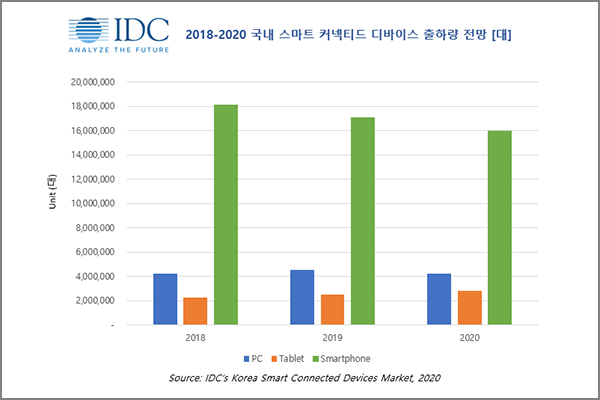
Shipment Forecast [Graph = Korea IDC]
According to the report , domestic smart connected device shipments in 2019 totaled 24.13 million units, a 2.0% year-on-year decrease. PCs and tablets grew by 7.2% and 12.2%, respectively, while smartphones declined by 5.9%.
This year, the market is rapidly transitioning to a non-face-to-face, contactless environment due to the COVID-19 pandemic, leading to increased demand for PCs and tablets used in online education, and the shift from desktops to laptops is accelerating due to the spread of remote work. On the other hand, smartphone users tend to hold off on replacing their devices or purchase cheaper ones as spending on other devices such as PCs and tablets increases.
Breaking down by device, PC shipments in 2019 grew 7.2% year-over-year to 4.55 million units, driven by demand for Windows 10 migration in the second half of the year. Large-scale demand was driven primarily by the public, education, military, financial, and manufacturing industries, and replacement of remaining inventory continued in the first half of 2020.
Online education and remote work are driving PC demand, but considering the massive Windows 10 migration in 2019, PC shipments in 2020 are expected to decline by 7.5% to 4.2 million units. Year-over-year growth is expected to be mixed, with growth in the first half and decline in the second half. Products with performance and reasonable prices suitable for online education and general work are preferred.
Last year, tablet shipments grew 12.2% to 2.52 million units, compared to 2.24 million the previous year. In the consumer sector, improvements in tablet-optimized entertainment, productivity, and creativity tools contributed to this growth, while in the commercial sector, steady demand for tablets as digital educational tools or as promotional gifts contributed to this growth.
Tablet shipments this year are expected to grow 11.8% to 2.82 million units. The market is expected to grow as household tablet purchases increase amid social distancing and online school openings, the adoption of tablets in non-face-to-face businesses expands after the COVID-19 pandemic, and the supply of public education digital textbooks delayed last year is also expected to drive market growth.
Smartphone shipments in 2019 were 17.06 million units, a 5.9% decrease from the previous year, and are projected to decline by another 6.3% this year to 15.98 million units due to supply disruptions and weakened consumer sentiment caused by COVID-19.
In the first half of last year, the first commercialized 5G services and 5G smartphones revitalized the market, but in the second half, demand fell significantly as benefits such as subsidies were significantly reduced due to suppliers' efforts to improve profitability.
This year, more manufacturers are expected to join the 5G market, and new products that maximize performance with cutting-edge technologies like clamshell foldables and AI/ML are expected to expand consumer choices.
Park Dan-ah, a researcher at IDC Korea, said, “Smart connected devices don’t just improve convenience and productivity, they also contribute to providing new and enjoyable experiences to users,” adding, “They are significantly increasing work efficiency with pens, dedicated OSs, detachable keyboards, and larger displays with bezel-less or foldable/dual screens.” Additionally, it was analyzed that “as connectivity with various surrounding objects and spaces, such as cars and homes, increases in the 5G environment, it is being utilized to build new lifestyles of the future.”
Kwon Sang-jun, director of IDC Korea, said, “In preparation for the post-COVID-19 era, IT innovation technologies such as video conferencing, collaboration tools, virtualization, endpoint management, and security are being introduced to maintain business continuity.” He also advised, “Since a decrease in household income and cost reduction by companies may lead to a return to mainstream and affordable products rather than premium products, the smart connected device market needs to transform into a solution form that bundles software and services in addition to devices.”

Comments
Related news
South Korean smartphone market continues to decline due to COVID-19 pandemic
The domestic smartphone market is expected to continue its downward trend. IDC announced that total smartphone shipments in the domestic market in 2019 reached approximately 17.06 million units, declining 5.9% year-over-year. Additionally, IDC forecasted continued market contraction in the first half of 2020 due to the impact of COVID-19.
2020.04.13by 이수민 기자

KDHC and LH Selected for This Year's Asia-Pacific Smart City Project
IDC selected a total of 19 outstanding smart city projects as this year's winners at the 6th Smart City Asia Pacific Awards (SCAPA). Domestically, Korea District Heating Corporation's IoT-based thermal transmission pipeline monitoring and management system and Korea Land & Housing Corporation's platform-based crime safety city service were each selected in the Smart Water category and the Public Safety category, respectively.
2020.06.13by 이수민 기자
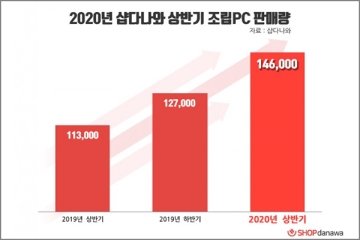
Domestically assembled PCs shipped 30% more in the first half of this year than last year
Danawa announced that ShopDanawa's assembled PC sales in the first half of 2020 reached 146,000 units, representing a 29% increase compared to the same period in 2019. CPU processor sales in the second quarter of this year increased by 29% compared to the same period in 2019, driven by non-contact demand and the launch of Intel's 10th generation processors.
2020.07.08by 이수민 기자
ESP32 Development Environment Selection and GPS Application Implementation
The ESP32 is a microcontroller that integrates Wi-Fi, Bluetooth, 12-bit ADC, capacitive touch, PWM, DAC, and UART in a single SoC. However, the abundance of features does not by itself solve the designer's problems. The real challenges lie in selecting the appropriate development environment, determining which pins can be used and which must be avoided, and converting raw data from modules into usable information. This document addresses ESP32 peripheral constraints (ADC2 and Wi-Fi coexistence limitation, UART1 occupancy, ADC non-linear regions), the trade-offs between Arduino IDE and ESP-IDF, and the process from connecting NEO-6M/NEO-M8N GPS modules to UART2, parsing NMEA sentences, and visualizing routes in Google Earth, all organized based on documented references.
2026.10.12by 편집부
MIPI CSI-2, DSI-2, C-PHY, D-PHY Test Solution Technical White Paper
The MIPI interface adopts a burst mode that transitions between low-power (LP) and high-speed (HS) states for low-power consumption, and in return, strict timing rules are imposed on state transitions. Additionally, the high-speed section operates as a packet-based protocol with headers, ECC, and CRC, so verification engineers must handle waveforms and protocols simultaneously. Traditional configurations combining general-purpose oscilloscopes and AWGs reveal limitations in setup complexity, measurement uncertainty, and lack of reproducibility when faced with these requirements. This white paper, based on webinar materials, organizes the structure of this problem and describes how the SV5C-DPTXCPTX generator for receiver testing and SV5C-DPRXCPRX analyzer for transmitter testing integrate state transition testing, stressed eye testing, and protocol analysis into a single bench, along with their application boundaries.
2026.10.12by 편집부











