



Technology developed to predict the number of confirmed COVID-19 cases imported from overseas has been developed.
 Published2020.08.24 12:17
Forecast of the number of confirmed cases imported from overseas over the next two weeks
As the number of confirmed COVID-19 cases worldwide surpasses 20 million, a domestic research team has developed a technology capable of predicting the number of confirmed cases imported from overseas.
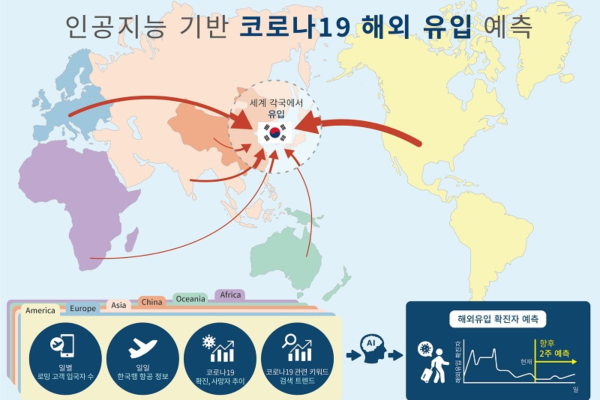
A research team led by Professor Jaegil Lee of the Department of Industrial and Systems Engineering at the Korea Advanced Institute of Science and Technology (KAIST) announced on the 19th that it has developed big data and AI technology that can predict the number of confirmed cases of COVID-19 imported from overseas over the next two weeks.
This study was presented on the 24th under the title 'Hi-COVIDNet: Deep Learning Approach to Predict Inbound COVID-19 Patients and Case Study in South Korea' at the 'AI for COVID-19' session of 'ACM KDD 2020', an international academic conference in the field of data mining.
When calculating the COVID-19 risk in each country, the research team primarily used the reported number of confirmed cases and deaths. However, because these figures are dependent on the number of diagnostic tests, they also used the frequency of COVID-19-related keyword searches as input data to calculate the COVID-19 risk in each country in real time.
In addition, the number of real-time arrivals is confidential information and is not disclosed to the public, so it was inferred from the number of flights arriving in Korea and the number of roaming customers entering the country each day. Data on the number of roaming customers entering the country was received from KT, but the limitation of only including KT customers entering the country was resolved by also considering the number of daily flights.
In addition, to predict the number of confirmed cases coming from overseas, geographical connections between countries must also be considered.
The research team designed an AI model called 'Hi-COVIDNet' to accurately predict the number of confirmed cases imported from each continent based on a geographical hierarchy consisting of countries and continents to learn geographical correlations, ultimately accurately predicting the total number of confirmed cases imported from overseas.
The research team used Hi-COVIDNet, a model created using only a short training period of about a month and a half, to predict the number of confirmed cases from overseas over the next two weeks. The results confirmed that this model achieved up to 35% higher accuracy than existing predictive machine learning or deep learning models based on time-series data.
This research was supported by the KAIST Global Strategy Institute's COVID-19 AI Task Force Team and the roaming dataset provided by KT and the Ministry of Science and ICT's COVID-19 Spread Prediction Research Alliance.
Comments
Related news
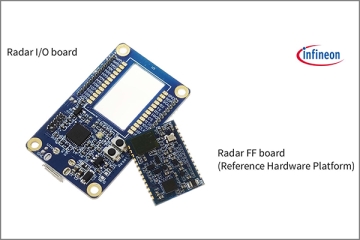
Infineon Radar-based People Count Solution "Anonymity Guaranteed"
With the spread of COVID-19, there became a need for solutions to help people maintain social distance within buildings. Infineon's smart people counting solution for entrances integrates a 60GHz radar sensor and software on a compact discrete radar board to accurately and anonymously count the number of people.
2020.08.04by 강정규 기자
"COVID-19 Turned from Crisis into Opportunity": Three Major Mobile Carriers Report Strong Q2 Results
All three major telecom companies released their Q2 2020 earnings results. All three companies achieved strong performance, with the key factor being turning the COVID-19 crisis into an opportunity. As face-to-face marketing opportunities decreased, they preserved related costs, and improved results by strengthening non-face-to-face services in response to increased demand. Based on K-IFRS consolidated financial statements, KT recorded revenue of 5.8765 trillion won and operating profit of 341.8 billion won, SK Telecom recorded revenue of 4.6028 trillion won and operating profit of 359.5 billion won, and LG Uplus recorded revenue of 3.2726 trillion won and operating profit of 239.7 billion won.
2020.08.10by 이수민 기자

Growing Korean public cloud market, 'will grow even bigger in 21'
Korea IDC stated that the domestic public cloud market size in 2019 reached 1.3010 trillion won, representing a 25.2% growth compared to the previous year, and attributed the significant market expansion to major cloud service providers expanding their services to existing customers who had become accustomed to public cloud services. The organization also anticipated that the non-face-to-face culture that spread due to COVID-19 would serve as a driving force for cloud market expansion, and that enterprises' scope of cloud adoption would broaden further.
2020.08.09by 이수민 기자
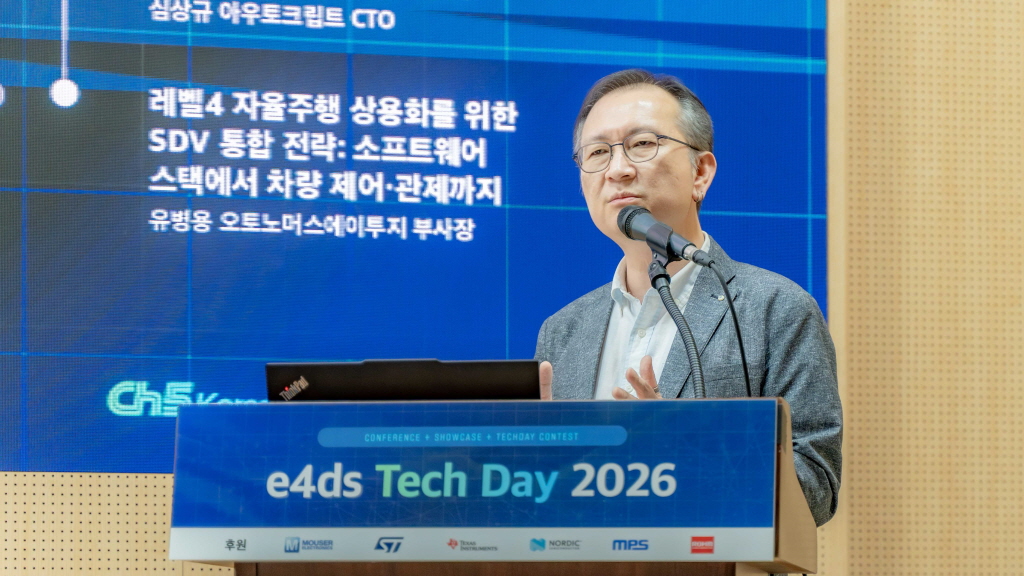
[e4ds Tech Day 2026 ⑨] Sim Sang-gyu, Autocrypt CTO: "In the Physical AI Era, Automotive Security Must Extend Beyond the Vehicle"
At e4ds Tech Day 2026, Sim Sang-gyu, CTO of Autocrypt, explained automotive cybersecurity strategies in the era of Physical AI and SDV (Software-Defined Vehicle). Automobiles are evolving as part of an ecosystem connected to AI, cloud, chargers, IoT, and robots, and he emphasized that the scope of security must expand beyond the vehicle interior to the entire connected environment. In particular, AI model tampering, adversarial attacks, OTA updates, and EV charger hacking were identified as major threats. He explained that response measures require zero trust, AI model integrity protection, intrusion detection, Security by Design and Default, and full lifecycle security management, and that proactive security system establishment beyond regulatory compliance is critical for securing future mobility competitiveness.
2026.10.12by 배종인 기자

NVIDIA to Invest $1 Billion in U.S. Science Over Next Five Years
NVIDIA has announced plans to invest $1 billion over the next five years to strengthen U.S. scientific and technological competitiveness. The company will enhance cutting-edge artificial intelligence research and development capabilities in key areas including quantum computing, healthcare, and energy security, while expanding support for higher education research institutions and cloud service providers. NVIDIA is participating as a major industry partner in the White House Office of Science and Technology Policy's Genesis Mission, and is promoting supercomputer construction in collaboration with national laboratories including Argonne and Los Alamos.
2026.10.12by 배종인 기자











