


KT Develops Short-Range 3D LiDAR Prototype with High Price Competitiveness
 Published2020.08.31 10:46
Create 24 detection lines and understand 3D space
KT announced on the 30th that it has developed an indoor short-range 3D lidar.
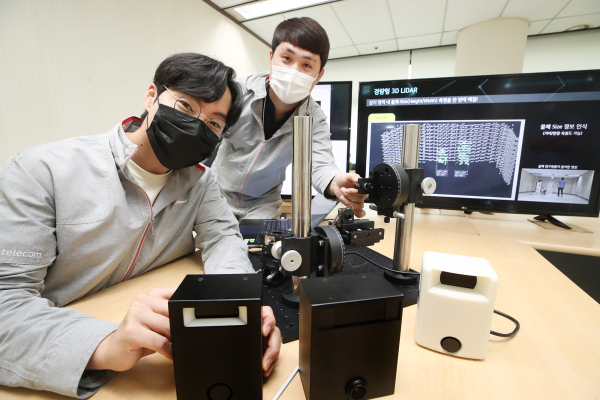
LIDAR is a device that uses a laser sensor to emit light and measure the distance, speed, and direction of surrounding objects by reflecting the light back to precisely determine the surrounding environment.
2D lidar currently used in industrial settings only detects the approach of hazards. Therefore, it is extremely difficult to fully implement unmanned or automated production lines using 2D lidar alone. While 3D lidar offers excellent performance, its high price makes it difficult to apply to a large number of equipment across industrial settings.
The newly developed short-range 3D lidar has a manufacturing cost that is one-tenth that of existing products, and controls a single laser with software to create up to 24 detection lines to identify approaching dangers.
Additionally, the detected space can be rendered in three dimensions, and AI analysis capabilities can be used to determine whether an approaching obstacle is a person or an object. If it's an object, the shape can be analyzed to determine its type.
Kim Bong-gi, executive director of the KT Convergence Technology Institute's Platform Research Lab, said, "We will not stop at research projects for short-range 3D lidar but further develop it into a commercial product."
Comments
Related news
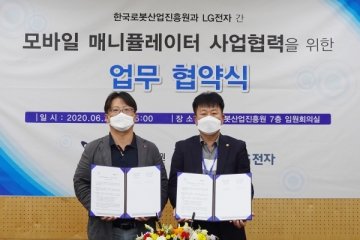
LG Electronics and KIRIA Enhance Safety of Industrial Autonomous Robots
LG Electronics and the Korea Robot Industry Promotion Agency have concluded a business agreement to enhance the safety of mobile manipulators. A mobile manipulator is a combination of a vertically articulated robot that performs movements similar to human arms and an autonomous mobile robot, which moves independently within factory production lines and other environments to perform various processes such as parts handling, product assembly, and inspection.
2020.06.30by 이수민 기자
.png)
5G Mobile Edge Computing Technology to be Integrated into Autonomous Robots
SK Telecom signed two cooperation agreements on the 4th: a joint collaboration agreement with Robotis for "development and commercialization of autonomous mobile robots based on 5G MEC," and a business partnership agreement with Woowa Brothers for "5G MEC and smart robot-based business cooperation." Based on these two collaborations, SK Telecom plans to integrate 5G MEC technology into autonomous mobile robots to be utilized in industrial and logistics fields.
2020.08.05by 명세환 기자
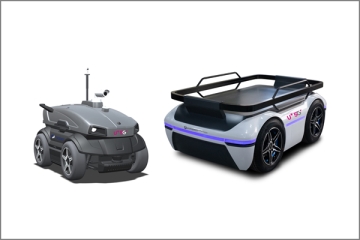
5G-based autonomous robots for factory patrols and logistics automation
LG Uplus and Unmanned Solutions have signed an MOU regarding autonomous robot business. Through this collaboration, both companies will promote the commercialization of outdoor autonomous service robots that can be utilized for various purposes including patrol, logistics, and disinfection operations. To this end, LG Uplus's video analytics solution, gas detection IoT sensors, and other industrial solutions along with communication technology will be integrated into the autonomous robots developed by Unmanned Solutions.
2020.08.06by 명세환 기자
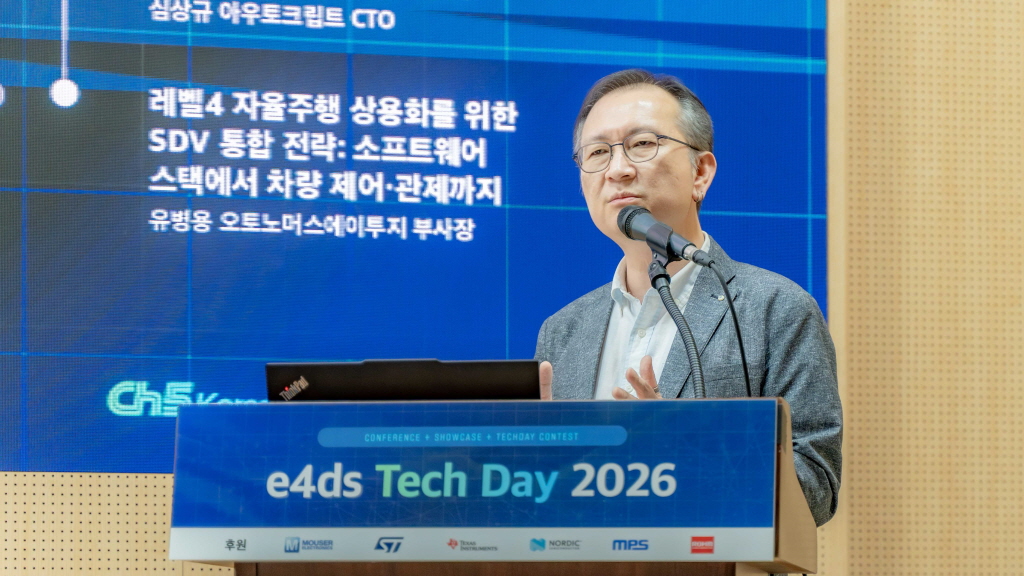
[e4ds Tech Day 2026 ⑨] Sim Sang-gyu, Autocrypt CTO: "In the Physical AI Era, Automotive Security Must Extend Beyond the Vehicle"
At e4ds Tech Day 2026, Sim Sang-gyu, CTO of Autocrypt, explained automotive cybersecurity strategies in the era of Physical AI and SDV (Software-Defined Vehicle). Automobiles are evolving as part of an ecosystem connected to AI, cloud, chargers, IoT, and robots, and he emphasized that the scope of security must expand beyond the vehicle interior to the entire connected environment. In particular, AI model tampering, adversarial attacks, OTA updates, and EV charger hacking were identified as major threats. He explained that response measures require zero trust, AI model integrity protection, intrusion detection, Security by Design and Default, and full lifecycle security management, and that proactive security system establishment beyond regulatory compliance is critical for securing future mobility competitiveness.
2026.10.12by 배종인 기자

Practical HIL Construction Strategy for Automotive and Off-Highway Controller Validation
As vehicle E/E architecture transitions to zonal structures and shifts to software-defined vehicles (SDV), the number of controllers (ECUs) requiring validation and software complexity are surging dramatically. Meanwhile, real vehicle testing cannot provide repeated verification under identical conditions and entails lead time and safety concerns. This white paper explains the principles of HIL (Hardware-in-the-Loop) validation and the structure of the NI platform composed of PXI, SLSC, and VeriStand, and through two actual implementation cases—Camera Record & Replay HIL for In-Cabin Monitoring Controller (ICMU) and Forklift Controller (VCU) HILS—describes how controller-level regression testing becomes possible. Additionally, it explicitly states application boundaries and limitations, such as lack of A2B support.
2026.10.12by 편집부











