



The three major mobile carriers have launched a task force to discuss roaming plans for their rural 5G networks.
 Published2020.09.02 16:31
Roaming Task Force plans to finalize its plan within six months.
The Ministry of Science and ICT announced on the 1st that it launched the Rural 5G Roaming Task Force (Roaming T/F) and held its first meeting remotely.
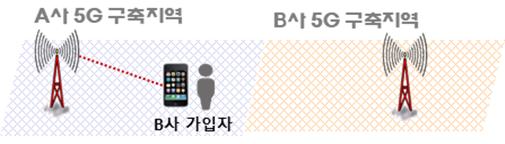
[Image = Ministry of Science and ICT]
If roaming between the three mobile carriers becomes possible in rural areas with low populations, each carrier will be able to provide 5G services to its users through third-party networks without having to build its own networks.
This is the first time that roaming has been implemented between domestic telecommunications companies since several times during the 2G era.
The Roaming T/F is comprised of the three mobile carriers (SK Telecom, KT, and LG Uplus), the Electronics and Telecommunications Research Institute (ETRI), the Telecommunications Technology Association (TTA), the Korea Telecommunications Operators Association (KTOA), and the Ministry of Science and ICT.
In the future, we plan to discuss ▲technical methods of roaming ▲target areas ▲roaming periods ▲cost settlement methods among the three mobile carriers, and we plan to come up with a final plan within six months.
Additionally, the Roaming T/F reviewed internet traffic trends in response to the resurgence of COVID-19 at the meeting held that day. Telecom operators said internet traffic in August was at a similar level to March, when the COVID-19 pandemic was prevalent.
However, he added that Internet traffic still remains at 40% to 50% of the capacity held by operators, as Internet facility capacity has been increased by about 13%.
Comments
Related news

Why is 6G commercialization being promoted when 5G has not yet taken hold?
Perspectives on 5G are not favorable. This is because its ultra-high-speed, ultra-low-latency, and ultra-connectivity characteristics have failed to deliver their intended performance even after more than a year since commercialization. 6G is a next-generation mobile communication technology that complements 5G with characteristics of ultra-performance, ultra-broadband, ultra-precision, ultra-spatial, ultra-intelligence, and ultra-reliability. With the Ministry of Science and ICT announcing plans to advance 6G R&D projects, we examined the differences between 5G and 6G.
2020.08.11by 이수민 기자
Keysight Unveils New Software to Integrate 5G Product Development Process
Keysight Technologies announced the launch of Pathwave Design 2021, an expanded and predictable open 5G and millimeter-wave software solution. Design and verification engineers can use this solution to accelerate chip, board, and system product launches by adding enhanced performance and accuracy to device, circuit, and system design.
2020.08.20by 강정규 기자
ETRI Sets Out to Develop 5G Edge Network and MEC Security Technologies
ETRI announced that it has developed technology capable of detecting and responding to potential security threats in 5G edge networks and multi-access edge computing. The research team plans to apply the developed technologies to smart factories and promote security demonstration of 5G MEC-based B2B convergence services as well as validation of technical effectiveness.
2020.08.20by 이수민 기자
European Patent Applications Surpass 200,000 for the First Time… South Korea Maintains 5th Place, Led by Batteries and Telecommunications
According to the European Patent Office (EPO)'s 'Technology Dashboard 2025', European patent applications last year reached 201,974, surpassing 200,000 for the first time. Korean companies and inventors filed 14,355 applications, representing a 9.5% increase from the previous year and maintaining 5th place by country. Battery, digital communication, and semiconductor technologies led the growth, with Samsung ranking as the top EPO applicant for the second consecutive year and LG reaching 3rd place. The presence of major domestic cities such as Seoul, Suwon, and Yongin was also confirmed. It was also revealed that Korea's European patent strategy is expanding beyond individual technologies to span the entire industry.
2026.03.24by 명세환 기자

SK Telecom First Applies AI-Based Network Operations at Gwanghwamun K-Pop Concert
SK Telecom announced that it applied an AI-based network operation system for the first time at a large-scale K-pop concert held in the Gwanghwamun area of Seoul on March 21st, managing communication quality throughout the event. Mobile data usage during the three hours before and after the concert reached 12.15TB, approximately doubling compared to the same time slot the previous weekend. SK Telecom monitored traffic using the AI system 'A-One' in five-minute and 50-meter units to respond to potential overload situations, while also operating temporary communication facilities and on-site personnel in parallel. This case is interpreted as confirmation of the practical applicability of AI-based autonomous network operation in an environment where demand from dense events and foreign users increases simultaneously.
2026.03.23by 명세환 기자











