



Launch of a Single Business Group Overseeing Next-Generation Intelligent Semiconductor Business
 Published2020.09.11 14:14
1.0096 trillion won will be invested over 10 years.
A single entity has been launched to oversee the development of next-generation intelligent semiconductors for the next 10 years.
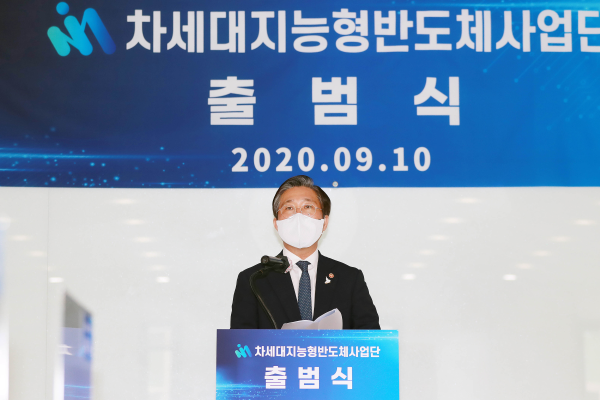
Minister of Trade, Industry and Energy Sung Yun-mo [Photo = Ministry of Trade, Industry and Energy]
On the 10th, the Ministry of Science and ICT (hereinafter MSIT) and the Ministry of Trade, Industry and Energy (hereinafter MOTIE) held a launch ceremony for the 'Next Generation Intelligent Semiconductor Project Group' (hereinafter Project Group) at the Semiconductor Industry Association located in Seongnam, Gyeonggi-do, and signed a Memorandum of Understanding (MOU) for the development of next-generation intelligent semiconductors and the establishment of an ecosystem to support them.
The launch ceremony was attended by about 20 officials from major domestic semiconductor companies and institutions, including Minister of Science and ICT Choi Ki-young, Minister of Trade, Industry and Energy Sung Yun-mo, Head of the Next-Generation Intelligent Semiconductor Business Group Kim Hyung-joon, and SK Hynix Vice Chairman Park Sung-wook.
The project consortium serves as the central hub for the next-generation intelligent semiconductor technology development project (hereinafter referred to as the project), which is being launched this year by the Ministry of Science and ICT and the Ministry of Trade, Industry and Energy. It establishes a mid-to-long-term development roadmap encompassing all sectors of the semiconductor industry, coordinates with infrastructure institutions to support this, and acts as a bridge for public-private cooperation.
1.0096 trillion won will be invested in the project from 2020 to 2029, making it the only project exceeding 1 trillion won among R&D projects that have undergone preliminary feasibility studies in the last five years.
This year, 103 companies, 32 universities, and 12 research institutes are participating in 82 projects. In the future, the development of future devices to reduce power consumption and achieve high performance, advancement of design technology to improve computational speed, and the devising of atomic-level process and equipment technologies to overcome miniaturization limitations will be pursued.
Meanwhile, at the launch ceremony, side events included the signing of a cooperation MOU to enhance competitiveness in the semiconductor materials, components, and equipment sectors, as well as an MOU for solidarity and cooperation between major semiconductor companies and institutions.
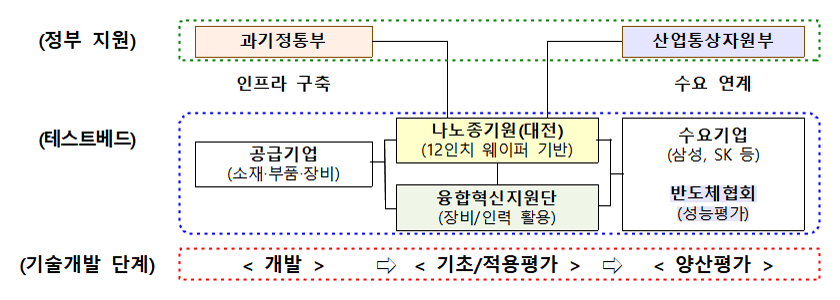
MOU Overview [Figure = Ministry of Science and ICT, Ministry of Trade, Industry and Energy]
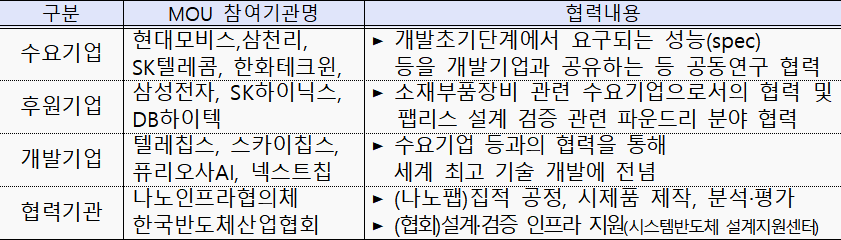
Key Contents of MOU [Table = Ministry of Science and ICT, Ministry of Trade, Industry and Energy]
Minister of Trade, Industry and Energy Sung Yun-mo stated, “To strengthen the overall competitiveness of the system semiconductor ecosystem, we will expand and reorganize the Convergence Alliance 2.0 to enhance solidarity and cooperation among design companies, foundries, and demand companies centered on AI semiconductors, and we will spare no comprehensive support to strengthen the competitiveness of the ecosystem, including the materials and equipment industries that will support this.”
Comments
Related news
Ten Korean fabless companies will be granted free access to Arm IP.
The Ministry of SMEs and Startups and Arm have concluded a comprehensive business agreement to support the growth of domestic semiconductor startups and venture companies. Under the agreement, Arm will provide Arm Flexible Access to the Ministry of SMEs and Startups for the next three years, while the Ministry will select ten startups and venture companies annually and provide support for them to utilize Arm's IP for one year.
2020.04.22by 이수민 기자
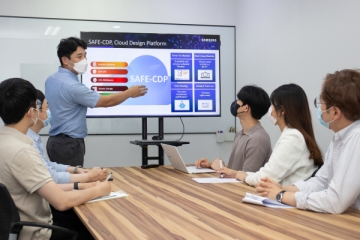
Samsung Electronics Supports Korean Fabless Companies with SAFE-CDP Chip Design Platform
Samsung Electronics announced that it will support domestic small and medium-sized fabless companies with SAFE-CDP, a platform that enables semiconductor chip design in the cloud. SAFE-CDP is a service that provides a virtual design environment allowing fabless customers to immediately begin chip design with just an idea.
2020.06.19by 이수민 기자
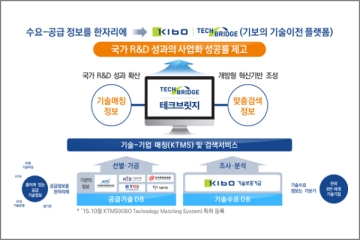
31 R&D Projects Selected to Support Commercialization of Materials, Parts, and Equipment Technologies for SMEs
The Ministry of SMEs and Startups has selected 31 projects in the first round for the Tech Bridge Commercialization Technology Development Project, which provides follow-up commercialization technology development funding to SMEs that have acquired core technologies in the materials, components, and equipment sectors from universities and research institutes.
2020.08.24by 명세환 기자

[e4ds Tech Day 2026 ⑨] Sim Sang-gyu, Autocrypt CTO: "In the Physical AI Era, Automotive Security Must Extend Beyond the Vehicle"
At e4ds Tech Day 2026, Sim Sang-gyu, CTO of Autocrypt, explained automotive cybersecurity strategies in the era of Physical AI and SDV (Software-Defined Vehicle). Automobiles are evolving as part of an ecosystem connected to AI, cloud, chargers, IoT, and robots, and he emphasized that the scope of security must expand beyond the vehicle interior to the entire connected environment. In particular, AI model tampering, adversarial attacks, OTA updates, and EV charger hacking were identified as major threats. He explained that response measures require zero trust, AI model integrity protection, intrusion detection, Security by Design and Default, and full lifecycle security management, and that proactive security system establishment beyond regulatory compliance is critical for securing future mobility competitiveness.
2026.10.12by 배종인 기자

NVIDIA to Invest $1 Billion in U.S. Science Over Next Five Years
NVIDIA has announced plans to invest $1 billion over the next five years to strengthen U.S. scientific and technological competitiveness. The company will enhance cutting-edge artificial intelligence research and development capabilities in key areas including quantum computing, healthcare, and energy security, while expanding support for higher education research institutions and cloud service providers. NVIDIA is participating as a major industry partner in the White House Office of Science and Technology Policy's Genesis Mission, and is promoting supercomputer construction in collaboration with national laboratories including Argonne and Los Alamos.
2026.10.12by 배종인 기자











