


Samsung Electronics Unveils Four Ultra-Small, High-Resolution 0.7μm Image Sensors
 Published2020.09.15 11:01
15% size reduction and 10% height reduction compared to 0.8μm
Isocell 2.0 to be applied to the GM5, which will enter mass production in the fourth quarter.
High-resolution cameras require image sensors with ultra-small pixels. This is because they allow for more pixels to be packed into a limited space while simultaneously achieving a slim design. Accordingly, on the 15th, Samsung Electronics unveiled four new mobile image sensors utilizing 0.7μm (micrometer) pixels.
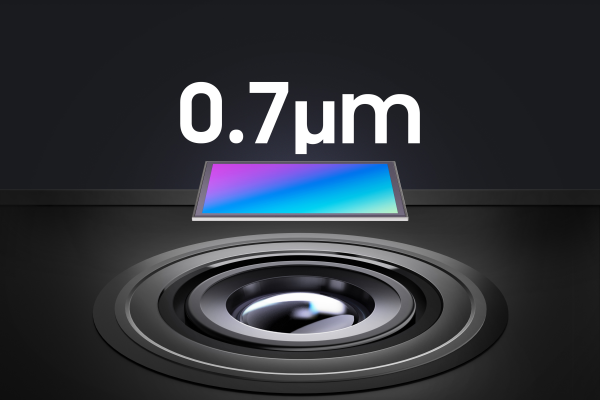
Samsung Electronics unveiled the industry's first 0.7μm pixel product in 2019. This year, it has expanded its product lineup with four new products based on 0.7μm pixels. The new products are ▲ the first 108-megapixel 'ISOCELL HM2' with 0.7μm pixels, ▲ the 64-megapixel 'GW3' capable of 4K 60fps shooting, ▲ the 48-megapixel 'GM5' that supports ultra-wide angle and folded zoom, and ▲ the ultra-small 32-megapixel 'JD1' optimized for bezel-less design.
In general, as the size of the image sensor pixels decreases, the area that receives light decreases, resulting in lower quality of the captured image. Samsung Electronics has also applied its proprietary "ISOCELL PLUS" technology, which minimizes light loss and inter-pixel interference, to its 0.7μm image sensor. It also features "Smart-ISO" technology, which automatically adjusts the ISO value based on the amount of light to enhance color reproducibility and minimize noise.
In addition, cutting-edge sensor technologies such as 'ISOCELL 2.0' and 'Staggered HDR' are also applied. ISOCELL 2.0 (applied to GM5 to be released in the fourth quarter) is a technology that minimizes light loss and inter-pixel interference by streamlining the partition structure between color filters, which can increase sensitivity by up to 12%, allowing for improved image quality even with smaller pixels. Staggered HDR (Staggered High Dynamic Range) is a technology that improves the way pixels are exposed to light, which has the advantage of obtaining high-quality images while improving image processing speed.
Implementing a 108-megapixel product with 0.7μm pixels allows for up to a 15% reduction in image sensor size compared to using 0.8μm pixels. The smaller image sensor also reduces the height of the camera module by up to 10%, allowing for smaller cameras in smartphones. Samsung Electronics is currently mass-producing the ISOCELL HM2, GW3, and JD1, and is supplying samples of the GM5.
Comments
Related news
Samsung Electronics Launches 100-Megapixel Image Sensor with PDAF Support
Samsung Electronics has launched the ISOCELL GN1, a 50-megapixel mobile image sensor based on 1.2μm pixels with phase detection autofocus capability. Each pixel contains two photodiodes, so in the case of 50 megapixels, it can output images at the level of 100 megapixels by utilizing the light received by 100 million photodiodes.
2020.05.19by 이수민 기자
Teledyne e2v Unveils Lighting-Independent 2MP MIPI Module
Teledyne e2v has launched a pre-focused compact optical module for industrial 2MP applications. The module is equipped with Teledyne e2v's Snappy 2-megapixel CMOS sensor, which features 2.8μm low-noise global shutter pixels. With fast self-exposure technology applied, rapid image processing is possible even when lighting conditions change.
2020.09.10by 강정규 기자
.png)
Mouser to Supply Millimeter-Wave Sensors for TI Industrial Radars
Mouser supplies TI's IWR6x millimeter-wave sensor product line. The IWR6x sensor products are integrated millimeter-wave sensors based on FMCW radar technology capable of operating in the 60GHz to 64GHz band, manufactured using low-power 45nm RFCMOS process.
2020.09.14by 강정규 기자

Intel Unveils Next-Generation 'Core Ultra Series 3' and vPro Platform for Enterprise PCs
Intel has officially unveiled the "Intel Core Ultra Series 3" for next-generation enterprise PCs and the latest vPro platform, addressing a wide range of demands from enterprise notebooks to high-performance workstations.
2026.03.26by 배종인 기자
ROHM Launches ESD Protection Diode Compatible with High-Speed Interfaces of 10Gbps or Higher
Semiconductor specialist ROHM has developed the 'RESDxVx series' of ESD (electrostatic discharge) protection diodes capable of responding to next-generation high-speed data communication environments exceeding 10Gbps, simultaneously enhancing both signal quality maintenance required in high-speed interfaces and IC protection performance.
2026.03.26by 배종인 기자











