



Microchip Releases Free Linux GUI Development Toolkit 'EGT'
 Published2020.09.24 11:29
On displays with up to XGA resolution
Provides high performance with basic hardware acceleration
A well-built graphical user interface (GUI) helps users interact efficiently with various applications.
Microchip Technology Inc. today announced the release of a new GUI development toolkit for its 32-bit Linux-based microprocessor (MPU) portfolio. The Ensemble Graphics Toolkit (EGT) helps developers in the industrial, medical, consumer, and automotive graphic display fields reduce development costs and time to market.
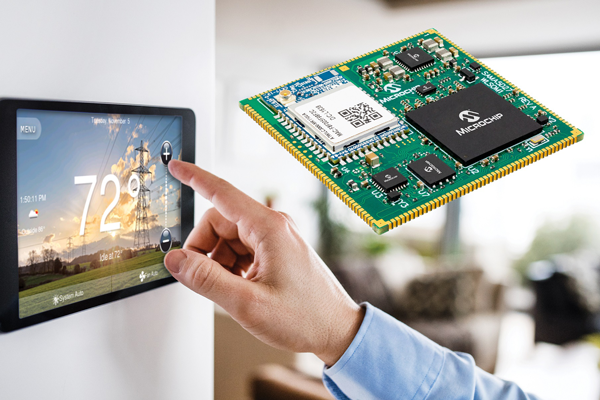
EGT is a free, open-source C++ GUI suite that supports Microchip's Arm Cortex-A5-based SAMA5 and SAM9 series and ARM926EJ-S processor-based MPU family, including System-in-Package (SiP) and System-on-Module (SoM) products.
Optimized for Microchip's 32-bit MPUs running the Linux operating system, the EGT leverages native hardware acceleration, including the graphics controller and video decoder, to provide users with high-performance capabilities on low- to mid-end graphics displays with resolutions up to XGA (1024×768 pixels).
EGT provides a variety of GUIs for Microchip MPUs that are power-efficient compared to other graphics solutions that rely on high-performance cores and 3D graphics acceleration. It also provides a cold boot time of less than 3 seconds, which is required for applications such as automotive dashboard clusters.
Available license- and royalty-free, EGT complements Microchip’s bare-metal/RTOS-based MPLAB Harmony Graphics Suite embedded software development framework and provides a royalty-free GUI.
EGT is fully integrated with Microchip's Long Term Support (LTS) Linux offering, Linux4SAM.
Linux4SAM supports a wide range of drivers, including the maXTouch family of touchscreen controllers, memory devices, power management, analog devices, and wired and wireless networking components and modules. Linux4SAM is regularly updated and supports all Microchip MPUs for the life of the product.
Comments
Related news

Arm Unveils New CPUs, GPUs, and NPUs with Enhanced Machine Learning
Arm announced four next-generation mobile solutions. The Cortex-A78 CPU offers 20% improved sustained performance per watt compared to the A77, and the Mali-G78 GPU delivers over 25% improved graphics performance compared to the G77. The Ethos-N78 NPU achieves 25% improved efficiency compared to the N77. Additionally, the Cortex-X custom program and Cortex-X1 CPU were also unveiled.
2020.05.27by 이수민 기자

TI Releases Free Simulator with 5,700 IC Models
Hardware engineers must go through accurate design and thorough verification processes regardless of how tight product development schedules are. This is why simulation tools are necessary. Accordingly, analog semiconductor company Texas Instruments and system semiconductor design tool company Cadence have made the PSPICE simulator for TI available for free.
2020.09.17by 명세환 기자
Microchip Launches RISC-V-Based SoC FPGA Development Kit
As processors adopting RISC-V, an open instruction set architecture, continue to increase, there is growing demand for affordable and standardized development platforms that support RISC-V technology and ecosystem. In response, Microchip has launched the iCEcle development kit for RISC-V-based PolarFire SoC FPGA.
2020.09.18by 이수민 기자

ESP32 Development Environment Selection and GPS Application Implementation
The ESP32 is a microcontroller that integrates Wi-Fi, Bluetooth, 12-bit ADC, capacitive touch, PWM, DAC, and UART in a single SoC. However, the abundance of features does not by itself solve the designer's problems. The real challenges lie in selecting the appropriate development environment, determining which pins can be used and which must be avoided, and converting raw data from modules into usable information. This document addresses ESP32 peripheral constraints (ADC2 and Wi-Fi coexistence limitation, UART1 occupancy, ADC non-linear regions), the trade-offs between Arduino IDE and ESP-IDF, and the process from connecting NEO-6M/NEO-M8N GPS modules to UART2, parsing NMEA sentences, and visualizing routes in Google Earth, all organized based on documented references.
2026.10.12by 편집부
MIPI CSI-2, DSI-2, C-PHY, D-PHY Test Solution Technical White Paper
The MIPI interface adopts a burst mode that transitions between low-power (LP) and high-speed (HS) states for low-power consumption, and in return, strict timing rules are imposed on state transitions. Additionally, the high-speed section operates as a packet-based protocol with headers, ECC, and CRC, so verification engineers must handle waveforms and protocols simultaneously. Traditional configurations combining general-purpose oscilloscopes and AWGs reveal limitations in setup complexity, measurement uncertainty, and lack of reproducibility when faced with these requirements. This white paper, based on webinar materials, organizes the structure of this problem and describes how the SV5C-DPTXCPTX generator for receiver testing and SV5C-DPRXCPRX analyzer for transmitter testing integrate state transition testing, stressed eye testing, and protocol analysis into a single bench, along with their application boundaries.
2026.10.12by 편집부











