


Ministry of Science and ICT Promotes AI Data Quality Standard as International Standard
 Published2020.10.05 15:57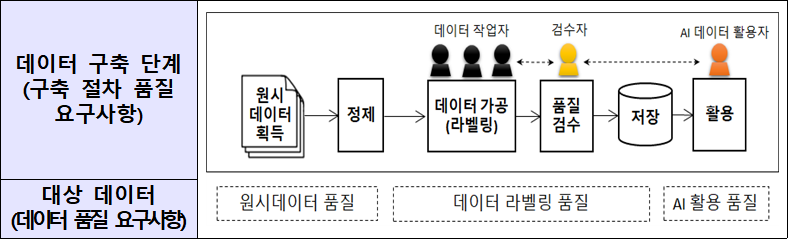
▲AI Data Quality Concept [Photo=Ministry of Science and ICT]
On the 5th, the Ministry of Science and ICT announced that it will pursue international standardization of AI data quality standards, a core resource of the Digital New Deal 'Data Dam'.
In this regard, it will develop a standard that establishes the concept and scope of quality and detailed requirements, and on the 6th will officially propose it to the group standardization organization (TTA PG 1005, AI-based Technology) within the Korea Information and Communication Technology Association, with plans to make it a TTA group standard.
Subsequently, it is expected to undergo a process of collecting opinions from related experts and achieve final adoption and confirmation in June of next year. Additionally, there are plans to proceed with related content toward international standardization achievements.
This standard was developed by supplementing and concretizing the previously developed 'Common Criteria for Building and Quality Management of AI Training Data ('19)' through the Korea Information and Communication Technology Association and the National Information Society Agency, based on analysis of overseas cases and review of AI and quality management.
Therefore, the quality of AI data focuses on user-oriented useful value, taking into account the diversity, accuracy, and validity of AI technology (models and algorithms) data.
However, even renowned open datasets built and updated over 4-6 years by global information and communication technology companies such as Microsoft and Google show data accuracy levels of only 43-83%, demonstrating that a systematic methodology for AI data quality has not yet been established globally.
Accordingly, the standard is being developed in the form of a universal standard applicable across diverse fields including natural language processing, autonomous vehicles, healthcare, agriculture and fisheries, and manufacturing.
The Ministry of Science and ICT announced that it is already applying the standard developed this time to projects in ten priority sectors of supplementary budget, and will rapidly advance standardization through collecting opinions from industry, academia, and research experts in the group standardization organization (TTA PG 1005, AI-based Technology) within the Korea Information and Communication Technology Association.
Furthermore, there are plans to propose related matters to the 'AI International Standardization Conference (ISO/IEC JTC1/SC42)' to achieve outcomes in international standardization.
Comments
Related news
AI provides early diagnosis of COVID-19 infection
Early diagnosis of COVID-19 infection is now possible through a pneumonia AI diagnostic service. Based on research findings that chest CT scans performed in the early stages of novel coronavirus infection are useful for early diagnosis of infection, DS Lab Global has developed an artificial intelligence model achieving 97.6% accuracy.
2020.03.05by 최인영 기자
KT develops COVID-19 spread prediction model using AI and big data.
KT is establishing a COVID-19 spread prediction research alliance with six research institutions in cooperation with the Ministry of Science and Technology. The alliance will jointly conduct research to predict domestic inflow of COVID-19 and regional transmission by leveraging floating population data through artificial intelligence, big data, and mathematical modeling.
2020.03.24by 최인영 기자
Korean AI Market to Grow at an Average Annual Rate of 17.8% by 2023
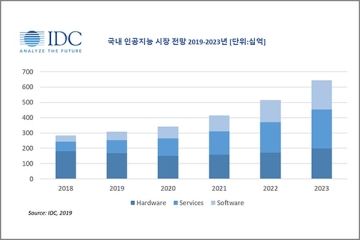
Korea IDC announced through its domestic artificial intelligence 2019-2023 market outlook report that the domestic AI market will grow at an average annual rate of 17.8% over the next five years and will form a market size exceeding 640 billion won by 2023. The report indicated that while the hardware market for AI accounted for the largest revenue share in the overall AI market in 2019, it will record lower growth rates in the future and will hold a smaller proportion than the consulting and development-related service market for AI deployment from 2022 onwards.
2020.04.03by 이수민 기자
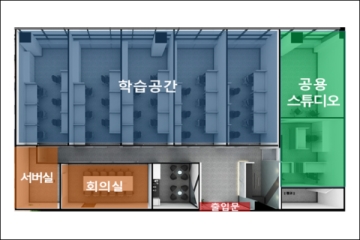
The Ministry of Science and ICT has begun developing AI to detect illegal counterfeit goods.
The Ministry of Science and ICT and the Korea Customs Service opened an AI-powered illegal counterfeit product detection demonstration lab at the Daejeon Technopark DiStation. The demonstration lab, with a total area of 288㎡, provides facilities and equipment that can process and train related data such as photographs and drawings of authentic products to identify counterfeit goods that imitate product designs.
2020.09.29by 김동우 기자
Camera for Both Humans and Machines: ST BrightSense 5MP Dual Shutter Image Sensor
Video consumed by humans and imagery analyzed by machines impose different requirements on the sensor in terms of shutter method and wavelength band. Until now, sensors had to be separated or supplemented with companion chips and high-performance processors, and this cost and complexity became a bottleneck in vision system design. The ST BrightSense next-generation 5MP image sensor (VD5943, VD1943, VB5943, VB1943) with 2.25 µm pixels supports both global and rolling shutters, and through on-chip staggered HDR (up to 100 dB), on-chip RGB-IR separation and 5MP NIR smart upscaling, and frame-by-frame context switching, absorbs both requirements internally at the sensor level. This white paper describes the rationale, choices, trade-offs, and results of each design decision based on presentation slides and technical Q&A, and specifies application boundaries. The product is scheduled for mass production in February 2026, and evaluation and sampling are currently available.
2026.10.13by 편집부











