This page was machine-translated and may differ from the original. View original
AI semiconductors are kick-starting our journey to becoming a comprehensive semiconductor powerhouse by 2030.

AI semiconductors to be developed as a second DRAM by 2030.
AI semiconductor market share of 20% by 2030,
20 innovative companies and 3,000 highly skilled workers achieved
Based on the competitiveness of memory semiconductors, a foundation is being laid for Korea to leap forward as a semiconductor powerhouse dedicated to AI.

On the 12th, the government held the 13th Science and Technology Ministerial Meeting at the System Semiconductor Design Support Center in Seongnam, Gyeonggi Province, and announced the AI semiconductor industry development strategy.
AI semiconductors are considered the foundation of the data-driven AI ecosystem and the next-generation growth engine for system semiconductors. However, the AI semiconductor market is still in its early stages with no dominant player.
The government established this strategy to foster AI semiconductors by focusing on Korea's unique strengths, including its world-leading memory semiconductor manufacturing capabilities.
What is an AI semiconductor?
AI semiconductors are semiconductors that process large-scale calculations required for implementing AI services, such as learning and inference, with high performance and efficiency.
The first generation can be defined as a hybrid of CPU and GPU, the second generation as NPU (Neural Processing Unit), and the third generation as neuromorphic. Currently, research on all generations of AI semiconductors is in progress.
AI semiconductors are used in various industries such as servers, mobile, automobiles, and home appliances. It is expected that convergence with other fields will create new markets. The market size itself is also projected to grow sixfold over the next ten years, from this year to 2030, reaching a total of $117.9 billion.
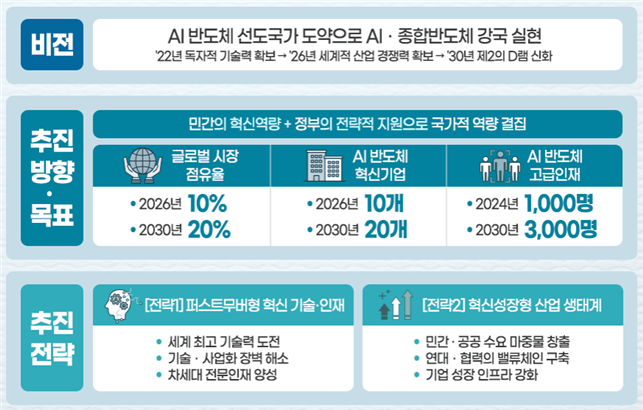
The government has established two major strategies to achieve ▲20% global market share ▲20 innovative companies ▲3,000 highly skilled individuals by 2030.
Strategy 1: Securing AI semiconductor technology and talent
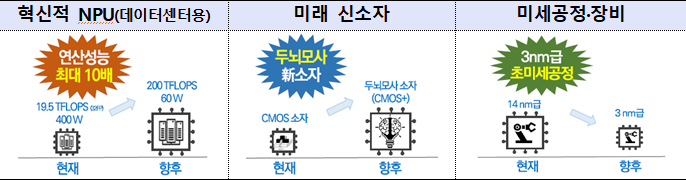
First, starting this year, the government will pursue the development of a 60W, 200TFLOPS NPU, a CMOS+ device, and a 3nm process and equipment, surpassing the current 400W, 19.5TFLOPS (1,000 trillion calculations per second) NPU for data centers, CMOS devices, and 14nm-class fine processes and equipment. Furthermore, the development of an NPU for Level 4 autonomous driving will also be pursued starting next year.

Next, we will pursue the 'BIG Project' starting next year to build and expand the PIM (Processing In Memory) semiconductor industry ecosystem that integrates storage (memory) and computation (processor). By 2024, we plan to develop PIM semiconductors based on domestic DRAM processes, and thereafter based on RRAM, MRAM, and PRAM processes.
Finally, we will establish a new AI Semiconductor Academy program, a 1:1 investment initiative between businesses and the government. Starting this year, we will foster a leading university that will train 3,000 master's and doctoral degree-level designers over the next 10 years. In addition to strengthening AI semiconductor practice-based training programs for current employees and undergraduates, we will also expand the talent pool through AI semiconductor design competitions.
Strategy 2: Activating the AI Semiconductor Industry Ecosystem
First, the One Company, One Chip project, AI semiconductor hotline, and AI chip testbed will be established. Through these initiatives, the government will support the launch of 50 demand-tailored AI semiconductors by 2030.

We will also support solidarity and cooperation among IP, fabless, design houses, and foundry companies that design, produce, assemble, and test AI semiconductors. To this end, we plan to establish an AI semiconductor process innovation valley in Pyeongtaek and Yongin, Gyeonggi Province. To foster AI semiconductor innovation companies, we plan to establish an AI semiconductor innovation design center in Seongnam, Gyeonggi Province.
Additionally, to promote the scale-up of AI semiconductor innovation companies, next-generation semiconductors will be included in the policy-based New Deal Fund's investment targets and investment briefings will be held to promote financial support for the AI semiconductor industry. Furthermore, the company plans to utilize the existing semiconductor fund to invest 70 billion won in R&D and M&A efforts for AI semiconductor companies.
A new AI semiconductor industry strategy meeting will be established.
To implement and review this strategy, an AI Semiconductor Industry Strategy Meeting will be held, co-chaired by the Ministers of Science and ICT and Trade. It has two sub-allies: the System Semiconductor Convergence Alliance and the Intelligent Semiconductor Forum, each of which promotes demand linkage in key fields and strengthening technological cooperation between industry, academia, and research institutes.

Minister of Science and ICT Choi Ki-young said, “We have established this measure to secure competitiveness in the AI semiconductor market early on,” and added, “We will proceed without a hitch with large-scale technology and talent development projects and initial demand creation linked to the Digital New Deal.”
Minister of Trade, Industry and Energy Sung Yun-mo said, “AI semiconductors are a major medium that will change the semiconductor market in the post-COVID-19 era and a key growth engine in the system semiconductor sector,” and expressed his ambition, saying, “We will maintain the ultra-gap in memory semiconductors and create a new gap in AI semiconductors to realize a comprehensive semiconductor powerhouse by 2030.”
AI semiconductor market share of 20% by 2030,
20 innovative companies and 3,000 highly skilled workers achieved
Based on the competitiveness of memory semiconductors, a foundation is being laid for Korea to leap forward as a semiconductor powerhouse dedicated to AI.

▲ AI Semiconductor Industry Development Strategy [Table = Ministry of Science and ICT, Ministry of Trade, Industry and Energy]
On the 12th, the government held the 13th Science and Technology Ministerial Meeting at the System Semiconductor Design Support Center in Seongnam, Gyeonggi Province, and announced the AI semiconductor industry development strategy.
AI semiconductors are considered the foundation of the data-driven AI ecosystem and the next-generation growth engine for system semiconductors. However, the AI semiconductor market is still in its early stages with no dominant player.
The government established this strategy to foster AI semiconductors by focusing on Korea's unique strengths, including its world-leading memory semiconductor manufacturing capabilities.
What is an AI semiconductor?
AI semiconductors are semiconductors that process large-scale calculations required for implementing AI services, such as learning and inference, with high performance and efficiency.
The first generation can be defined as a hybrid of CPU and GPU, the second generation as NPU (Neural Processing Unit), and the third generation as neuromorphic. Currently, research on all generations of AI semiconductors is in progress.
AI semiconductors are used in various industries such as servers, mobile, automobiles, and home appliances. It is expected that convergence with other fields will create new markets. The market size itself is also projected to grow sixfold over the next ten years, from this year to 2030, reaching a total of $117.9 billion.
The government has established two major strategies to achieve ▲20% global market share ▲20 innovative companies ▲3,000 highly skilled individuals by 2030.
Strategy 1: Securing AI semiconductor technology and talent
First, starting this year, the government will pursue the development of a 60W, 200TFLOPS NPU, a CMOS+ device, and a 3nm process and equipment, surpassing the current 400W, 19.5TFLOPS (1,000 trillion calculations per second) NPU for data centers, CMOS devices, and 14nm-class fine processes and equipment. Furthermore, the development of an NPU for Level 4 autonomous driving will also be pursued starting next year.

▲ Technology development encompassing not only products but also materials, parts, and equipment
It is scheduled to be held [Table = Ministry of Science and ICT, Ministry of Trade, Industry and Energy]
Next, we will pursue the 'BIG Project' starting next year to build and expand the PIM (Processing In Memory) semiconductor industry ecosystem that integrates storage (memory) and computation (processor). By 2024, we plan to develop PIM semiconductors based on domestic DRAM processes, and thereafter based on RRAM, MRAM, and PRAM processes.
Finally, we will establish a new AI Semiconductor Academy program, a 1:1 investment initiative between businesses and the government. Starting this year, we will foster a leading university that will train 3,000 master's and doctoral degree-level designers over the next 10 years. In addition to strengthening AI semiconductor practice-based training programs for current employees and undergraduates, we will also expand the talent pool through AI semiconductor design competitions.
Strategy 2: Activating the AI Semiconductor Industry Ecosystem
First, the One Company, One Chip project, AI semiconductor hotline, and AI chip testbed will be established. Through these initiatives, the government will support the launch of 50 demand-tailored AI semiconductors by 2030.

▲ Promoting solidarity among AI semiconductor companies [Image = Ministry of Science and ICT, Ministry of Trade, Industry and Energy]
We will also support solidarity and cooperation among IP, fabless, design houses, and foundry companies that design, produce, assemble, and test AI semiconductors. To this end, we plan to establish an AI semiconductor process innovation valley in Pyeongtaek and Yongin, Gyeonggi Province. To foster AI semiconductor innovation companies, we plan to establish an AI semiconductor innovation design center in Seongnam, Gyeonggi Province.
Additionally, to promote the scale-up of AI semiconductor innovation companies, next-generation semiconductors will be included in the policy-based New Deal Fund's investment targets and investment briefings will be held to promote financial support for the AI semiconductor industry. Furthermore, the company plans to utilize the existing semiconductor fund to invest 70 billion won in R&D and M&A efforts for AI semiconductor companies.
A new AI semiconductor industry strategy meeting will be established.
To implement and review this strategy, an AI Semiconductor Industry Strategy Meeting will be held, co-chaired by the Ministers of Science and ICT and Trade. It has two sub-allies: the System Semiconductor Convergence Alliance and the Intelligent Semiconductor Forum, each of which promotes demand linkage in key fields and strengthening technological cooperation between industry, academia, and research institutes.
▲ (From left) Minister of Science and ICT Choi Ki-young and Minister of Trade, Industry and Energy Sung Yun-mo
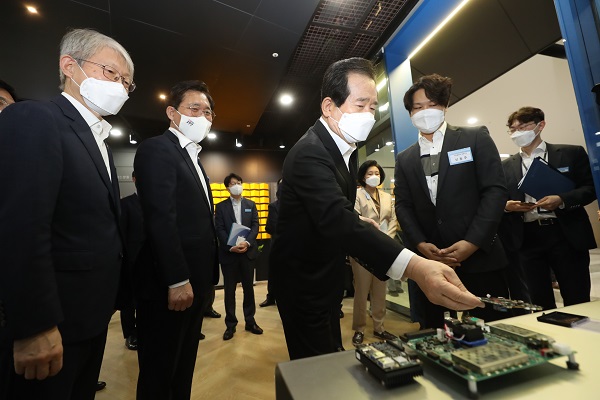
Prime Minister Chung Sye-kyun and Mobilint CEO Shin Dong-joo [Photo = Ministry of Science and ICT and Ministry of Trade, Industry and Energy ]
Minister of Science and ICT Choi Ki-young said, “We have established this measure to secure competitiveness in the AI semiconductor market early on,” and added, “We will proceed without a hitch with large-scale technology and talent development projects and initial demand creation linked to the Digital New Deal.”
Minister of Trade, Industry and Energy Sung Yun-mo said, “AI semiconductors are a major medium that will change the semiconductor market in the post-COVID-19 era and a key growth engine in the system semiconductor sector,” and expressed his ambition, saying, “We will maintain the ultra-gap in memory semiconductors and create a new gap in AI semiconductors to realize a comprehensive semiconductor powerhouse by 2030.”
본 기사에 대한 정정·반론·추후보도 청구는 보도 청구 안내를, 그간 게재된 보도문은 정정·반론보도 모아보기를 참고해 주세요.