



KAIST Develops Smart Speaker That Initiates Conversations First
 Published2020.11.02 16:37
학생 40명, 1주일간 총 3500개 사용자 응답 데이터 수집
KAIST 전산학부 이의진 교수 연구팀이 스마트 스피커 인공지능 비서가 적시에 최적의 발화 시점을 결정할 수 있는 중요한 사용자 상황맥락 요인을 발견했다고 28일 밝혔다.
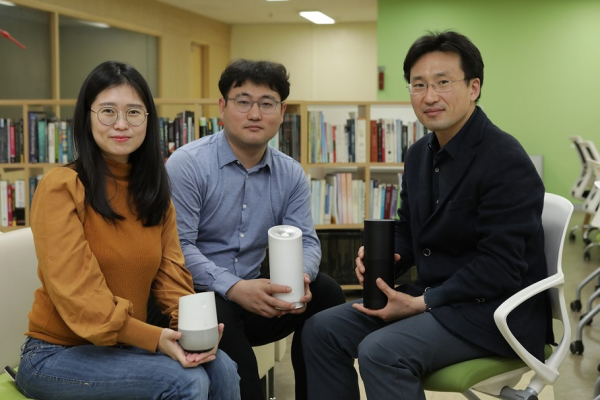

똑똑한 음성비서가 사용자가 처해 있는 상황을 정확히 이해한 후 선제적으로 일정 및 건강관리를 도와주는 방향으로 개발되고 있는 것이다. 하지만 아무 때나 눈치 없이 말을 건다면 도움은커녕 하는 일에 방해만 될 수 있다.
이의진 교수 연구팀은 스마트 스피커가 선제적으로 음성서비스를 제공하기 좋은 최적의 시점을 찾는 공동연구를 수행했다. 그 결과 연구팀은 스마트 홈 환경에서의 최적의 발화(發話) 시점을 결정하는 중요한 사용자 상황맥락 요인을 찾았다.
최적의 발화 시점에 관한 추론은 인공지능 비서가 음성서비스를 시작하거나 중지 또는 재개를 스스로 결정하고 제어하기 위한 필수적인 기술이다. 연구팀이 찾아낸 중요한 상황맥락 요인은 최적의 발화 시점 추론 시 정확성을 높일 것으로 관계자들은 기대하고 있다.
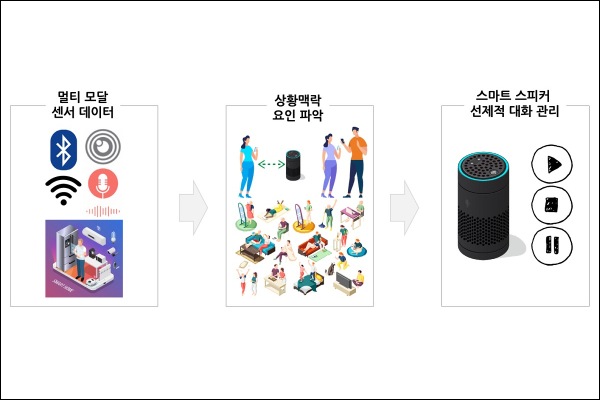
▲ 멀티모달 센서 데이터 기반 선제적 대화 관리 [사진=KAIST]
데이터 분석 결과 전체 참가자 응답 중 47%는 대화하기 부적절한 것으로 드러났다. 연구진은 대화하기 좋은 시점을 결정하는 주요 상황 요인을 찾기 위해 19개의 실내 활동 범주를 만들었다. 이를 통해 연구팀은 적절한 시점을 결정하는 상황맥락 요인으로 크게 개인적 요인과 움직임 요인, 사회적 요인을 꼽았다.
개인적 요인은 크게 `활동 집중도', `긴급함과 바쁨 정도', `정신적·육체적 상태' 그리고 `다중 작업수행을 위한 듣기 또는 말하기 가능성' 등 4가지다. 예를 들면 집중해서 공부하고 있거나 드라이로 머리를 말리고 있을 때는 스피커와 대화가 어려웠다. 움직임 요인은 `외출', `귀가' 그리고 `활동 전환' 등 3가지다.
특히 사용자 움직임이 있을 때는 스피커와 대화 가능한 거리가 최적 시점 판단에 큰 영향을 미쳤다. 외출은 스피커와 대화 가능 범위 밖으로 나가는 움직임이고, 귀가는 범위 안으로 들어오는 움직임이다. 범위 안으로 들어오는 귀가(歸家) 상황일 때는 대부분 대화하기 좋은 시점으로 분류됐다.
일반적으로 스마트 스피커는 거실처럼 집 구성원이 함께 생활하는 공간에 설치된다. 수집된 사용자 응답 중 절반은 룸메이트가 함께 있을 때 수집됐다. 연구팀은 전화 대화뿐만 아니라 누군가와 함께 있다는 것 또한 스마트 스피커와 대화하기 좋은 시점에 영향을 끼친다는 현상을 발견했다. 룸메이트가 자고 있거나 어떤 활동에 집중하고 있을 때 스마트 스피커와의 대화로 인한 갈등을 최소화하고 싶기 때문이다.
이번 연구에 제1 저자로 참여한 차나래 학생은 "이번 연구가 미래 스마트 스피커 개발의 중요한 토대가 될 것ˮ이라면서 "앞으로는 센서 데이터로 감지된 상황맥락 정보를 활용해 스마트 스피커가 스스로 대화를 시작·중지, 또는 재개하기 좋은 타이밍을 선제적으로 감지해 지능적인 음성서비스를 제공할 수 있을 것ˮ이라고 밝혔다.
한편, 이 연구는 유비쿼터스 컴퓨팅 분야 국제 최우수 학술지인 `Proceedings of the ACM on Interactive, Mobile, Wearable and Ubiquitous Technologies' 9월호에 게재됐다.
Comments
Related news
"Analyzing Video with AI Following Voice" Xilinx and SKT Strengthen Cooperation in AI Inference
To realize AI-based physical unauthorized access detection, it is necessary to monitor millions of commercial and residential camera systems in real time. For this, fast and accurate AI accelerators are required. Xilinx announced that its data center accelerator card is used in SK Telecom's unauthorized access detection service 'T-View'. This marks the third instance of SK Telecom using Xilinx's FPGA-based accelerator card in its services, following the ASR-based AI speaker Nugu and call center SST solution. Xilinx's Alveo U250 data center accelerator card is mounted on SK Telecom's AI inference accelerator AIX and runs on SK Telecom's data center servers.
2019.11.01by 이수민 기자
Smart speaker can recognize voice clearly without deep learning
Smart speakers that understand and respond to users' voices in living rooms, kitchens, bedrooms, and even inside vehicles are no longer just science fiction. According to global market research firm Canalyst, the number of smart speakers installed worldwide is expected to exceed 200 million units by the end of 2019. However, users remain dissatisfied with AI speakers that still produce unexpected responses. We spoke with a veteran engineer who developed an ADC product—a speaker that responds consistently and clearly even at low volumes and from a distance—to learn about the core technology.
2019.12.03by 최인영 기자
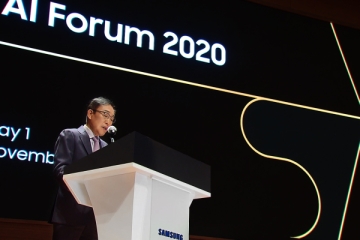
Samsung Electronics Hosts the 4th Samsung AI Forum 2020
Held for the fourth time this year, the 'Samsung AI Forum' is a venue where world-renowned AI experts share the latest technology trends and research achievements, exploring ways in which AI technology can assist human life in this rapidly changing era marked by recent events such as pandemics. This AI Forum was broadcast through Samsung Electronics' YouTube channel, providing researchers and students in the AI field worldwide with the opportunity to engage in real-time Q&A and exchange with world-leading scholars. In his opening remarks, CEO Kim Ki-nam stated, "While AI technology has been rapidly applied to people's lives in recent years and has had positive impacts, challenges requiring massive amounts of data such as pandemics and natural disasters remain difficult to solve with current AI algorithms and hardware," thereby presenting the direction in which AI technology should advance.
2020.11.02by 김동우 기자
Camera for Both Humans and Machines: ST BrightSense 5MP Dual Shutter Image Sensor
Video consumed by humans and imagery analyzed by machines impose different requirements on the sensor in terms of shutter method and wavelength band. Until now, sensors had to be separated or supplemented with companion chips and high-performance processors, and this cost and complexity became a bottleneck in vision system design. The ST BrightSense next-generation 5MP image sensor (VD5943, VD1943, VB5943, VB1943) with 2.25 µm pixels supports both global and rolling shutters, and through on-chip staggered HDR (up to 100 dB), on-chip RGB-IR separation and 5MP NIR smart upscaling, and frame-by-frame context switching, absorbs both requirements internally at the sensor level. This white paper describes the rationale, choices, trade-offs, and results of each design decision based on presentation slides and technical Q&A, and specifies application boundaries. The product is scheduled for mass production in February 2026, and evaluation and sampling are currently available.
2026.10.13by 편집부
AI-based Universal Robots Automation Solution
In manufacturing environments where declining labor populations overlap with frequent production item changes, existing programming-based robot automation requires reconfiguration from weeks to several months each time product models change. This white paper takes this flexibility gap as its starting point and synthesizes, based on webinar presentation materials and technical Q&A, what collaborative robots gain and forfeit compared to industrial robots, why process automation is transitioning from rule-based to learning-based (4th generation) approaches, and how Universal Robots' hardware, software, and partner ecosystem implement this. Additionally, it clarifies the application boundaries and limitations, including that AI Accelerator is still at the development kit stage.
2026.10.13by 편집부











