


KT Completes Construction of Korea's First "5G Integrated Core Network"
 Published2020.11.03 11:24
Preemptively introduce CUPS to accommodate SA and NSA simultaneously
Providing stable communication quality by applying edge communication centers
KT announced on the 3rd that it has completed the development and construction of core network technology capable of simultaneously accommodating 5G Standalone (SA) and Non-Standalone (NSA) services.
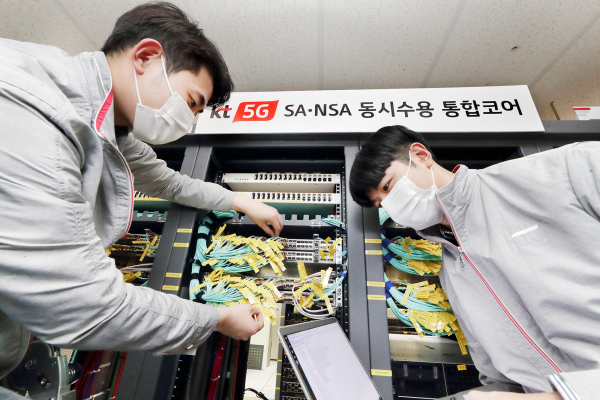
Currently, domestic 5G services are provided using the NSA method. NSA separates the control portion to the LTE network and the data portion to the 5G network, whereas SA processes both control and data through the 5G network. Since SA does not go through the LTE network, it is expected to reduce latency and consume less battery power compared to the NSA method.
To transition to SA services, equipment that meets the SA service requirements defined in the SA international standard of the 3GPP must be developed and introduced. KT proactively introduced Control & User Plane Separation (CUPS) and completed the construction of a separate core network for SA services.
When KT launched its NSA-based 5G commercial service last April, it was the only domestic telecommunications operator to introduce CUPS technology into its NSA core network. Since then, we have continuously advanced this technology and succeeded in developing the nation's first '5G integrated core technology' capable of simultaneously accommodating both NSA and SA standards.
KT collaborated closely with Samsung Electronics from the design stage to build the '5G SA-NSA integrated core network.' It applied core SA technologies such as a long-distance standard CUPS structure, 5G integrated session management, virtualization infrastructure integrated orchestration, service-customized network slicing, and ultra-low latency edge communication center access control.
In the case of other companies' NSA core networks that do not apply CUPS technology, a separate core network for SA services must be built and interconnected with the existing NSA core network. However, based on 5G integrated core technology, KT can accommodate SA services as well simply by upgrading the software on existing installed and operating NSA core equipment, without installing new equipment.
KT plans to apply 5G integrated core technology to eight edge communication centers nationwide. Through this, it plans to rapidly provide ultra-low latency 5G services to SA users via a nationwide 5G integrated core network based on these edge communication centers.
Comments
Related news

5G-based industries are expected to reach $8 trillion over the next decade.
A 5G-based industry is projected to add approximately 8 trillion dollars, or around 9,187 trillion Korean won, to global GDP by 2030. Nokia revealed this through its "5G Business Readiness" report, which was prepared based on a survey conducted in collaboration with Nokia Bell Labs targeting 1,628 decision-makers across 6 industries in 8 countries including South Korea.
2020.10.12by 이수민 기자
SKT to Fully Push Forward Advancement of 5G Capillaries, "Fronthaul"
SK Telecom announced on the 15th that it will introduce 5G wireless fronthaul equipment to provide 5G services in areas where it is difficult to install optical cables. SKT deployed 5G wireless fronthaul equipment in its commercial 5G network for the first time in Korea in Jinju, Gyeongnam in early October. Starting from Jinju, it is prioritizing installation in old urban areas where optical cable construction is difficult, and is expanding to island areas and inland mountainous regions.
2020.10.16by 김동우 기자

ADI and NEC Design '5G O-RAN Massive MIMO' RU
Analog Devices and NEC Corporation have designed a Massive MIMO antenna radio unit (RU) for Rakuten Mobile's 5G network. This wireless device transmits large-capacity data with excellent efficiency using Massive MIMO and digital beamforming technology at 3.7GHz frequency. Without requiring maintenance, repair, and labor costs associated with physical infrastructure that interferes with existing networks, operators can provide high-speed internet access worldwide at lower costs than before through cloud-native virtual networks. NEC has already begun shipments of the 5G network Massive MIMO antenna RU for Rakuten Mobile.
2020.10.23by 강정규 기자
European Patent Applications Surpass 200,000 for the First Time… South Korea Maintains 5th Place, Led by Batteries and Telecommunications
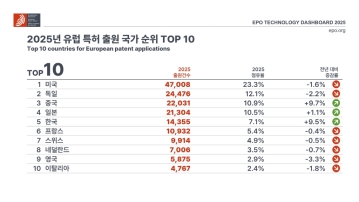
According to the European Patent Office (EPO)'s 'Technology Dashboard 2025', European patent applications last year reached 201,974, surpassing 200,000 for the first time. Korean companies and inventors filed 14,355 applications, representing a 9.5% increase from the previous year and maintaining 5th place by country. Battery, digital communication, and semiconductor technologies led the growth, with Samsung ranking as the top EPO applicant for the second consecutive year and LG reaching 3rd place. The presence of major domestic cities such as Seoul, Suwon, and Yongin was also confirmed. It was also revealed that Korea's European patent strategy is expanding beyond individual technologies to span the entire industry.
2026.03.24by 명세환 기자

SK Telecom First Applies AI-Based Network Operations at Gwanghwamun K-Pop Concert
SK Telecom announced that it applied an AI-based network operation system for the first time at a large-scale K-pop concert held in the Gwanghwamun area of Seoul on March 21st, managing communication quality throughout the event. Mobile data usage during the three hours before and after the concert reached 12.15TB, approximately doubling compared to the same time slot the previous weekend. SK Telecom monitored traffic using the AI system 'A-One' in five-minute and 50-meter units to respond to potential overload situations, while also operating temporary communication facilities and on-site personnel in parallel. This case is interpreted as confirmation of the practical applicability of AI-based autonomous network operation in an environment where demand from dense events and foreign users increases simultaneously.
2026.03.23by 명세환 기자











