


[Webinar Key Q&A] True 5G Depends on Millimeter Waves
 Published2020.11.09 12:21
5G SA based on millimeter wave bands is needed
The widest bandwidth among existing wireless communications
5G is the next generation of mobile communications following LTE. But it is more than just the “next generation.” 5G will lead wireless standards for at least the next 10 years. In order to lay the foundation for a network that will operate for 10 years, we need to think about what will happen in the future.
In theory, 5G has three advantages. First, it is ultra-high speed. 5G is 20 times faster than LTE. The maximum transmission speed is 20 Gbps and the typical speed is 10 Gbps. Next, it is ultra-low latency. The transmission latency of 5G (1 ms) is 10 times shorter than that of LTE (10 ms). Lastly, it is hyper-connectivity. The maximum number of devices connected to 5G is 1 million per 1 km2, which is 10 times more than LTE (100,000).
However, 5G needs to solve several problems to realize the theoretical advantages mentioned above.
5G operates in two ways: 'Standalone mode (SA)', which operates only with 5G, and 'Non-Standalone mode (NSA)', which operates together with LTE. There are also two frequency bands: 'Sub-6Ghz' and 'millimeter wave (mmWave)'. The currently commercialized 5G is 5G NSA, which uses the sub-6Ghz band. Therefore, in order to realize true 5G, it must be able to operate in SA while also using the millimeter wave band.
Although the sub-6 GHz bands are still insufficient, major countries' 5G plans include building millimeter wave band infrastructure. Therefore, securing related technologies is expected to have a significant impact on corporate competitiveness in the future.
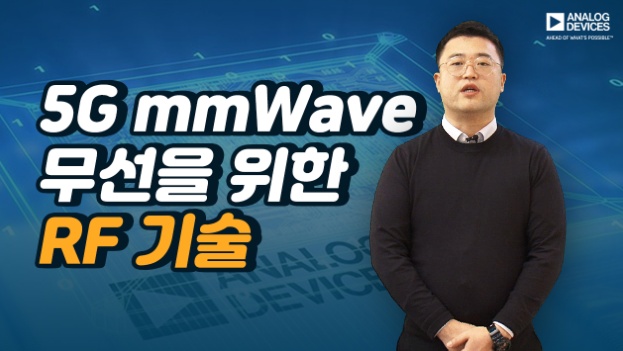
In April of this year, Thomas Cameron, Director of Wireless Technologies at Analog Devices (ADI), hosted a webinar titled “RF Technology for 5G mmWave Wireless” at the e4ds EEWebinar.
Below are some questions from webinar attendees about millimeter wave technology and answers from ADI Korea Vice President Jongpil Han and others.
Q. What band does the millimeter wave band refer to? (ID: br**)
A. Representative millimeter wave bands include 28GHz, 39GHz, and 47GHz. The bandwidth is approximately 1GHz.
Q. What exactly is beamforming? (ID: kh**)
A. Beamforming is a technology that enables stronger, faster, and more stable wireless communication by transmitting wireless signals from a beamformer (router) toward a beamformer (client). In other words, it is a traffic transmission technique for mobile base stations that identifies the most efficient data transmission path for a specific user, thereby reducing interference to surrounding users. There are several ways to implement beamforming in 5G networks, depending on the situation and technology. Structurally, there are analog, digital beamforming, and hybrid beamforming that combines them.
Q. What is the direction of the beamforming market? (ID: le**)
A. The market is being built around hybrid beamforming that merges analog and digital.
Q. I understand that 5G has many shadow areas due to its band characteristics and is greatly affected by environmental and regional characteristics. Are there any solutions such as special antenna design and installation of a large number of base stations? (ID: ho**)
A. As the question suggests, 5G has higher path loss than LTE. The industry is trying to solve this problem by adding repeaters.
Q. It seems like it will take some time for full-scale millimeter wave utilization. Verizon in the US is currently providing millimeter wave band 5G mobile communication service, and Docomo in Japan is also said to be starting this year, but I think it will be a limited service. How many more years will it take before millimeter wave 5G service can be used on general consumer devices without worrying about battery or coverage? (ID: et**)
A. The use of millimeter wave band 5G services is just beginning. It seems that there will be a lot of growing pains to use it properly without any problems.
Q. Can the millimeter wave band be utilized by configuring transmission/reception modules in narrow spaces such as smart factories rather than wide spaces such as urban areas? (ID: bl**)
A. If a factory structure that makes it difficult to use Ethernet can guarantee LOS (Line-Of-Sight), it can consider building a smart factory that communicates using the millimeter wave band.
Q. If the module supports 16GHz or 42GHz bands, does the PCB on which the module is mounted also need to be designed to handle that frequency? At this speed, it is much faster than PCIe Gen 5, but it seems like it won’t work on a general PCB. (ID: br**)
A. To reduce losses on the PCB, using a low-loss PCB, as you asked about, is of great help from a system perspective.
Q. Are there any security issues when applying 5G to smart factories? (ID: w3**)
A. Smart factories still prefer wired Ethernet-based networks over wireless ones due to the need for security, synchronization between devices, and continuous connectivity.
Q. In the 5G era, security for wireless communications is expected to promote the development of new technologies. Will artificial intelligence and machine learning be incorporated? (ID: ho**)
A. Millimeter waves have the widest bandwidth among the wireless communications currently in use. Therefore, I think there will be attempts to integrate them with various applications.
Q. It was mentioned in the webinar that 5G millimeter wave technology will also be used in ANN (Artificial Neural Network). Is it possible to configure an ANN that is harmless to the human body with the current low-power, low-heat technology? (ID: pe**)
A. I think millimeter waves would be effective for ANNs because they require wide bandwidth. Low power is determined by the semiconductor process and has nothing to do with the frequency being millimeter waves. Research is being conducted in the industry regarding electromagnetic waves.
Q. If a millimeter wave band beamforming module is installed in a smartphone terminal, the number of antennas is expected to increase compared to the existing band. Is it possible to integrate more than a few dozen? If you calculate it based on the antenna size relative to the wavelength, it doesn't seem impossible. (ID: ki**)
A. As the question suggests, it seems that integrated and adaptive antennas will be adopted due to the short electrical length caused by space constraints within the terminal and the use of high frequencies.
Q. You said that 5G technology will last for the next 10 years. Some organizations and companies are currently researching 6G. Do you think there will be no significant changes in technology? (ID: ji**)
A. I think 5G is the starting point of future mobile communication technology. Therefore, it will provide a testing ground for future communication technology.
Q. What is the level of implementation of beamforming technology with mobile devices such as drones in the millimeter wave band? (ID: k8**)
A. Research is currently underway on beamforming with moving objects at speeds of 120 to 500 km/h based on the current ITU-R M.2410-0 report.
Q. What is the transmittance of 28GHz or 39GHz frequencies through the windows of buildings or cars? If the loss is high, it seems that 5G mmWave communication in cars will be difficult, which will limit its universality. Do I need to install mmWave antennas in cars? (ID: em**)
A. There is no information on the transmittance yet, so it is not exact, but even with just the glass window, there is a large loss. As the question suggests, in order to apply V2X applications to vehicles, the vehicle will need to be equipped with a millimeter wave antenna as a basic requirement.
Meanwhile, ADI's partner, Analog World, will host a webinar on 5G RF in general, including millimeter wave and beamforming technology, on the 12th.
Comments
Related news
.jpg)
LG Uplus partners with government agencies to strengthen 5G network security.
LG Uplus has signed a mutual cooperation agreement with the Electronics and Telecommunications Research Institute (ETRI) on edge computing security including 5G equipment supply chain and next-generation mobile communication convergence service technology. The agreement ceremony was attended by LG Uplus Vice Chairman Ha Hyun-hoe and other key executives, as well as ETRI President Kim Myung-jun, and they agreed to establish mutual cooperation systems by field including △security technology △communication technology and fundamental research technology △convergence service technology to strengthen security stability for 5G communication services.
2020.10.29by 김동우 기자
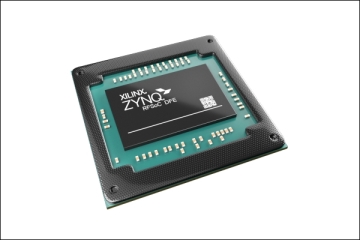
Xilinx Unveils DFE Platform for 5G Infrastructure Expansion
To build 5G infrastructure, solutions that can adapt to three 5G scenarios—eMBB, mMTC, and URLLC—are required. Additionally, these solutions must be scalable according to evolving 5G standards such as O-RAN, as well as innovative 5G business models. In response, Xilinx has launched the adaptive wireless platform 'Zynq RFSoC DFE'.
2020.11.04by 이수민 기자

Three Mobile Carriers Accelerating De-Telecom Shift: "Q3 Earnings Strong Driven by Strong Growth in Non-Telecom Sectors"
The three major mobile carriers released their Q3 2020 financial results. While the three carriers secured a large number of 5G subscribers and MNO revenue increased slightly, face-to-face businesses experienced negative growth due to COVID-19. On the other hand, they achieved solid performance in AI solutions and IDC business through accelerated digitalization. In Q3, the three carriers were actively engaged in business diversification to break away from a revenue structure focused on telecommunications.
2020.11.06by 이수민 기자
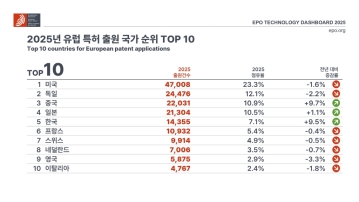
European Patent Applications Surpass 200,000 for the First Time… South Korea Maintains 5th Place, Led by Batteries and Telecommunications
According to the European Patent Office (EPO)'s 'Technology Dashboard 2025', European patent applications last year reached 201,974, surpassing 200,000 for the first time. Korean companies and inventors filed 14,355 applications, representing a 9.5% increase from the previous year and maintaining 5th place by country. Battery, digital communication, and semiconductor technologies led the growth, with Samsung ranking as the top EPO applicant for the second consecutive year and LG reaching 3rd place. The presence of major domestic cities such as Seoul, Suwon, and Yongin was also confirmed. It was also revealed that Korea's European patent strategy is expanding beyond individual technologies to span the entire industry.
2026.03.24by 명세환 기자

SK Telecom First Applies AI-Based Network Operations at Gwanghwamun K-Pop Concert
SK Telecom announced that it applied an AI-based network operation system for the first time at a large-scale K-pop concert held in the Gwanghwamun area of Seoul on March 21st, managing communication quality throughout the event. Mobile data usage during the three hours before and after the concert reached 12.15TB, approximately doubling compared to the same time slot the previous weekend. SK Telecom monitored traffic using the AI system 'A-One' in five-minute and 50-meter units to respond to potential overload situations, while also operating temporary communication facilities and on-site personnel in parallel. This case is interpreted as confirmation of the practical applicability of AI-based autonomous network operation in an environment where demand from dense events and foreign users increases simultaneously.
2026.03.23by 명세환 기자











