



The ICT industry in 2020, devastated by COVID-19: "Will 2021 be different?"
 Published2020.11.16 15:31
Data, AI, 5G, and digital twins accelerate development amid COVID-19.
The need to determine whether the contactless economic paradigm is sustainable
This year, COVID-19 has consumed every issue.
Many experts predict that the COVID-19 pandemic will end as early as the second half of next year. However, many experts believe a complete end to the pandemic will be impossible. While many argued that we should prepare for the post-COVID era in the second and third quarters, now in the fourth quarter, there are voices calling for us to prepare for the "with COVID" era.
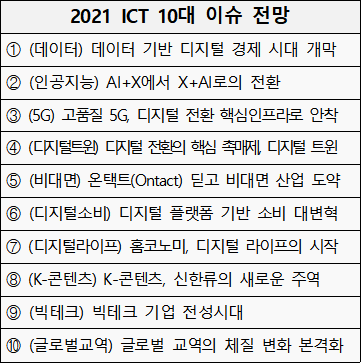
The information and communications technology (ICT) sector, while hit hard by COVID-19 this year, also secured new growth engines. On November 10th, COVID-19 was at the center of the "Top 10 ICT Issues of 2021," announced by Moon Hyung-don, Director of the Technology Policy Division at the Institute for Information and Communications Technology Planning and Evaluation (IITP).
The '2020 ICT Top 10 Issues' announced last year covered △5G △protectionism △AI △regulation △mobility △New Southern/New Northern Policy △subscription economy △semiconductors △changes in labor in the era of the 4th Industrial Revolution △eco-friendly ICT, etc. COVID-19 has impacted all of these areas, and they are reflected in the top 10 ICT issues of 2021.
◇ First Issue: "The Dawn of the Data Economy"
Data is being recognized for its potential, considered the crude oil of the Fourth Industrial Revolution. Data utilization is increasing in sectors such as finance, manufacturing, healthcare, media, distribution, infrastructure, and transportation. Data volumes and market sizes are growing daily, fueling the rise of the data economy. The COVID-19 pandemic has further enhanced the value of data by driving the rise of remote work and the expansion of online platform businesses.
Our government is also laying the foundation for a data economy by investing 7.9 trillion won in the Digital New Deal project, which will build data platforms such as public data dams and private data exchanges. Through this, the government plans to enhance the intelligence of all industries and digital inclusion across society.
As the value of data increases, efforts to strengthen data sovereignty are continuing. The European Union (EU) is restricting data transfers, the United States is expanding data subject rights, China is regulating data transfers, and Japan is promulgating a digital law aimed at prohibiting the misuse of personal information. They are all wary of the indiscriminate collection of their citizens' data by Google, Amazon, Facebook, and others.
On the other hand, international organizations such as the Organization for Economic Co-operation and Development (OECD) and the World Economic Forum (WEF) emphasize the development of technologies and policies that can ensure fairness and stability, saying that strengthening data sovereignty should not lead to restrictions on data sharing and reuse. South Korea is seeking a balance between the data economy and sovereignty by enforcing the three data laws (Personal Information Protection Act, Information and Communications Network Act, and Credit Information Protection Act) starting in August.
◇ Second issue: The transition from “AI+X” to “X+AI”
As AI technologies like deep learning, machine learning, and computer vision mature, their application in business is increasing. A 2019 McKinsey survey found that companies that adopted AI technologies experienced cost savings of over 60% in supply chain management and manufacturing, and revenue increases of up to 80% in marketing.
Related Article: The Role and Limitations of AI Technology in the COVID-19 Pandemic
Having fully recognized the potential of AI technology, governments around the world are exploring ways to integrate it into all industries. South Korea is also pursuing a next-generation AI technology development project. This year, the project to develop AI algorithms that overcome the shortcomings of existing deep learning, including: explainable AI; AI capable of learning from small amounts of data; AI capable of applied learning; and AI algorithms capable of measuring learning capacity, passed a preliminary feasibility study.
Additionally, approximately 250 billion won will be invested in the development of domestically produced AI-specific semiconductors by 2029, and a preliminary feasibility study for the development of Processing-In-Memory (PIM) semiconductors, which combine processors and memory, will be conducted starting in 2022. Through the development and advancement of next-generation AI technologies, AI is expected to challenge "creativity," previously considered a domain exclusive to humans. Accordingly, legal discussions related to AI are expected to intensify.
◇ Third Issue: "5G Established as a Core Infrastructure for the Digital Economy"
Major countries, including the US, China, the EU, and Japan, are making large-scale investments to commercialize and expand 5G networks. South Korea, too, is continuously expanding its 5G infrastructure to ensure early adoption. As a result, it has achieved the title of world's first 5G network and achieved a level of quality comparable to that of any other country. However, this is relatively true, not absolutely.
Related article: Why 6G commercialization is being pursued even though 5G hasn't yet taken hold.
5G, capable of transmitting and receiving large amounts of data at high speeds and with low latency, requires a much larger infrastructure—base stations and repeaters—than LTE (4G) due to its short radio range. If 5G networks cannot be accessed anytime, anywhere, the benefits of 5G are meaningless. As of July of this year, approximately 120,000 5G base stations have been built, but this is still insufficient.
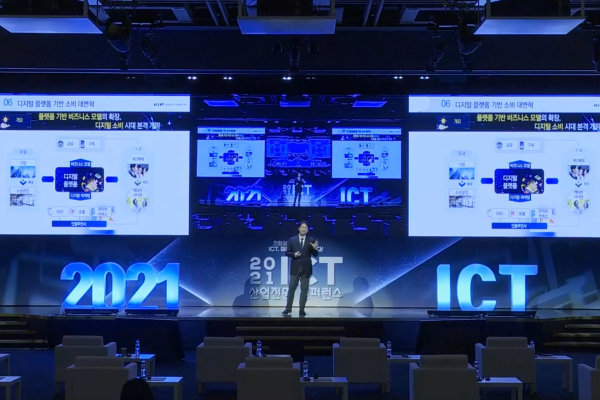
[Capture = 2021 ICT Industry Outlook Conference YouTube Screenshot]
To address quality issues, the three mobile carriers plan to invest 25 trillion won by 2022 to accelerate the expansion of 5G infrastructure. However, during the Ministry of Science and ICT's audit held last October, it was revealed that there were no plans to provide the 'millimeter wave (mmWave; 28GHz) band 5G standalone mode (SA)' service, which can be considered a true 5G service that is 20 times faster than LTE, to the general public.
Even as infrastructure expands, the general public is expected to use "sub-6GHz (3.5GHz) 5G SA and non-standalone (NSA)" services, which are two to four times faster than LTE. Dissatisfaction is expected to persist unless reasonable rates are introduced. Millimeter-wave 5G SA services are expected to be utilized in industrial settings via dedicated networks.
The industrial application of 5G is expected to be driven by the development of "mobile edge computing (MEC)" technology, which decentralizes data processing at the base station level, and "network slicing" technology, which virtually divides the same physical network to provide diverse services. As these two technologies mature to commercialization, industries such as autonomous vehicles, smart factories, digital healthcare, and smart cities are expected to accelerate further.
◇ Fourth Issue: "Digital Twins: A Catalyst for Digital Transformation"
A digital twin is a digital replica identical to the real world, and was selected as one of the ten key projects of the Korean New Deal. With the acceleration of digitalization brought about by COVID-19, digital twins are also showing signs of expansion.
When a digital twin is introduced to a business, it can virtually reproduce the workplace in a digital space and connect it with real-world components. Facility management and inspection, as well as product testing and personnel training, can be performed virtually, and these are immediately reflected in reality, eliminating spatial and temporal constraints.
Related Article: The Present and Future of Smart City Platforms: A Look at Daegu's Suseong Alpha City
Singapore, the UK, and the US are implementing projects under the names "Virtual Singapore," "VU.CITY," and "Smart America," respectively, to virtually implement their national territories and manage them as smart city platforms. The government is also working on data standardization and the development of a common platform to virtually construct a nationwide 3D map, a 12cm-resolution image map, an integrated underground space map, and a detailed road map.
Currently, the digital twin market is dominated by global companies like GE, Microsoft, Siemens, and Emerson. Due to the lack of a domestically produced integrated solution, the adoption of digital twins in Korea remains in its infancy. Hyundai Wia, POSCO Engineering & Construction, and Doosan Infracore are utilizing solutions from Siemens, Dassault Systèmes, and others for product design, remote control, and 3D simulation.
The government expects that as domestic digital twin technology matures through the Digital New Deal, market opportunities for related domestic companies such as Telstar Homemel, Vernect, SK Telecom, and KT will increase.
◇ The COVID-19 issue: Is it temporary or permanent?
The fifth issue, “Leaping Forward in Non-face-to-face Industry, Overcoming Ontact,” the sixth issue, “A Great Transformation in Consumption Based on Digital Platforms,” the seventh issue, “Home Economy, the Beginning of Digital Life,” and the eighth issue, “K-Content, Emerging as a New Leading Player in the New Korean Wave,” are based on a series of changes in work and consumption patterns that occurred as non-face-to-face interactions became established as daily life due to COVID-19.
Each issue addresses ⑤ the emergence of non-face-to-face businesses in various fields, ⑥ the increase in consumption and marketing based on digital platforms, ⑦ the spread of remote education, work, and leisure culture, and ⑧ the convergence of content and ICT. COVID-19 has fueled the growth of remote service providers like Zoom, e-commerce companies like Coupang, OTT providers like Netflix, as well as information security and non-face-to-face healthcare companies.
However, it is difficult to say for sure whether this should be viewed as the emergence of a new industry or a paradigm shift, or as a phenomenon resulting from the restrictions on face-to-face consumption by consumers, unless COVID-19 is eradicated. Governments and businesses should carefully examine whether current non-face-to-face businesses will remain a viable option for consumers even when both face-to-face and remote consumption are possible.
◇ Ninth Issue: "The Golden Age of Big Tech"
As of October of this year, seven of the top ten companies by global market capitalization (Apple, Microsoft, Amazon, Google, Alibaba, Facebook, and Tencent) were ICT platform companies. Their combined market capitalization amounts to approximately $7.2 trillion, or approximately 800 trillion won.
Big tech companies are aggressively expanding their businesses through M&A. Facebook has strengthened its core business through the acquisitions of WhatsApp, Instagram, and GP, while Microsoft is diversifying its business by acquiring GitHub (open source), Affirmed (cloud), and Metaswitch (5G).
Regulations aimed at curbing the monopoly power of Big Tech companies are also being discussed. In July, the US convened an antitrust hearing with representatives from GAFA (Google, Apple, Facebook, and Amazon). The EU fined Google €1.5 billion (approximately 2 trillion won) for violating antitrust laws. In September, South Korea also launched an investigation into whether Apple and Google abused their monopolistic positions in the app market.
Despite regulations, Big Tech companies continue to expand, and this trend extends to domestic companies as well. Currently, Naver (Messenger, Pay), Kakao (webtoons, web novels), and Woowa Brothers (delivery) are each striving to enter the Asian market based on their respective platforms.
◇ We must prepare for a new global competitive landscape through digital transformation.
The tenth issue is “Full-scale changes in the constitution of global trade.” The report stated that the growth of digital commerce due to COVID-19 will shift the center of gravity of global trade, and that technological barriers will further increase due to the spread of protectionist trends following the prolonged US-China trade dispute.
Director Moon, who presented 10 issues, stated, "Digitalization has rapidly advanced due to COVID-19," adding, "We are seeing the spread of online digital life and business expansion through digital innovation." He added, "I hope this year will be a year in which we overcome the national economic and social crisis by realizing a digital Republic of Korea."
Comments
Related news

ICT exports return to year-on-year growth for the first time in three months
The Ministry of Science and ICT announced that Korea's ICT exports in June were provisionally tallied at $14.96 billion and imports at $8.96 billion, recording a trade surplus of $5.99 billion. Export volume increased 1% compared to the same month last year, marking a shift to growth for the first time in three months since April. However, the average daily export value decreased 7.6% compared to the same month last year.
2020.07.14by 명세환 기자

Ministry of Science and ICT Establishes 'Online Export Platform' for COVID-19 Support
The Ministry of Science and ICT will support domestic information and communications technology (ICT) enterprises facing difficulties in exploring overseas markets since COVID-19, and will establish and operate 'ICT Cyber World', an integrated export support platform in a non-face-to-face environment, starting from November 4th. ICW is configured as a three-dimensional exhibition hall incorporating virtual reality technology and operates around the clock. Anyone can view content and company introduction videos from approximately 400 promising domestic enterprises in the ICT industry sectors including artificial intelligence, big data, and cloud computing. Additionally, theme-based conferences and forums will be held simultaneously online.
2020.11.04by 김동우 기자
'Remote' Conference to be Held to View ICT in the Post-COVID Era
The Ministry of Science and ICT will hold an online conference on the 10th and 11th to discuss changes in the ICT industry in the post-Corona era, future prospects, and policy directions. The 'ICT Industry Outlook Conference,' which marks its 20th anniversary this year, has selected the ICT future world as envisioned by people in their 20s as the conference theme. The selected themes are five in total: a convenient world, a safe world, a world of togetherness, a fair world, and an innovative world.
2020.11.09by 이수민 기자
ESP32 Development Environment Selection and GPS Application Implementation
The ESP32 is a microcontroller that integrates Wi-Fi, Bluetooth, 12-bit ADC, capacitive touch, PWM, DAC, and UART in a single SoC. However, the abundance of features does not by itself solve the designer's problems. The real challenges lie in selecting the appropriate development environment, determining which pins can be used and which must be avoided, and converting raw data from modules into usable information. This document addresses ESP32 peripheral constraints (ADC2 and Wi-Fi coexistence limitation, UART1 occupancy, ADC non-linear regions), the trade-offs between Arduino IDE and ESP-IDF, and the process from connecting NEO-6M/NEO-M8N GPS modules to UART2, parsing NMEA sentences, and visualizing routes in Google Earth, all organized based on documented references.
2026.10.12by 편집부
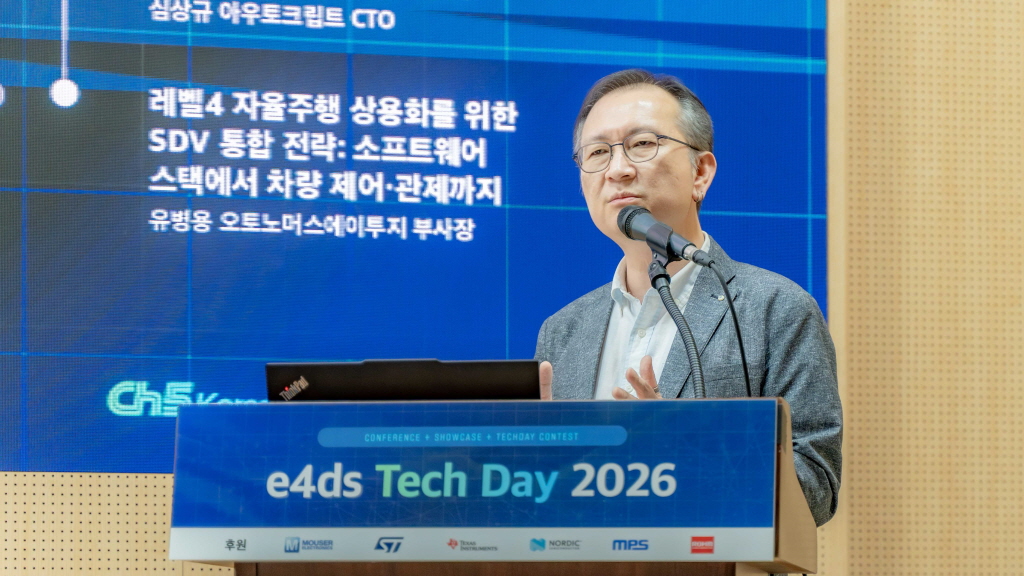
[e4ds Tech Day 2026 ⑨] Sim Sang-gyu, Autocrypt CTO: "In the Physical AI Era, Automotive Security Must Extend Beyond the Vehicle"
At e4ds Tech Day 2026, Sim Sang-gyu, CTO of Autocrypt, explained automotive cybersecurity strategies in the era of Physical AI and SDV (Software-Defined Vehicle). Automobiles are evolving as part of an ecosystem connected to AI, cloud, chargers, IoT, and robots, and he emphasized that the scope of security must expand beyond the vehicle interior to the entire connected environment. In particular, AI model tampering, adversarial attacks, OTA updates, and EV charger hacking were identified as major threats. He explained that response measures require zero trust, AI model integrity protection, intrusion detection, Security by Design and Default, and full lifecycle security management, and that proactive security system establishment beyond regulatory compliance is critical for securing future mobility competitiveness.
2026.10.12by 배종인 기자











