


KAIST Successfully Develops Memory-Centric AI-Accelerated PIM System
 Published2020.11.17 16:40
KAIST Develops PIM-Based AI Accelerator Semiconductor System
PIM, a next-generation semiconductor that adds AI computing capabilities to memory.
A domestic research team has successfully developed an intelligent semiconductor system optimized for accelerating AI recommendation system learning algorithms based on Processing-In-Memory (PIM) technology.
A research team led by Professor Min-soo Yoo of the Department of Electrical and Electronic Engineering at the Korea Advanced Institute of Science and Technology (KAIST) announced on the 16th that it had developed a memory-centric AI accelerator semiconductor system based on PIM technology.
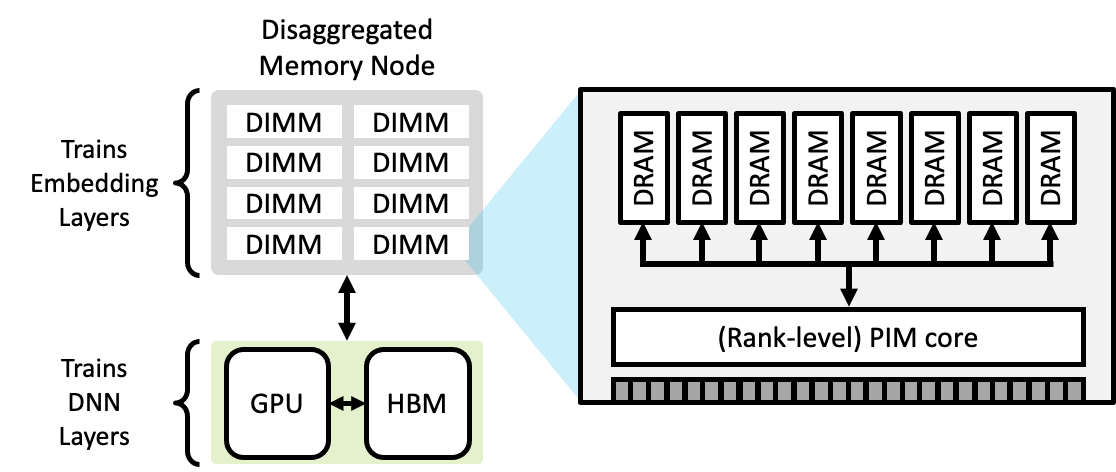
Schematic diagram of the applied accelerator system [Figure = KAIST]
AI recommendation system algorithms are the AI technology that big tech companies like Google, Amazon, YouTube, and Facebook use to create content recommendations and personalized advertisements. As revenue from online advertising is a primary revenue model for Silicon Valley big tech companies like Google and Facebook, demand for advanced recommendation AI technology has been rapidly increasing in recent years.
According to data recently disclosed by Facebook, 70% of AI computations processed in Facebook data centers are used to process recommendation algorithms, and 50% of computing resources for AI algorithm training are used to train recommendation algorithms.
Accordingly, the research team succeeded in developing an intelligent semiconductor system based on PIM technology with AI computational functions added to memory semiconductors.
The von Neumann architecture, consisting of three elements—processor, memory, and program—is a standard computer architecture. Memory stores programs, and the processor retrieves and processes the stored programs from memory. However, because the processor is faster than the memory, delays are unavoidable.
PIM technology integrates CPU and RAM into a single semiconductor, effectively demonstrating a memory-centric design. Research team members explained that the developed system accelerates the learning process for AI recommendation algorithms by up to 21 times compared to existing AI acceleration systems using NVIDIA GPUs.
The research team stated that the results of this study are significant in that they suggest the possibility of commercialization and success of PIM technology designed around memory in the global AI semiconductor market, which is expected to see significant increase in demand and rapid growth in the future.
Meanwhile, the results of the study are scheduled to be presented at the International Symposium on High-Performance Computing Architectures (HPCA), hosted by IEEE, in February next year.
Comments
Related news

Applied-BE Accelerates 'Chip Integration Technology' for Future Industries
Applied Materials is collaborating with BE Semiconductor Industries (Besi) to develop a comprehensive and validated equipment solution for die-to-die hybrid bonding. Die-to-die hybrid bonding is an advanced chip-to-chip interconnect technology that enables heterogeneous chip and subsystem designs in products related to cutting-edge technologies such as high-performance computing, AI, and 5G.
2020.11.04by 김동우 기자
12-inch fab investment scale increases, "Most of the increase is focused on memory"
Fab investment scale this year is expected to surge due to accelerated global digitalization from the COVID-19 pandemic, with this trend projected to continue through 2021. According to the 300mm (12-inch) fab outlook report released by SEMI, 300mm fab investment scale is expected to increase 13% year-over-year in 2019, surpassing the previous record high in 2018, and is projected to grow by as much as 20% by 2023.
2020.11.05by 이수민 기자
Xilinx and Samsung Electronics Launch the Industry's First Smart SSD
Xilinx showcased the SmartSSD CSD and partner solutions at the Flash Memory Summit virtual conference and expo. The product is a flexibly programmable storage platform implemented on an FPGA basis, enabling developers to address a wide range of data center challenges. Additionally, new types of software developers can easily implement innovative hardware-accelerated solutions using familiar high-level languages.
2020.11.11by 강정규 기자
[e4ds Tech Day 2026 ⑨] Sim Sang-gyu, Autocrypt CTO: "In the Physical AI Era, Automotive Security Must Extend Beyond the Vehicle"
At e4ds Tech Day 2026, Sim Sang-gyu, CTO of Autocrypt, explained automotive cybersecurity strategies in the era of Physical AI and SDV (Software-Defined Vehicle). Automobiles are evolving as part of an ecosystem connected to AI, cloud, chargers, IoT, and robots, and he emphasized that the scope of security must expand beyond the vehicle interior to the entire connected environment. In particular, AI model tampering, adversarial attacks, OTA updates, and EV charger hacking were identified as major threats. He explained that response measures require zero trust, AI model integrity protection, intrusion detection, Security by Design and Default, and full lifecycle security management, and that proactive security system establishment beyond regulatory compliance is critical for securing future mobility competitiveness.
2026.10.12by 배종인 기자
NVIDIA to Invest $1 Billion in U.S. Science Over Next Five Years
NVIDIA has announced plans to invest $1 billion over the next five years to strengthen U.S. scientific and technological competitiveness. The company will enhance cutting-edge artificial intelligence research and development capabilities in key areas including quantum computing, healthcare, and energy security, while expanding support for higher education research institutions and cloud service providers. NVIDIA is participating as a major industry partner in the White House Office of Science and Technology Policy's Genesis Mission, and is promoting supercomputer construction in collaboration with national laboratories including Argonne and Los Alamos.
2026.10.12by 배종인 기자











