



"Smart factories, the driving force behind manufacturing innovation," a qualitative shift, not a quantitative expansion, has begun.
 Published2020.11.23 16:15
Ability to respond to sustainable production and supply chain disruptions
Major manufacturing nations depend on smart factories and data.
As the COVID-19 pandemic continues, the adoption of smart factories across the manufacturing industry is being considered a key strategy for sustainable production and preparing for supply chain disruptions. Consequently, projects to build new smart factories or convert existing ones into smart factories are actively underway worldwide, leading to significant growth in the related market.
A smart factory is an intelligent factory that applies information and communication technologies (ICT) like AI, IoT, and big data to all or part of the manufacturing process, from planning and design to production, distribution, and sales, to enhance productivity and product quality. It goes beyond simply increasing productivity and efficiency to producing "customer-tailored products," making it a more advanced concept than automation, which minimizes human intervention.
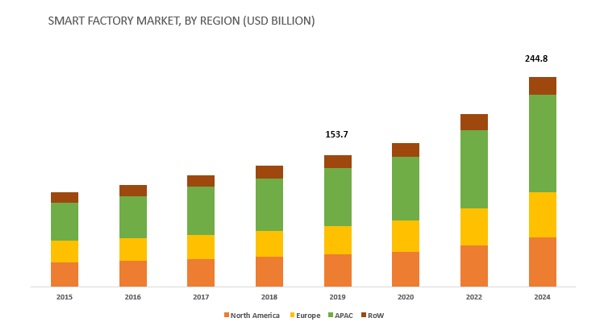
Growth Outlook [Graph = Market & Market]
According to market research firm MarketsandMarkets, the global smart factory market size is expected to grow at a compound annual growth rate (CAGR) of 9.8%, from $153.7 billion in 2019 to $244.8 billion in 2024. Product Lifecycle Management (PLM) and Manufacturing Execution Systems (MES) are driving factors. Regionally, the Asia Pacific market is projected to show the highest growth rate (CAGR of 11.0%).
South Korea is a manufacturing-centric nation. According to the accounting firm Deloitte, Korea ranked fifth globally in manufacturing competitiveness in 2016 and sixth in 2018. It is projected to maintain its sixth place ranking in 2020, following the US, China, Germany, Japan, and India. To achieve further growth beyond maintaining its current position, South Korea must continuously implement strategies to address changes in the manufacturing ecosystem, such as the widespread adoption of smart factories.
Smart factories are now more sophisticated than widespread.
In December 2018, the Ministry of SMEs and Startups achieved quantitative results based on the "SME Smart Manufacturing Innovation Strategy," which aimed to deploy 30,000 smart factories and establish 10 smart industrial complexes by 2022. In July of this year, as part of the Korean Digital New Deal, the Ministry announced the "Smart Manufacturing 2.0 Strategy," declaring its commitment to advancing the manufacturing industry through AI and data.
On November 12th, the company announced the "Intelligent Manufacturing Innovation Implementation Strategy," a follow-up measure to its Smart Manufacturing 2.0 strategy, aimed at shifting smart factories from the current "quantitative distribution" focus to "qualitative advancement." The strategy aims to increase the advancement rate of companies implementing smart factories and enhance the technological competitiveness of smart manufacturing suppliers.
To this end, we have decided to promote qualitative advancement through reform of the distribution system, expand the use of AI-centered manufacturing data, and create continuous results through strengthened post-management. In particular, to expand the use of AI-centered manufacturing data, a specific plan was established for the early activation of 'My Manufacturing Data' and the creation of leading cases linked to the 'AI Manufacturing Platform (Korea AI Manufacturing Platform; KAMP)'.
KAMP is a foundation for efficient AI utilization, bringing together data storage and analysis infrastructure, AI experts, and verification services—all of which are difficult for small and medium-sized manufacturing companies to acquire. The My Manufacturing Data system analyzes and processes manufacturing data produced in smart factories, returning the benefits to the manufacturing companies that produce the data.
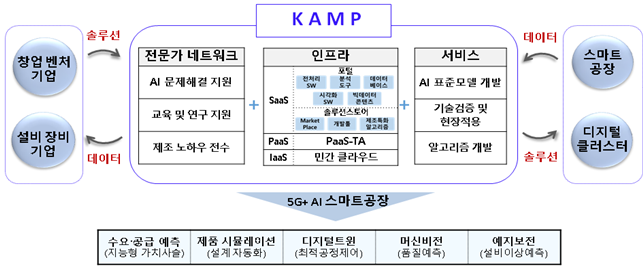
The Ministry of SMEs and Startups is promoting the early activation of the KAMP-based My Manufacturing Data System in three stages. △Phase 1, which promotes the use of manufacturing data and AI based on the cloud, will be carried out until the second half of 2020; △Phase 2, which expands AI smart factories through solution stores, will be carried out until the second half of 2021; and △Phase 3, which establishes a foundation for activating My Manufacturing Data, will be carried out until the first half of 2020.
In addition, to promote the production and use of high-quality manufacturing data, the Manufacturing Data Sharing Standard (MDSR) was established to define the definition, scope, transaction requirements, and profit distribution of manufacturing data, thereby clarifying the rights relationships among manufacturing data producers, traders, and distributors.
Manufacturing Innovation Strategies of Global Manufacturing Powerhouses
To promote advanced manufacturing, the United States launched the Advanced Manufacturing Partnership (AMP) in 2011 and AMP 2.0 in 2013. Following this, in 2018, the United States announced and is currently pursuing a strategy to secure advanced manufacturing leadership, focusing on expanding manufacturing jobs, establishing a strong manufacturing and defense industry base, and combating unfair trade practices to help American manufacturers fully realize their market potential.
The Biden administration (scheduled to take office on January 20, 2021), which has touted "Made in all of America, by all of America's workers" as its economic revitalization slogan, is also expected to prioritize the revival of manufacturing.
Since 2013, Germany has been promoting the 'Industry 4.0' policy, which aims to transform traditional industries such as manufacturing into smart factories equipped with intelligent production systems by combining IT systems and networking production facilities. This is part of Germany's national science and technology development policy, the 'German High-Tech Strategy 2020', established in 2010, and is supplemented by the 'German High-Tech Strategy 2025' announced in 2018.
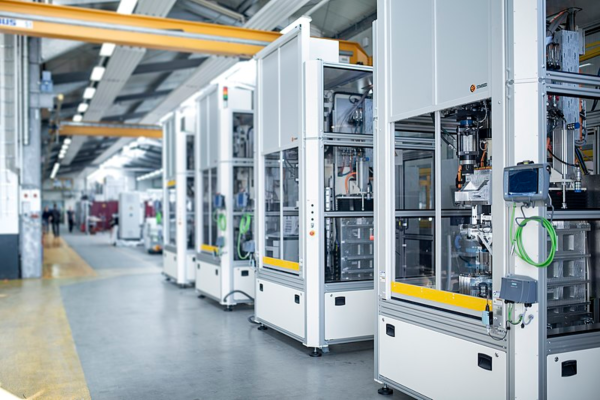
Showing the way forward [Photo = HAHN Group]
In 2015, China announced its "Made in China 2025" strategy, benchmarking Germany's Industry 4.0 initiative. This strategy, embodying the ambition to transform China from a quantitative manufacturing powerhouse into a qualitative one through the convergence of the internet and manufacturing, aims to overtake Germany and Japan by 2035. It prioritizes creativity over manufacturing, quality over speed, and brand over product.
In 2017, Japan named its vision for society in the era of the Fourth Industrial Revolution "Society 5.0" and proposed "Connected Industry" as a means to advance it. This strategy aims to connect diverse industries, companies, people, machines, and data to create new added value, products, and services, and to increase productivity, thereby addressing various social issues and strengthening national competitiveness.
India launched the "Make in India" initiative in 2014, which aims to transform the country into a manufacturing hub by building digital networks, improving infrastructure, reviewing all regulatory procedures, and providing faster administrative services. The plan is to select 25 sectors with high potential and develop sector-specific development policies to increase the manufacturing sector's share of India's GDP from 15% in 2014 to 22% by 2022.
We must prepare for the social changes that will be brought about by building a smart factory ecosystem.
Traditional manufacturing powerhouses like the United States, Germany, and Japan, as well as emerging manufacturing powerhouses like China and India, are establishing manufacturing innovation policies to introduce and expand smart factories and are concentrating national capabilities to secure future growth engines.
Our country is also pursuing a paradigm shift from quantitative expansion to qualitative advancement, exceeding its goals and supporting policies such as expanding the base of smart manufacturing.
The smart factory ecosystem is expected to organically connect value chains across a wide range of sectors, including communications, networks, and technical personnel, based on AI and data. Therefore, we must proactively prepare for the societal innovation and transformation brought about by the smart factory ecosystem and strategically respond to the digital economy era.
Comments
Related news
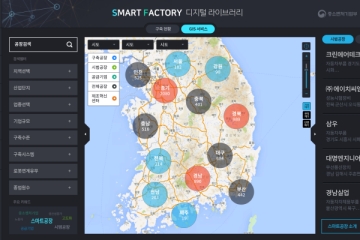
The Ministry of SMEs and Startups has begun building a "Smart Factory Digital Library."
A gateway will be established where anyone can easily obtain information related to smart factories. The Ministry of SMEs and Startups announced that it will proceed with building a "Smart Factory Digital Library" service that comprehensively provides information on smart factories.
2020.09.23by 이수민 기자
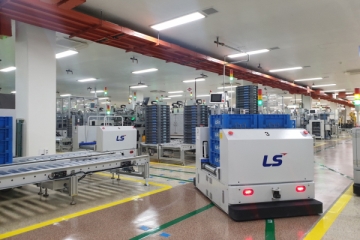
LS Electric Provides Full-Life Support for SMEs Building Smart Factories
LS Electric has entered into an agreement with 14 partner companies selected for the 2020 Smart Factory Construction Support Program to jointly implement the 2020 Large-Small Business Cooperation Smart Factory Construction Support Project. LS Electric operates TechSquare, a win-win cooperation smart factory platform, to support the smooth implementation of smart factories.
2020.11.07by 이수민 기자
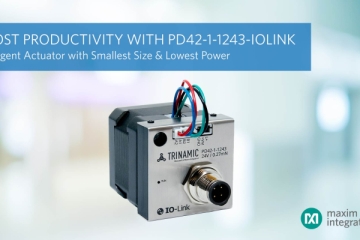
Maxim launches intelligent actuator to minimize factory downtime
Maxim Integrated Korea has launched 'PD42-1-1243-IO-Link', an intelligent actuator from Trinamic. By utilizing this solution, smart factory systems can rapidly adjust the electrical characteristics of the actuator remotely, minimizing factory downtime and maximizing throughput.
2020.11.18by 강정규 기자

[e4ds Tech Day 2026 ⑨] Sim Sang-gyu, Autocrypt CTO: "In the Physical AI Era, Automotive Security Must Extend Beyond the Vehicle"
At e4ds Tech Day 2026, Sim Sang-gyu, CTO of Autocrypt, explained automotive cybersecurity strategies in the era of Physical AI and SDV (Software-Defined Vehicle). Automobiles are evolving as part of an ecosystem connected to AI, cloud, chargers, IoT, and robots, and he emphasized that the scope of security must expand beyond the vehicle interior to the entire connected environment. In particular, AI model tampering, adversarial attacks, OTA updates, and EV charger hacking were identified as major threats. He explained that response measures require zero trust, AI model integrity protection, intrusion detection, Security by Design and Default, and full lifecycle security management, and that proactive security system establishment beyond regulatory compliance is critical for securing future mobility competitiveness.
2026.10.12by 배종인 기자
NVIDIA to Invest $1 Billion in U.S. Science Over Next Five Years
NVIDIA has announced plans to invest $1 billion over the next five years to strengthen U.S. scientific and technological competitiveness. The company will enhance cutting-edge artificial intelligence research and development capabilities in key areas including quantum computing, healthcare, and energy security, while expanding support for higher education research institutions and cloud service providers. NVIDIA is participating as a major industry partner in the White House Office of Science and Technology Policy's Genesis Mission, and is promoting supercomputer construction in collaboration with national laboratories including Argonne and Los Alamos.
2026.10.12by 배종인 기자











