



KETI-RIST Begins Demonstration Testing of 'Augmented Reality' Technology in Manufacturing
 Published2020.11.27 12:05
XR enables optimal new process development through process simulation.
KETI Continues Development of Intelligent Digital Twin and XR Solutions
In the manufacturing industry, demand for digital twin-based extended reality (XR) technology is increasing due to increasingly complex factory facilities and a shortage of skilled workers. In particular, the secondary battery materials market is growing rapidly due to increasing demand for electric vehicle batteries, necessitating increased production per unit of equipment through digitalization of manufacturing processes.
The Korea Electronics Technology Institute (KETI) and the Pohang Research Institute of Science and Technology (RIST) announced on the 26th that they have begun solution demonstration and verification testing by applying digital twin-based XR technology, which is currently being developed to improve corporate productivity and worker job skills, to the pilot manufacturing plant of POSCO Chemical's secondary battery materials (anode and cathode) within RIST.
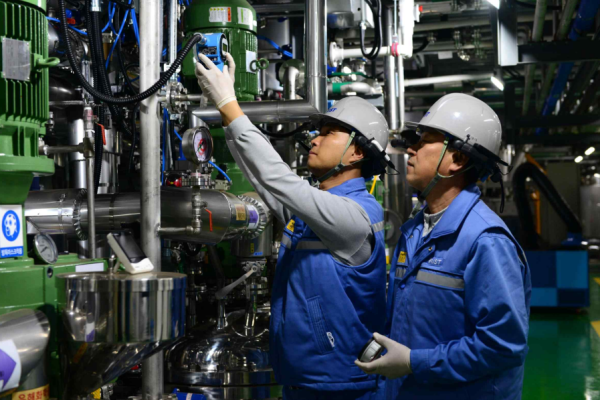
RIST field workers demonstrating [Photo = KETI]
This project, promoted by the Ministry of Science and ICT and the National IT Industry Promotion Agency (NIPA), is part of the 'XR Convergence Project (Manufacturing)' project, and has received a total of KRW 10 billion in funding over three years from August of this year. KETI is the lead organization, and RIST, ETRI, Onmakers Co., Ltd., Vernect Co., Ltd., Stance Co., Ltd., and Frontech Co., Ltd. are participating organizations in technology development.
The recently developed digital twin-based XR technology can simulate various process data by virtually replicating POSCO Chemical's actual pilot manufacturing facility and developing an optimal new process. Additionally, XR solutions that support multi-party remote collaboration and education/training can enhance the job skills of entry-level workers and increase workplace stability.
KETI plans to develop a simulation digital twin next year and an intelligent digital twin the year after, and will also continue to develop XR solutions that link with these.
Meanwhile, on this day, the two organizations demonstrated a three-party remote collaboration solution to solve the magnetic filter clogging problem that frequently occurs at secondary battery material manufacturing sites, an education and training solution for diamond frame pump replacement work, and a connected digital twin visualization solution that links POI data for real-time monitoring.
Comments
Related news
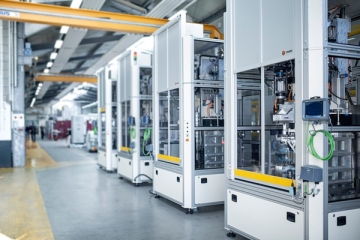
"Smart factories, the driving force behind manufacturing innovation," a qualitative shift, not a quantitative expansion, has begun.
Smart factory construction and transformation projects are being actively implemented worldwide, driving significant growth in the related market. South Korea ranks as a manufacturing powerhouse following the United States, China, Germany, Japan, and India. To go beyond maintaining its current position and achieve further growth, the country must continuously execute strategies to respond to changes in the manufacturing ecosystem, such as the widespread adoption of smart factories.
2020.11.23by 이수민 기자

Dell Introduces Two AI HPC Solutions to Accelerate Digital Manufacturing
Data is critical fuel for humanity's new future, and what matters to data scientists is leveraging AI applications more effectively and minimizing the time required to gain insights. Dell Technologies announced the launch of two new Dell EMC Ready solutions that support high-performance computing for digital manufacturing, including biotech and healthcare, and stated that it will expand global partnerships to implement HPC and AI as a service.
2020.11.25by 이수민 기자
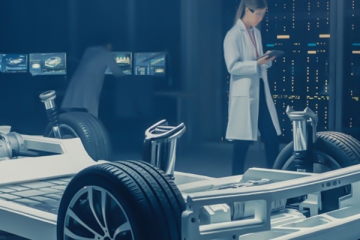
EV Quality Depends on Efficiency of “Battery Activation and Testing Process”
EV adoption is on track. Battery-powered vehicles are projected to account for 10% of total automotive sales in 2025. Demand for high-performance batteries is also surging rapidly. Batteries represent approximately 40% of EV prices. The activation and testing processes, which are the finishing steps in battery manufacturing, account for up to 20% of battery production costs. By achieving efficiency improvements in both processes, EV price competitiveness and quality can be secured.
2020.11.26by 이수민 기자
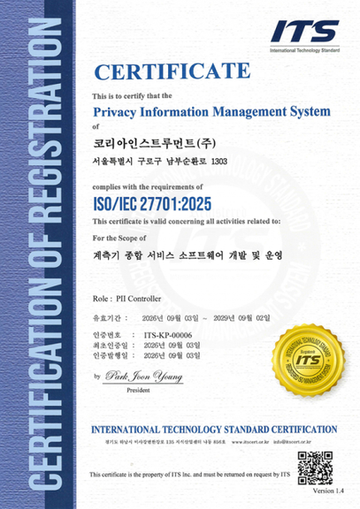
Korea Instrument, KOLAS Accredited Calibration Agency First to Simultaneously Acquire ISO/IEC 27,001·27,701
Korea Instrument has become the first among KOLAS accredited calibration agencies to simultaneously acquire ISO/IEC 27,001 and ISO/IEC 27,701 certifications. Through its proprietary platforms CWIZ Enterprise and CWIZ Partners, the company has embedded information security and personal data protection requirements across all business processes including customer information, equipment data, and calibration reports, with plans to continuously advance its management system through regular audits and security inspections.
2026.10.12by 배종인 기자

TeamViewer One, IT Incident Automation Workflow and Resolution Center Enhanced
TeamViewer has added IT incident automation capabilities and an advanced Resolution Center to its integrated digital workplace management platform 'TeamViewer ONE'. Recurrent service disruptions, configuration errors, and capacity shortages are automatically handled according to preset policies, and device status verification through script deployment can be managed in a unified interface, significantly reducing repetitive tasks for IT teams.
2026.10.12by 배종인 기자











