


ZTE and GSMA Intelligence Release Green 5G White Paper
 Published2020.11.26 10:51
On the 26th, ZTE held the 5G Summit & User Congress on Green 5G. At the event, ZTE announced a white paper titled "5G Energy Efficiencies, Green is the New Black," authored by GSMA Intelligence, a key component of the GSMA and a leader in global carrier, media, and technology (TMT) research.
This white paper contains an overview and principles of building communication networks and improving energy efficiency suitable for the 5G era, analyzed from various perspectives ranging from cost reduction and network performance optimization to securing stable energy and the international community's efforts to reduce carbon emissions. It also covers the feasibility of saving energy and reducing consumption through innovation in wireless access networks and scalable network methods.
According to the white paper, to fundamentally reduce energy consumption of wireless access base stations, individual analysis of each component comprising the 5G network is required. Effective tools include improving battery solution efficiency, reducing equipment energy consumption, applying sleep states with more intelligent artificial intelligence, and selective network deployment planning. Through this method, end-to-end energy savings and reduced consumption of wireless access base stations can be achieved, and a green communication network advantageous to users can be established.
Energy conservation has become a top priority and mission for the telecommunications industry, which seeks to support the international community's climate change goals and reduce wireless network operating costs. As the number of users of services requiring large bandwidth, such as video streaming on smartphones via LTE and 5G networks, increases, wireless networks are reaching a level comparable to ubiquitous access. Consequently, barring any unforeseen circumstances, electricity and energy consumption is expected to continue increasing in the future.
Wireless access networks account for the largest share of energy in mobile networks and are considered the biggest factor in energy consumption. The white paper predicts that data traffic per user will triple from current levels by 2025. It is inevitable that the deployment and expansion of LTE and 5G networks will place a greater load on network energy consumption.
Tim Hatt, Head of Research at GSMA Intelligence, stated, "Energy accounts for 20–40% of the industry's total operating costs (Opex) and represents a significant portion of operators' expenses." He added, "As telecommunications companies set ambitious goals to achieve carbon neutrality and ultimately net-zero emissions, there is a growing acceleration in restructuring fuel sources around energy-efficient network technologies and renewable energy. Companies are treating energy and climate change response not merely as a matter of Corporate Social Responsibility (CSR), but as a core business objective."
Over the past few years, ZTE has filed more than 500 patents related to 5G innovation. ZTE is constantly striving to reduce power consumption of wireless base station equipment through its self-developed high-performance chipsets, industry-leading architectural designs, and intelligent network operation tools.
ZTE’s PowerPilot, a 4G and 5G network energy saving solution equipped with energy saving features and AI-based traffic load prediction capabilities, is the industry’s first AI-powered service-sensing energy saving solution. PowerPilot detects service types and differences in energy efficiency for each service. By analyzing service requirements in real time and supporting services through more energy-efficient networks, it maximizes the energy efficiency of the entire network.
According to typical network configuration calculations, the PowerPilot solution saves approximately twice as much energy as existing AI-based energy-saving solutions, and saves up to 20% of energy in multi-mode networks, resulting in substantial reductions in operating costs. To date, ZTE's PowerPilot energy-saving solution has been implemented in over 20 networks and approximately 600,000 websites worldwide, saving operators more than $1 billion in electricity costs.
Jason Tu, ZTE’s technology spokesperson and senior researcher for NFV/SDN products, stated, “ZTE has always considered energy conservation and consumption reduction a corporate responsibility and has strived to develop innovative technologies.” He explained, “By enhancing technology efficiency and expanding its deployment, ZTE is building 5G green networks in collaboration with operators to fulfill its commitment to the ‘Climate Action’ sector of the UN Sustainable Development Goals (SDGs).”

Comments
Related news
Global foundries report their highest sales growth in a decade... "Only Samsung can challenge TSMC."
Remote education and work enablement, along with increased demand for high-performance mobile phones and infrastructure due to full-scale 5G commercialization, are driving a boom in the foundry market. Taiwan-based market research firm TrendForce forecasts that global foundry revenue will increase by 23.8% year-over-year this year. This represents the highest growth rate in a decade.
2020.11.19by 이수민 기자

Xilinx and TI Develop GaN-Based 5G Small Cell 'DFE'
5G small cells must support three 5G scenarios including eMBB, mMTC, and URLLC, requiring a scalable adaptive wireless platform. To address this, Xilinx announced that it has developed a scalable adaptive DFE solution together with TI that reduces the number of antennas in small cells and improves energy efficiency.
2020.11.25by 이수민 기자
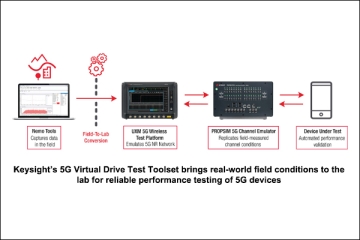
Keysight Unveils Real-World-Based "5G VDT Toolset"
Keysight has launched a 5G virtual drive test toolset that enables 5G device and chipset manufacturers, as well as mobile operators, to validate end-user experience in laboratory environments that are similar to field conditions and fully automated. The toolset combines the company's channel and network emulation capabilities with collection, logging, and scripting tools to implement a realistic test environment, allowing 5G devices to be validated across various network signaling and wireless channel conditions.
2020.11.25by 이수민 기자
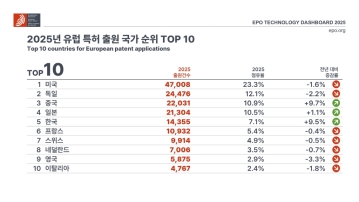
European Patent Applications Surpass 200,000 for the First Time… South Korea Maintains 5th Place, Led by Batteries and Telecommunications
According to the European Patent Office (EPO)'s 'Technology Dashboard 2025', European patent applications last year reached 201,974, surpassing 200,000 for the first time. Korean companies and inventors filed 14,355 applications, representing a 9.5% increase from the previous year and maintaining 5th place by country. Battery, digital communication, and semiconductor technologies led the growth, with Samsung ranking as the top EPO applicant for the second consecutive year and LG reaching 3rd place. The presence of major domestic cities such as Seoul, Suwon, and Yongin was also confirmed. It was also revealed that Korea's European patent strategy is expanding beyond individual technologies to span the entire industry.
2026.03.24by 명세환 기자

SK Telecom First Applies AI-Based Network Operations at Gwanghwamun K-Pop Concert
SK Telecom announced that it applied an AI-based network operation system for the first time at a large-scale K-pop concert held in the Gwanghwamun area of Seoul on March 21st, managing communication quality throughout the event. Mobile data usage during the three hours before and after the concert reached 12.15TB, approximately doubling compared to the same time slot the previous weekend. SK Telecom monitored traffic using the AI system 'A-One' in five-minute and 50-meter units to respond to potential overload situations, while also operating temporary communication facilities and on-site personnel in parallel. This case is interpreted as confirmation of the practical applicability of AI-based autonomous network operation in an environment where demand from dense events and foreign users increases simultaneously.
2026.03.23by 명세환 기자











