


Hybrid Lithium-ion Battery Developed to "Charge in Seconds"
 Published2020.12.04 10:21
Based on a porous conductive carbon structure
Realized through the development of high-capacity cathode and anode materials
Lithium-ion batteries hold the highest market share among existing energy storage systems (ESS) due to their wide operating voltage and high energy density.
On the other hand, research on high-performance electrode materials and next-generation energy storage devices is currently underway due to problems such as the low ionic conductivity of organic electrolytes, slow electrochemical reaction rates, low power density due to limited electrode material characteristics, long charging times, and large volume due to asymmetry between the cathode and anode.
A research team led by Professor Jung-Koo Kang of the Department of Materials Science and Engineering at the Korea Advanced Institute of Science and Technology (KAIST) announced on the 3rd that they have developed a hybrid lithium-ion battery capable of rapid charging in seconds to minutes.
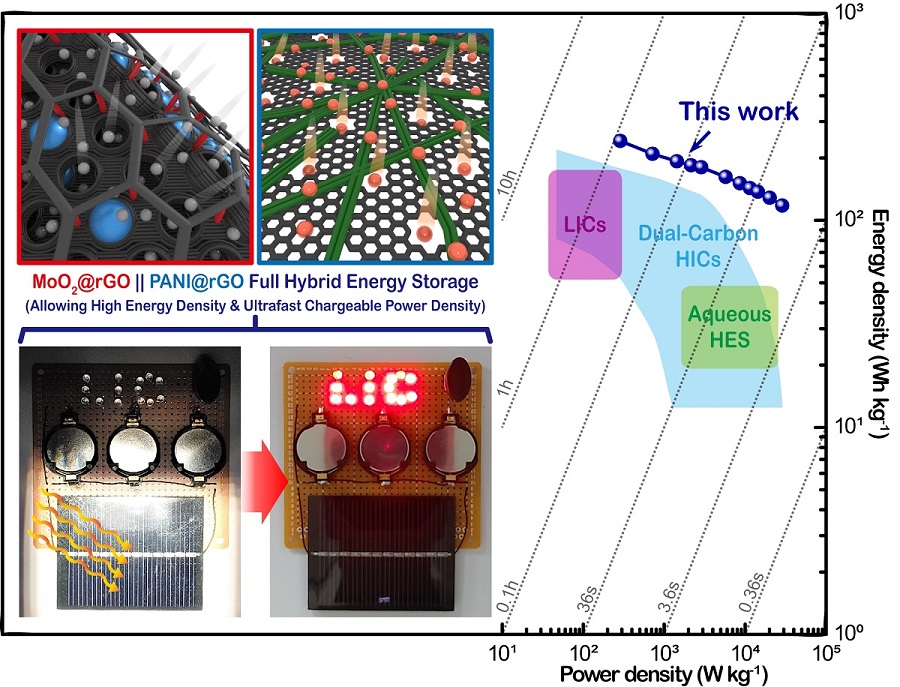
Realization of rapid-charged device characteristics utilizing [Image=KAIST]
The research team developed high-capacity cathode and anode materials based on a conductive carbon structure with a porous structure in which mesopores, which are holes 2 to 50 nm (nanometers) in size, and micropores, which are holes smaller than 2 nm, coexist, and realized the battery.
Hybrid batteries have high storage capacity for the battery negative electrode. It is receiving significant attention as a next-generation energy storage device capable of replacing automotive lithium-ion batteries, as it possesses both the advantages of high capacity and the rapid ion charging and discharging of capacitor anodes.
To realize high-energy and high-power density batteries, it is necessary to improve the electrical conductivity and ion storage characteristics of the battery anode, increase the ion storage capacity of the capacitor anode, and optimize the two electrodes based on different ion storage mechanisms.
Professor Kang's research team developed conductive carbon-based cathode and anode materials utilizing porous reduced graphene oxide, and succeeded in realizing a high-energy, high-output hybrid lithium-ion energy storage device through high-capacity cathodes and anodes with improved rate characteristics.
The research team first created a carbon structure bonded with molybdenum oxide (MoO2) of 5–10 nm size by carbonizing porous nanocrystals, known as Metal-Organic Frameworks (MOFs), as a negative electrode material for batteries. During the carbonization process, the graphene oxide surrounding the carbon structure was reduced, increasing electrical conductivity through the formation of conductive carbon bonds.
In addition, a porous structure with micropores formed by metal etching was fabricated. The micropores facilitate the penetration of lithium ions (Li+) in the electrolyte, while the nano-sized metal oxide and reduced graphene oxide shells exhibit high capacity and high-rate discharge characteristics through enhanced electrical conductivity.
Along with this, the research team applied a fabrication technique to create a new structure by cross-linking a fibrous conductive polymer onto the surface of reduced graphene oxide as a positive electrode material for capacitors. Polyaniline (PANI), a conductive polymer, is polymerized instantaneously at low temperatures and has strong bonding forces (π-π bonds) on the reduced graphene oxide surface, and enables the adsorption of anions (PF6-) through the nitrogen doping effect.
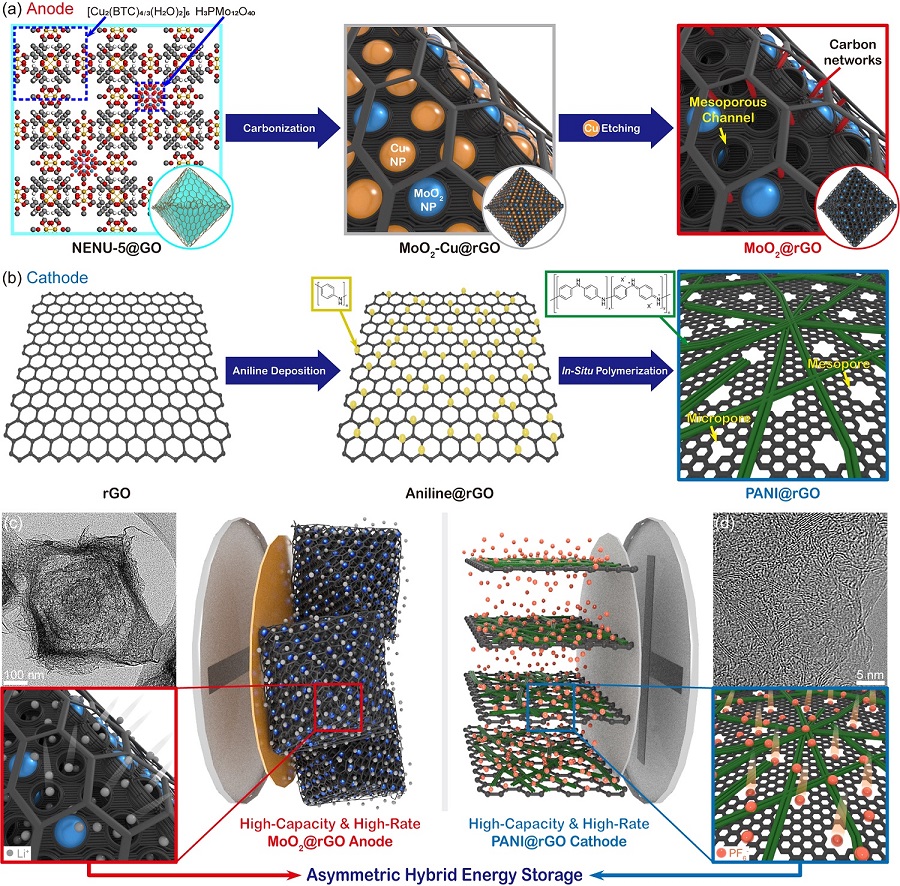
Synthesis process of cathode materials [Figure=KAIST]
The reduced graphene oxide anode combined with a conductive polyaniline polymer exhibited energy storage characteristics comparable to commercially available activated carbon (AC), along with an ion storage capacity increased by 200% compared to reduced graphene oxide. Through this process, the research team developed a high-performance hybrid battery using the newly developed anode material (MoO2@rGO) and cathode material (PANI@rGO).
Professor Kang Jeong-gu said, “The hybrid battery developed this time is a next-generation lithium-ion battery capable of rapid charging within tens of seconds due to high power density as well as energy density at the level of lithium-ion batteries,” and expressed his expectation that “if the scope of application is expanded to all electronic devices, including EVs, the quality of life for humanity will improve.”
Meanwhile, the results of this study were published as a cover article in the international materials science journal 'Advanced Energy Materials (IF 25.245)' on November 10.
Comments
Related news
Maxim Launches Fuel Gauge IC to Extend Li-ion Battery Life
Damaged batteries have a high potential to cause internal cell leakage, and if the leakage continues, it can lead to fire and explosion hazards. To prevent the shipment of leaking cells, factory inspection is important, but self-discharge detection of the battery itself is equally critical. In response, Maxim has launched the MAX17320, a high-precision lithium-ion fuel gauge IC that monitors self-discharge risk and extends operating time in multi-cell battery-powered products.
2020.11.24by 강정규 기자
Next-Generation Electric Vehicle Battery Seminar Held Both Online and Offline
As electric vehicle adoption expands, the global electric vehicle fleet is expected to reach 22 million units in 2025. Accordingly, demand for solid-state batteries and secondary batteries is growing. Engineers now need to develop their capabilities to address the numerous challenges surrounding electric vehicle batteries. Myceforum will hold the 2020 Next-Generation Battery Latest Technology Seminar in both online and offline formats on Thursday, December 17, at the aT Center in Yangjae, Seoul.
2020.11.26by 명세환 기자

EV Quality Depends on Efficiency of “Battery Activation and Testing Process”
EV adoption is on track. Battery-powered vehicles are projected to account for 10% of total automotive sales in 2025. Demand for high-performance batteries is also surging rapidly. Batteries represent approximately 40% of EV prices. The activation and testing processes, which are the finishing steps in battery manufacturing, account for up to 20% of battery production costs. By achieving efficiency improvements in both processes, EV price competitiveness and quality can be secured.
2020.11.26by 이수민 기자

Intel Unveils Next-Generation 'Core Ultra Series 3' and vPro Platform for Enterprise PCs
Intel has officially unveiled the "Intel Core Ultra Series 3" for next-generation enterprise PCs and the latest vPro platform, addressing a wide range of demands from enterprise notebooks to high-performance workstations.
2026.03.26by 배종인 기자
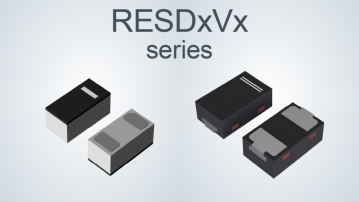
ROHM Launches ESD Protection Diode Compatible with High-Speed Interfaces of 10Gbps or Higher
Semiconductor specialist ROHM has developed the 'RESDxVx series' of ESD (electrostatic discharge) protection diodes capable of responding to next-generation high-speed data communication environments exceeding 10Gbps, simultaneously enhancing both signal quality maintenance required in high-speed interfaces and IC protection performance.
2026.03.26by 배종인 기자











