


The foundation for indoor millimeter-wave 5G mobile communication services has been laid.
 Published2020.12.10 15:50
28GHz 5G signal transmitted to indoor distributed antennas
20Gbps service in indoor environments such as airports and train stations
Network technology that provides seamless 5G service even indoors has been developed by domestic researchers.
The Electronics and Telecommunications Research Institute (ETRI) announced on the 10th that it has developed the world's first optical repeater technology capable of receiving millimeter wave (mmWave; 28GHz) based broadband 5G signals from a base station and sending them into a building.
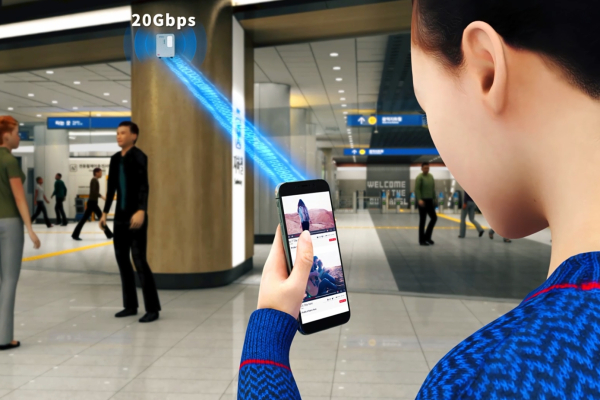
Approximately 80% of the mobile data used in daily life is consumed indoors. By utilizing this technology, it is possible to use services at 20Gbps, the maximum transmission speed of 5G, in indoor environments such as airports, train stations, and large shopping malls. Compared to existing methods, transmission capacity, equipment size, and construction costs have been improved, so it is expected to be widely utilized.
The technologies developed by the research team include 'RoF (Radio over Fiber) optical transmission technology,' which converts 5G wireless signals into optical signals and transmits them without signal distortion over a range of up to 5km, and '5G base station interface technology,' which connects outdoor 5G base stations and indoor distributed antenna systems via OTA (Over The Air).
This is a method in which a 5G base station interface installed on the rooftop of an apartment receives a 5G signal from a nearby base station, converts it into an optical signal at an apartment terminal box equipped with RoF technology, and then transmits it to antennas distributed throughout the indoor areas on each floor.
This technology has a high transmission capacity because it can transmit signals by multiplexing 5G signals into 32 bands. Since it does not require the implementation of complex functions like a base station and only requires the implementation of relatively simple functions, the construction cost is one-fifth of that of installing a separate base station.
.jpg)
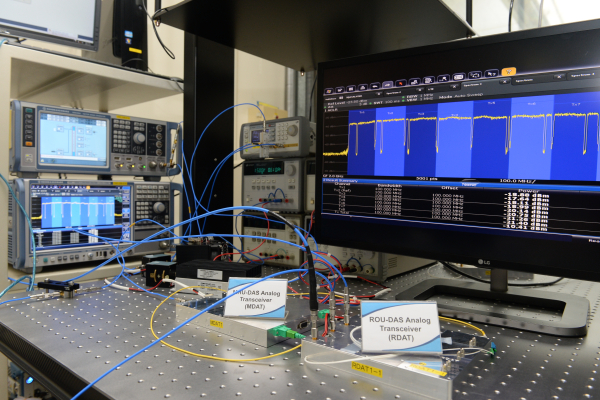
The research team announced that they developed a diary-sized RoF (Road of Flight) receiver and implemented RoF technology by embedding it into the host and antenna units that make up an indoor distributed antenna system. They also developed 5G base station interface technology in the form of a laptop-sized independent module to easily interoperate with the host unit.
The research team plans to develop next-generation communication infrastructure construction technology to provide 6G services beyond 5G in indoor environments in the future.
Meanwhile, this achievement was made possible as part of the Ministry of Science and ICT's 'Development of Indoor Distributed Antenna System (DAS) Technology Based on Analog Intermediate Frequency over Fiber (IFoF) for 5G Mobile Communication.' Currently, the research team has completed a total of five technology transfers to optical module and system companies, including HFR, Lightron, Rontec, and JT.
Comments
Related news

3 mobile carriers accept '3.17 trillion' in exchange for frequency reallocation... "Conditions for building 5G wireless stations"
Discussions on frequency reallocation have been concluded. The three mobile carriers will be required to pay between a minimum of 3.17 trillion won and a maximum of 3.77 trillion won, depending on the number of 5G wireless stations constructed, in exchange for reusing 310㎒ of the 320㎒ bandwidth of 3G and LTE frequency bands whose usage period expires in 2021 for the next five years. The Ministry of Science and ICT has finalized the detailed policy plan for mobile communication frequency reallocation containing these provisions, and SK Telecom, KT, and LG U+ have accepted it.
2020.12.01by 이수민 기자
ETRI develops 25 Gbps wireless backhaul using mmWave bands.
Backhaul connecting base stations and telephone exchanges has been implemented through wired methods. However, wired approaches have many installation constraints depending on environmental conditions, such as difficulties in laying new cables, and require substantial construction time and costs. ETRI has developed wireless backhaul technology capable of up to 25 Gbps-class communication within a 1 km range by utilizing millimeter-wave band frequencies.
2020.12.02by 이수민 기자
Demonstration of "smart city" services based on 5G's low-latency characteristics begins.
ETRI has developed a 5G drone-based control service solution and 5G CCTV-based intelligent road safety support service technology, and completed demonstration for precision control services. It can also be utilized for density analysis for quarantine management within buildings, making it useful for security control within buildings as well.
2020.12.07by 이수민 기자
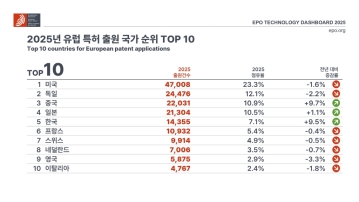
European Patent Applications Surpass 200,000 for the First Time… South Korea Maintains 5th Place, Led by Batteries and Telecommunications
According to the European Patent Office (EPO)'s 'Technology Dashboard 2025', European patent applications last year reached 201,974, surpassing 200,000 for the first time. Korean companies and inventors filed 14,355 applications, representing a 9.5% increase from the previous year and maintaining 5th place by country. Battery, digital communication, and semiconductor technologies led the growth, with Samsung ranking as the top EPO applicant for the second consecutive year and LG reaching 3rd place. The presence of major domestic cities such as Seoul, Suwon, and Yongin was also confirmed. It was also revealed that Korea's European patent strategy is expanding beyond individual technologies to span the entire industry.
2026.03.24by 명세환 기자
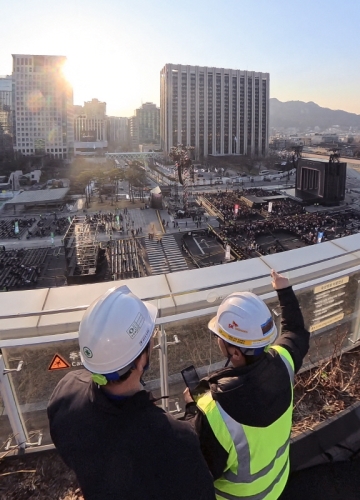
SK Telecom First Applies AI-Based Network Operations at Gwanghwamun K-Pop Concert
SK Telecom announced that it applied an AI-based network operation system for the first time at a large-scale K-pop concert held in the Gwanghwamun area of Seoul on March 21st, managing communication quality throughout the event. Mobile data usage during the three hours before and after the concert reached 12.15TB, approximately doubling compared to the same time slot the previous weekend. SK Telecom monitored traffic using the AI system 'A-One' in five-minute and 50-meter units to respond to potential overload situations, while also operating temporary communication facilities and on-site personnel in parallel. This case is interpreted as confirmation of the practical applicability of AI-based autonomous network operation in an environment where demand from dense events and foreign users increases simultaneously.
2026.03.23by 명세환 기자











