


"Where should data processing be done more efficiently?" Edge computing comes to mind.
 Published2020.12.21 15:15
Expected to be generated outside the cloud
Edge computing will drive intelligent IoT services.
The importance of IoT devices that wirelessly connect objects continues to grow in key fields of the Fourth Industrial Revolution, such as smart factories, autonomous vehicles, and virtual and augmented reality.
According to a 2019 report from IDC, there will be 41.6 billion IoT devices generating nearly 79.4 zettabytes (ZB) of data by 2025.
Gartner reported in 2018 that “approximately 10% of enterprise-generated data is processed outside of centralized data centers and the cloud,” and predicted that “this figure will continue to grow, reaching approximately 75% by 2025.”
This shows that cloud computing has limitations in accommodating various IoT services that require real-time processing. There is also the risk of cloud server processing overload due to the ever-increasing volume of data and network traffic, and there is also the issue of privacy infringement because all information is transmitted to the cloud server.
In fact, on the 14th, there was an incident where major Google services such as YouTube, Gmail, Google Meet, and Google Cloud were paralyzed for an hour due to an error in the authentication system storage of Google servers.
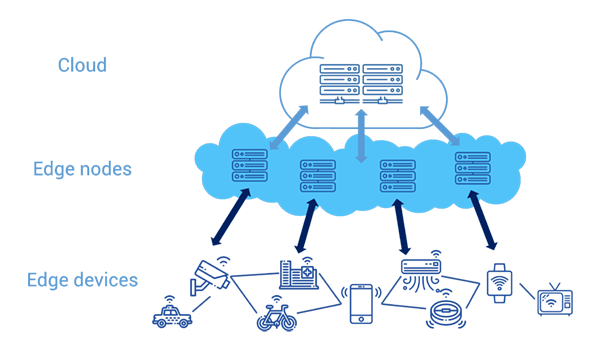
Distributed computing that processes nearby [Image = Alibaba]
To address the challenges of centralized computing, a new data processing paradigm called distributed edge computing is emerging, which processes data in real time at the site or near where it is generated.
On the 1st of this month, ETRI's Intelligent Information Standards Lab published a paper titled "Edge Computing Technology Trends" that examined the concept, characteristics, and future trends of edge computing.
The Birth and Development of Edge Computing
Edge computing is an industrial data processing method that shortens data processing time and reduces internet bandwidth usage by processing data generated from edge devices in real time on the device where the data was generated or on a nearby server instead of sending it to the cloud.
As computing resources move around the terminal device, it can provide IoT management, data storage, content caching, compute offload, and service delivery. />
Edge computing dates back to the 1990s, when Akamai launched its Content Delivery Network (CDN). The idea was to place nodes geographically closer to end users to deliver cached content, such as images and videos.
Pervasive computing, an IoT-based technology that emerged in 1997, aimed to reduce the load on computing resources and improve the battery life of mobile devices, offloading specific tasks of more resource-intensive applications to local servers.
The "P2P (Peer-to-Peer) Overlay Network," introduced in 2001, is a proximity routing concept introduced to avoid slow downloads through long-distance servers. By connecting computers without a central server, it not only reduces overall network load but also improves application latency.
The first public cloud computing service launched in 2006. Amazon's Elastic Compute Cloud (EC2) was the first cloud service to lease computing and storage resources to end users.
Cloud computing is a type of Internet-based computing that processes information by sending it to a server or other computer connected to the cloud rather than to one's own computer.
Cloudlets, introduced in 2009, are edge-located, mobile mini-cloud data centers designed to support resource-intensive mobile applications.
In 2012, Cisco introduced the concept of fog computing, a distributed cloud that performs massive computation, storage, and communication using intelligent edge nodes. It has facilitated IoT scalability by providing the ability to process large numbers of IoT devices and big data in local area networks close to where the data is generated.
The paper, introducing the above history, stated, "Today, we are already living in the era of edge computing, and intelligent edge computing is gradually being adopted." It emphasized, "Depending on the type of data, centralized cloud computing or end-to-end distributed edge computing is appropriate for processing. Therefore, the best future solution will require a complementary implementation of cloud and edge computing."
Advantages of Edge Computing Over Cloud Computing
The paper listed five advantages of edge computing: reduced network latency, reduced costs, high scalability, reliability, and security.
First, edge computing has lower network latency than cloud computing. If IoT applications require sub-second response times, waiting for requests to the cloud can be problematic.

Any delays can result in damage [Photo = Pixabay]
If a safety control system detects that a person is too close to a machine, it must immediately stop the machine. Delayed response times can lead to serious injury or damage to the machine. Human recognition and machine stopping by sensors must not be delayed due to network communication.
Autonomous vehicles and augmented reality applications require response times of less than 20ms. Cloud-based communication alone cannot provide this. However, processing sensor data at the edge gateway can avoid network latency and achieve the desired response times.
Edge computing is also more cost-effective than cloud computing. Most of the telemetry data generated by sensors and actuators is not relevant to IoT applications, so edge computing allows for filtering and processing the data before sending it to the cloud.
This reduces network costs associated with data transmission, as well as cloud storage and processing costs for data not related to applications.
Next is scalability. IT infrastructure requirements as a business grows are unpredictable, and building and expanding dedicated data centers is expensive.
Edge computing devices allow for data analytics, storage, and processing to be placed closer to end users, allowing for rapid and cost-effective expansion of their scope and functionality. Adding new devices doesn't require significant bandwidth from the network core, reducing expansion costs.
Reliability is also high. When edge computing devices and edge data centers are located close to end users, problems in distant networks are less likely to impact them. Even if a data center goes down, edge computing devices can continue to operate independently, as they essentially perform critical processing functions.
Additionally, with so many network-connected edge computing devices and edge data centers, users have multiple paths to access the products and information they need, making it difficult for a single failure to completely disrupt service. Therefore, companies can guarantee faster and smoother service to customers.
Finally, edge computing reduces the amount of data that must travel across the network. Because it distributes data rather than storing it in a single location, it offers security advantages. Furthermore, while information residing in the cloud is prone to hacking, edge computing prevents this by only transmitting relevant information to the cloud.
In other words, even if a hacker infiltrates the cloud, not all user information is at risk. Sometimes, no network connection is required at all. Therefore, compared to the cloud, edge computing potentially poses fewer security risks.
The above advantages are not absolute. Gartner warns that edge computing increases the external attack surface, allowing insecure endpoint devices to become intrusion points into the core network. Furthermore, high scalability can also lead to increased deployment and management costs for edge computing environments.
Where is edge computing used?
Edge computing is expected to be particularly useful in areas requiring real-time data processing at the edge, such as smart factories, autonomous vehicles, and virtual and augmented reality.
Leveraging edge computing in smart factories can reduce network and storage resource costs by reducing communication load on central data centers or servers, improve process efficiency and equipment productivity through real-time equipment failure prediction, and reduce repair costs through preventive measures.
Autonomous vehicles are equipped with many sensors to communicate with other vehicles on the road and detect their surroundings. Edge computing collects and analyzes massive amounts of data generated in real time by sensors within the vehicle.
Processing this data in the cloud requires network transmission, which can lead to response errors and connection delays, but edge computing prevents this.

It is expected to be effective in the necessary VR/AR fields. [Photo = Pixabay]
While virtual reality (VR) and augmented reality (AR) have primarily been used in gaming and media, their applications in manufacturing, healthcare, and automotive are now being discussed. Combining and synchronizing the real world and user movements with the digital world requires a significant amount of graphic rendering processing. Edge computing is an effective way to split the workload between VR/AR devices and the cloud.
The world's three largest public cloud providers—Amazon, Microsoft, and Google—already offer edge computing capabilities. Amazon provides services that extend the capabilities of cloud platforms to IoT edge devices through 'AWS Wavelength' and Microsoft provides 'Azure IoT Edge'.
Google has enabled the extension of Google Cloud's data processing and machine learning capabilities to gateways or IoT edge devices through its AI chip, the Edge TPU (Tensor Processing Unit), and its software stack, Cloud IoT Edge.
In addition to these, NVIDIA is working to enter the market with its 'EGX' AI edge computing platform, Intel with its edge computing systems such as 'EdgeX' and 'StarlingX', HPE with its 'Edgeline (EL)' data center and edge computing infrastructure solution, and IBM with its 'Edge IoT Analytics' technology.
Real-time data processing and reduced latency drive the development of edge computing.
MarketsandMarkets predicts that the edge computing market size will grow from $3.6 billion (KRW 4 trillion) in 2020 to $15.7 billion (KRW 17.3 trillion) in 2025, at a compound annual growth rate of 34.1%.
This is interpreted as a result of the increasing demand for real-time data processing and reduced network delay in almost all industries due to the acceleration of digitalization.
The paper predicts that the field of edge computing will continue to develop over the next five years.This will lead to the creation of new business models, advancement of cloud services, and acceleration of development of edge AI chips.
Comments
Related news
Arm Unveils Project Cassini for Edge Computing Infrastructure
Over the past period, enterprises have addressed data computation demand through the adoption of cloud computing models. However, with the explosive growth of data, power efficiency has sharply declined, necessitating new approaches. In response, Arm held the 'Arm DevSummit 2020' and announced a new Neoverse platform that accelerates infrastructure computing innovation, as well as the Project Cassini initiative.
2020.11.04by 이수민 기자

Schneider Electric Strengthens Infrastructure Management Solutions
Schneider Electric is strengthening its core solutions for data center and edge computing implementation. EcoStruxure IT Expert is Schneider Electric's next-generation data center management solution that enables remote management anytime from mobile devices, tablets, and other platforms. EcoStruxure IT Expert can select and analyze data for specific purposes through a data lake collected from millions of devices connected to Schneider Electric, enabling execution and providing valuable insights.
2020.11.06by 김동우 기자

IBM and AT&T to Offer Open 5G MEC Control Services
Many enterprises are pursuing hybrid cloud strategies. In particular, as 5G and edge computing technologies continue to advance, high control capabilities in remote environments have become increasingly important. IBM has announced that it will enable enterprise customers to manage applications hosted in hybrid cloud environments through AT&T networks via "IBM Cloud Satellite."
2020.11.10by 이수민 기자
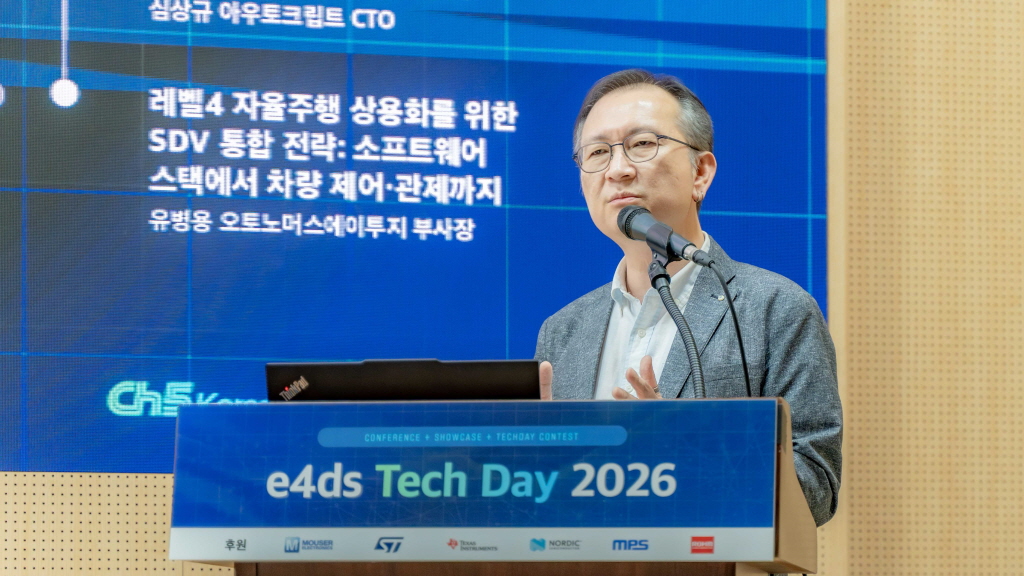
[e4ds Tech Day 2026 ⑨] Sim Sang-gyu, Autocrypt CTO: "In the Physical AI Era, Automotive Security Must Extend Beyond the Vehicle"
At e4ds Tech Day 2026, Sim Sang-gyu, CTO of Autocrypt, explained automotive cybersecurity strategies in the era of Physical AI and SDV (Software-Defined Vehicle). Automobiles are evolving as part of an ecosystem connected to AI, cloud, chargers, IoT, and robots, and he emphasized that the scope of security must expand beyond the vehicle interior to the entire connected environment. In particular, AI model tampering, adversarial attacks, OTA updates, and EV charger hacking were identified as major threats. He explained that response measures require zero trust, AI model integrity protection, intrusion detection, Security by Design and Default, and full lifecycle security management, and that proactive security system establishment beyond regulatory compliance is critical for securing future mobility competitiveness.
2026.10.12by 배종인 기자

NVIDIA to Invest $1 Billion in U.S. Science Over Next Five Years
NVIDIA has announced plans to invest $1 billion over the next five years to strengthen U.S. scientific and technological competitiveness. The company will enhance cutting-edge artificial intelligence research and development capabilities in key areas including quantum computing, healthcare, and energy security, while expanding support for higher education research institutions and cloud service providers. NVIDIA is participating as a major industry partner in the White House Office of Science and Technology Policy's Genesis Mission, and is promoting supercomputer construction in collaboration with national laboratories including Argonne and Los Alamos.
2026.10.12by 배종인 기자











