



ETRI is working on localizing key optical communication components for 5G networks.
 Published2020.12.29 15:24
Import substitution and overseas expansion of 25Gbps 5G optical source devices
Next year, we aim to commercialize 10 new products and generate 8 billion won in sales.
Optical communication components are attracting attention as a key component of 5G networks. 5G networks require a denser base station configuration than LTE, leading to the widespread adoption of wavelength division multiplexing (WDM) over the existing point-to-point approach.
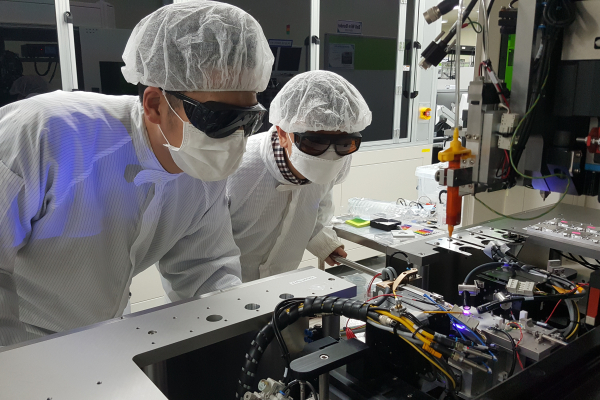
The optical element bonding process is in progress [Photo = ETRI]
The Electronics and Telecommunications Research Institute (ETRI) announced on the 29th that in preparation for 5G commercialization, it has successfully commercialized 11 products in collaboration with small and medium-sized enterprises (SMEs) for core telecommunications components, generating a total of 2.7 billion won in sales. The commercialization projects pursued by the research institute are expected to continue to generate revenue as the 5G market expands.
Wavelength multiplexing is a method of sending multiple optical signals of different wavelengths through a single strand of optical fiber. Recently, demand for products capable of 25 Gbps or more per channel is increasing in line with the 5G network advancement plans of the three major mobile carriers. However, there is still a high dependence on Japan for core optical components.
Moreover, the trend toward small-quantity, diversified products that require the development of separate optical components for each wavelength band due to the expansion of the number of channels through wavelength multiplexing, and the pressure to shorten the development period to secure a competitive edge, are putting a burden on the commercialization of technologies by small and medium-sized optical communication component companies.
ETRI Honam Research Center and eight optical communication component companies (Oi Solution Co., Ltd., Eldis Co., Ltd., Corset Co., Ltd., Optella Co., Ltd., Geos Technology Co., Ltd., ChemOptix Co., Ltd., Wooriro Co., Ltd., and Optisys Co., Ltd.) have been working on the commercialization of related products since last year through the ‘Optical Communication Components Commercialization Project for Intelligent Information Networks’ with support from the Ministry of Science and ICT and the National Information Society Agency (NIA).
ETRI announced that it has developed 20 types of optical communication products through its business initiatives. In particular, 25 Gbps optical source devices, previously heavily reliant on Japan, have achieved approximately 2 billion won in sales through companies such as Eldis and Oi Solutions, contributing to import substitution for domestic 5G optical components and entry into the Chinese market.
Officials anticipate that sales will rapidly increase next year, with the market for 25 Gbps optical communication components for 5G networks expected to become active, and the resulting ripple effects, including import substitution, will be maximized. The research team plans to commercialize approximately 10 additional products by next year, including optical communication components for 5G networks and data centers, generating 8 billion won in sales.
Comments
Related news
.jpg)
Tektronix Unveils New Optical Transceiver Test Platform
Tektronix has launched the '8 Series Sampling Oscilloscope' platform as a distributed modular measurement instrument. The 8 Series Sampling Oscilloscope features parallel acquisition capabilities that deliver up to 4 channels per mainframe and the highest measurement accuracy for PAM4 optical signals across multiple simultaneous inputs.
2020.12.09by 이수민 기자

The foundation for indoor millimeter-wave 5G mobile communication services has been laid.
ETRI has developed an optical repeater technology that can receive millimeter-wave based broadband 5G signals from base stations and deliver them into buildings. A 5G base station interface installed on an apartment rooftop receives 5G signals from nearby base stations, and an apartment terminal box equipped with RoF technology converts them into optical signals, which are then transmitted to antennas distributed throughout each floor indoors.
2020.12.10by 이수민 기자
5G AI emergency medical system secures golden time for emergency patients
An R&D achievement report was held for the development project of a 5G-based AI emergency medical system. This project, which is being promoted by the Ministry of Science and ICT, the Ministry of Health and Welfare, and the National Fire Agency, aims to establish a consistent management system from the occurrence of emergency patients to treatment. The core objective is to secure the golden hour through customized emergency treatment for the four major severe emergency patient categories in Korea and rapid emergency room transport, thereby increasing survival rates of emergency patients.
2020.12.18by 이수민 기자
European Patent Applications Surpass 200,000 for the First Time… South Korea Maintains 5th Place, Led by Batteries and Telecommunications
According to the European Patent Office (EPO)'s 'Technology Dashboard 2025', European patent applications last year reached 201,974, surpassing 200,000 for the first time. Korean companies and inventors filed 14,355 applications, representing a 9.5% increase from the previous year and maintaining 5th place by country. Battery, digital communication, and semiconductor technologies led the growth, with Samsung ranking as the top EPO applicant for the second consecutive year and LG reaching 3rd place. The presence of major domestic cities such as Seoul, Suwon, and Yongin was also confirmed. It was also revealed that Korea's European patent strategy is expanding beyond individual technologies to span the entire industry.
2026.03.24by 명세환 기자

SK Telecom First Applies AI-Based Network Operations at Gwanghwamun K-Pop Concert
SK Telecom announced that it applied an AI-based network operation system for the first time at a large-scale K-pop concert held in the Gwanghwamun area of Seoul on March 21st, managing communication quality throughout the event. Mobile data usage during the three hours before and after the concert reached 12.15TB, approximately doubling compared to the same time slot the previous weekend. SK Telecom monitored traffic using the AI system 'A-One' in five-minute and 50-meter units to respond to potential overload situations, while also operating temporary communication facilities and on-site personnel in parallel. This case is interpreted as confirmation of the practical applicability of AI-based autonomous network operation in an environment where demand from dense events and foreign users increases simultaneously.
2026.03.23by 명세환 기자











